
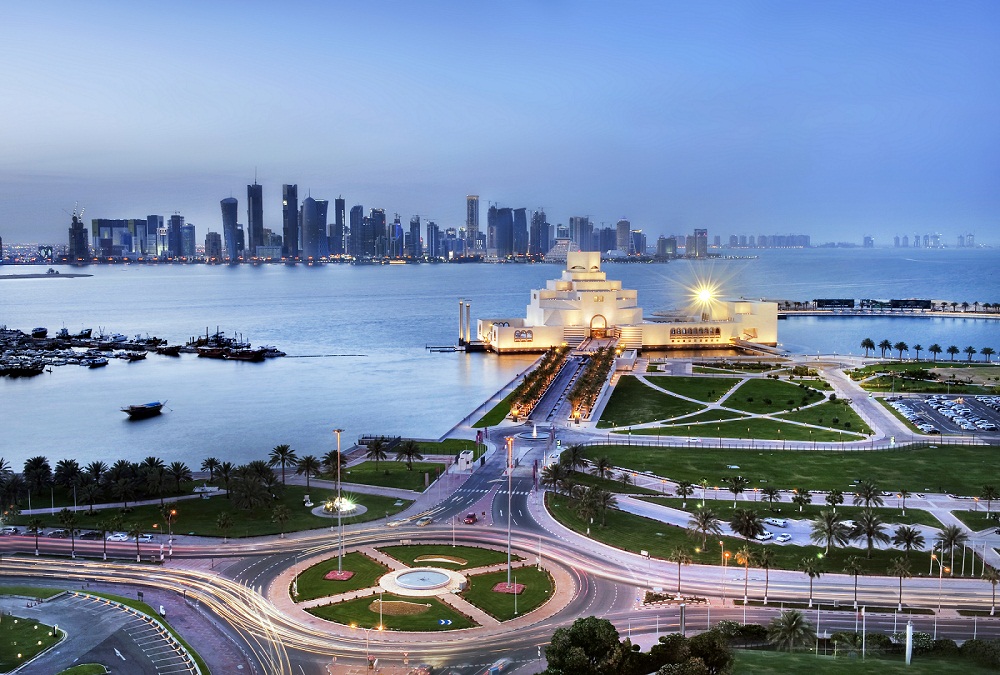
Photo: Musab.hawamda · CC BY-SA 4.0 · Wikimedia Commons
National Museum of Qatar is a museum in Doha, Qatar. Architect Jean Nouvel designed the museum building. The free Lokali audio guide runs 7 minutes.
✓ Published October 2026 · how we write these guides
Visitor facts
| Lokali audio guide | 7 min · free |
|---|---|
| Type | Museum |
| Location | Doha, Qatar |
| Coordinates | 25.2885, 51.5493 |
| Official website | nmoq.org.qa |
| Languages | 50+, in the Lokali app |
The story
Stand still for a moment and listen. Out here the air carries a dry heat, and somewhere close you can hear water moving over stone. Above you, huge pale discs tilt and overlap at strange angles. They look like plates stacked by a giant who never finished the job. The colour is the colour of sand, and in strong sun it seems to glow from the inside. This is the National Museum of Qatar, and it may be the only building you ever visit that was shaped by a crystal.
The crystal is called a desert rose. It forms naturally in the salt flats and sandy ground of the Arabian Peninsula. When water evaporates from mineral-rich sand, gypsum and sand grains grow together into thin, curved petals. The result looks like a flower made of stone. Children in Qatar have picked these up from the desert for generations. The French architect Jean Nouvel took that small, familiar object and scaled it up into a museum. Every disc you see above you is one petal of that rose.
The museum opened to the public in 2019, after years of construction. Nouvel and his team designed the building as hundreds of interlocking discs of different sizes. Some lie almost flat and form roofs. Others stand on edge and act as walls. Many lean at angles that seem to defy gravity. Because the discs overlap, they cast deep shadows across the walls below. In a hot climate, that shade is practical as well as beautiful. Notice how cool the gaps between the petals feel.
Here is the first thing many visitors miss. This modern building is not the start of the story. It wraps around an older structure — a restored palace from the early twentieth century. It belonged to Sheikh Abdullah bin Jassim Al Thani, a son of the founder of modern Qatar. The palace was the seat of government and a family home. Later it became the country's first national museum, in the 1970s. So the new building is, in a real sense, a museum built around a museum.
Take a look at the old palace when you reach it. The walls are low and simple, made in the traditional Gulf style. You will see plaster surfaces, wooden doors, and courtyards built to catch the breeze. The contrast with the giant discs is deliberate. The petals curl around the palace like a protective arm. Nouvel did not try to hide the old building or compete with it. Instead, the new structure frames it, like a setting around a jewel.
Inside, the museum is designed as a journey rather than a set of separate rooms. The galleries follow one long path, and you walk through them in sequence. The story moves through three broad chapters. The first covers the beginnings — the geology of the peninsula, its plants and animals. The second covers life in Qatar before oil, in the desert and along the coast. The third covers the modern history of the country and the building of the nation.
The opening galleries begin long before people. You learn how this flat, dry land formed, and how the sea shaped its edges. There are displays about the creatures that live in harsh conditions here — in the sand, in the shallow waters, in the sky. This section reminds you that Qatar is a peninsula. The sea is never far away, and for most of history the sea mattered more than the land.
One of the most striking features inside is the use of film. Large projections run across the curved walls of many galleries. The images move around you rather than sitting in a frame. You might see the desert at dawn, waves on the coast, or faces of people telling their stories. The museum commissioned filmmakers to create these works specially for the spaces. Because the walls bend and slope, the films feel less like a cinema and more like weather around you.
The chapter on traditional life is where many visitors slow down. Before oil, people here lived by herding, fishing, trading, and pearl diving. Pearling shaped the coastal towns for centuries. Divers went down again and again on a single breath, collecting oysters from the seabed. It was hard and dangerous work, and whole families depended on the season. The galleries show tools, boats, clothing, and everyday objects from this world. Look closely, and you can sense how much skill lived in simple things.
The second surprise is a single object that stops people in their tracks. It is known as the Pearl Carpet of Baroda. It was made in India in the nineteenth century for a maharaja — an Indian prince — of Baroda. The carpet is embroidered with an enormous number of natural pearls, along with precious stones and gold. It shows the scale of the pearl trade that once linked the Gulf with India and beyond. Natural pearls from these waters ended up in palaces far away.
The final chapter moves into the twentieth century and beyond. The discovery of oil, and later natural gas, changed Qatar faster than almost anywhere on earth. Within a few generations, a country of small coastal settlements became a modern state with a skyline of towers. The galleries trace this change through photographs, documents, and personal stories. The tone here is thoughtful. The museum asks visitors to think about what was gained, and also what was nearly lost along the way.
When you step back outside, walk toward the water features around the building. The museum sits near the southern end of the Corniche, Doha's long seaside promenade. A lagoon and gardens surround part of the site, and sculptural fountains rise from the water. From the right angle, the discs reflect in the pools, and the whole building seems to float. In the late afternoon, the low sun turns the petals warm gold, and their shadows grow long and sharp.
Before you leave, take one last look up at the petals overhead. Think of that small desert rose a child might hold in one hand. Here it has become a place large enough to hold an entire country's story — the sea, the sand, the pearl divers, and the modern city across the bay. Listen again for the water, feel the shade on your skin, and notice how the light keeps shifting across the discs as you walk away.
Key facts
What to look for
Practical tips
Common questions
Is there a free audio guide to National Museum of Qatar?
Yes — the Lokali app narrates National Museum of Qatar free of charge in 50+ languages. The guide runs about 7 minutes, covers the history, what to look for on site and practical tips, and works offline once downloaded.
Where is National Museum of Qatar?
National Museum of Qatar is in Doha, Qatar, at 25.2885, 51.5493. Tap the map link on this page for directions from where you are.
What is National Museum of Qatar known for?
Architect Jean Nouvel designed the museum building. Building shape inspired by the desert rose crystal.
What should you look for at National Museum of Qatar?
Overlapping sand-coloured discs leaning at odd angles. Deep shadows cast between the curved petals. Low plaster walls of the restored old palace.
What should you know before visiting National Museum of Qatar?
Visit in late afternoon for warm light on the discs. Follow the galleries in order as one continuous journey.
When is the best time to visit National Museum of Qatar?
Visit in late afternoon for warm light on the discs.
On the map
Opens directions to National Museum of Qatar from your location.
More to see near National Museum of Qatar
Hear National Museum of Qatar in your language
The full story, narrated, in 50+ languages. Download it before you go and it plays offline, at your own pace, with no ticket and no tour group.