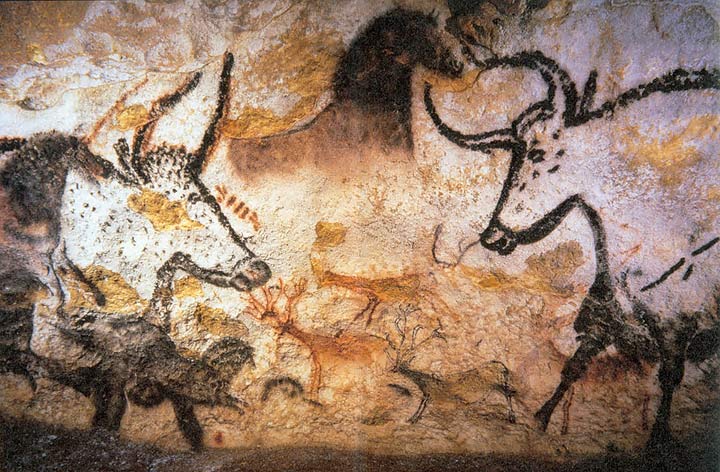
Prehistoric Sites and Decorated Caves of the Vézère Valley
45.0575° N · 1.1700° E · Archaeological Site
Photo: EU · Public domain · Wikimedia Commons
Prehistoric Sites and Decorated Caves of the Vézère Valley is an UNESCO World Heritage Site of prehistoric decorated caves in the Vézère Valley, France. UNESCO listed the Vézère Valley as World Heritage in 1979. The free Lokali audio guide runs 7 minutes.
✓ Published October 2026 · how we write these guides
Visitor facts
| Lokali audio guide | 7 min · free |
|---|---|
| Type | Archaeological Site |
| Location | Dordogne, France |
| Coordinates | 45.0575, 1.1700 |
| Languages | 50+, in the Lokali app |
The story
Listen first. Beneath the chatter of the road and the rush of the river, there is a hush here. It is the hush of limestone. Pale cliffs rise above the Vézère, streaked with grey and rust, and their overhangs throw long, cool shadows across the valley floor. Run your hand along the rock if you can reach it. It feels chalky, slightly damp, and older than any word we have for time. People have sheltered under these ledges for tens of thousands of years.
This is the Vézère Valley, a quiet river corridor in the Dordogne, in southwest France. In 1979, UNESCO listed its prehistoric sites and decorated caves as World Heritage. The listing covers 147 prehistoric sites and 25 decorated caves, scattered along a stretch of river roughly forty kilometres long. That is an extraordinary density. Few places on Earth hold so much evidence of early human life in so small a space.
Why here? The answer is in the geology. Over millions of years, the river cut down through soft limestone. Water then carved caves, galleries, and deep overhangs, which the French call abris, or rock shelters. These shelters faced the sun, stayed dry, and sat close to fresh water and migrating herds. For Ice Age hunters, this valley offered almost everything a community needed. They returned again and again, generation after generation.
Now, a surprise that many visitors miss. Some of the most important words in the study of human prehistory come from tiny villages along this river. The Mousterian, the toolmaking tradition linked to Neanderthals, takes its name from the site of Le Moustier. The Magdalenian, a late Ice Age culture famous for its art, takes its name from the rock shelter of La Madeleine. Scientists around the world use these names every day. Most of them have never seen the quiet corners of the Dordogne that gave them.
The most famous name of all came from a building site. In 1868, workers were building a railway line near the village of Les Eyzies. They cleared a rock shelter called Cro-Magnon and found human bones and tools. The remains belonged to early modern humans, people anatomically like us. The name of that small shelter became the popular name for the first modern Europeans. A railway cutting gave our ancestors their nickname.
Les Eyzies itself sits pressed against the cliffs, and locals often call it the capital of prehistory. Look up at the rock face above the village. The National Museum of Prehistory is built into and against the cliff, near the old castle walls. On a ledge, a stone statue of an early human looks out over the rooftops. It was carved by the sculptor Paul Dardé in the early twentieth century. Today scientists see it as an outdated image, but it remains a much-loved local landmark.
The valley is not only about bones and stone tools. It is about art. Deep inside these caves, Ice Age people painted and engraved animals by the light of flickering lamps. They drew horses, bison, mammoths, deer, and wild cattle called aurochs, the giant ancestors of modern cattle. They used natural pigments: red and yellow ochre from iron-rich earth, and black from charcoal or manganese. Many of these images are well over ten thousand years old.
The best known of these caves is Lascaux, near the town of Montignac. In September 1940, a group of teenagers went exploring and slipped into a narrow opening. According to the popular story, a dog helped lead them to it. Inside, they found walls covered in painted animals, some of them enormous. Researchers generally date the paintings to around seventeen thousand years ago. The cave quickly became one of the great discoveries of the twentieth century.
But fame came at a cost. After the war, the cave opened to the public, and huge numbers of visitors came. Their breath, body heat, and the outside air changed the climate inside. Green algae and other growths began to appear on the walls. In 1963, the authorities closed Lascaux to the public to protect it. Since then, only a small number of specialists may enter. The original cave is now one of the most carefully guarded rooms in France.
So how do people see Lascaux today? Through very careful copies. A first replica, Lascaux II, opened in the 1980s close to the original. Later, a much larger centre opened at the foot of the hill in Montignac, often called Lascaux IV. Artists reproduced the paintings by hand, using the same kinds of pigments. Here is a second surprise: many visitors say the copy still makes their skin prickle. The human skill behind the images comes through, even in reproduction.
A few caves in the valley still let you stand in front of original Ice Age art. Font-de-Gaume, near Les Eyzies, holds painted bison in red and black. It is one of the very few caves with original polychrome paintings, meaning paintings in several colours, that remain open to visitors. Nearby, Les Combarelles holds fine engraved lines scratched into the rock. In these caves, group sizes are small and visits are short, because every visitor affects the delicate air inside.
Further afield, the cave of Rouffignac is known locally as the cave of the hundred mammoths. Visitors travel deep inside on a small electric train, a ride that families especially enjoy. On the ceiling and walls, you can see mammoths drawn in black outline, along with other animals. Look closely in the caves and you may see natural bumps in the rock used as part of an animal's body. The artists worked with the stone, not just on it.
Above ground, the valley has its own quiet beauty. Walnut orchards line the roads. Stone farmhouses carry steep roofs of dark brown tiles. Canoes drift along the green water under the cliffs in summer, and herons stand in the shallows. In the villages, you will smell woodsmoke in cooler months and see markets with walnuts, cheese, and local produce. Life here has carried on, layer upon layer, right on top of the oldest human story.
Before you move on, look again at the cliff nearest to you. Notice the dark band where an overhang throws its shadow. Notice the blackened patches, the small hollows, the places where water seeps from the rock. Somewhere under ledges like these, people once sat by a fire, shaped a tool, or planned a hunt. As you walk away, listen once more to that limestone hush. It is the same quiet they heard.
Key facts
What to look for
Practical tips
Common questions
Is there a free audio guide to Prehistoric Sites and Decorated Caves of the Vézère Valley?
Yes — the Lokali app narrates Prehistoric Sites and Decorated Caves of the Vézère Valley free of charge in 50+ languages. The guide runs about 7 minutes, covers the history, what to look for on site and practical tips, and works offline once downloaded.
Where is Prehistoric Sites and Decorated Caves of the Vézère Valley?
Prehistoric Sites and Decorated Caves of the Vézère Valley is near Dordogne, France, at 45.0575, 1.1700. Tap the map link on this page for directions from where you are.
What is Prehistoric Sites and Decorated Caves of the Vézère Valley known for?
UNESCO listed the Vézère Valley as World Heritage in 1979. The listing covers 147 prehistoric sites and 25 decorated caves.
What should you look for at Prehistoric Sites and Decorated Caves of the Vézère Valley?
The stone statue of an early human above Les Eyzies. Dark overhangs where rock shelters cut into the cliffs. Red and black painted bison inside Font-de-Gaume.
What should you know before visiting Prehistoric Sites and Decorated Caves of the Vézère Valley?
Reserve cave visits well ahead; group sizes are strictly limited. Bring a light jacket, since caves stay cool year-round.
On the map
Opens directions to Prehistoric Sites and Decorated Caves of the Vézère Valley from your location.
More to see near Prehistoric Sites and Decorated Caves of the Vézère Valley


Hear Prehistoric Sites and Decorated Caves of the Vézère Valley in your language
The full story, narrated, in 50+ languages. Download it before you go and it plays offline, at your own pace, with no ticket and no tour group.