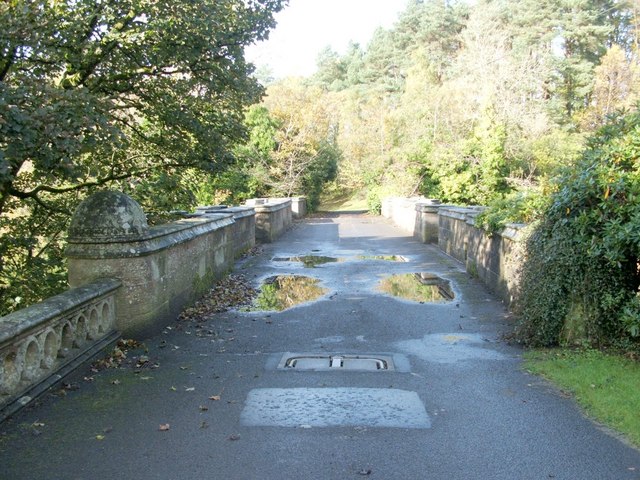
Photo: Lairich Rig · CC BY-SA 2.0 · Wikimedia Commons
Overtoun Bridge is a road bridge in West Dunbartonshire, Scotland, UK, carries an estate driveway across Overtoun Burn. Completed in the 1890s as a carriage approach. The free Lokali audio guide runs 6 minutes.
✓ Published October 2026 · how we write these guides
Visitor facts
| Lokali audio guide | 6 min · free |
|---|---|
| Type | Bridge |
| Location | Dumbarton, United Kingdom |
| Coordinates | 55.9527, -4.5253 |
| Languages | 50+, in the Lokali app |
The story
Listen first. Below the stone parapet, water runs over rock somewhere deep in the trees. You can hear it clearly, but from the road you cannot quite see it. The air smells of wet moss and fallen leaves. The stone under your hand is rough and cold, cut in heavy grey blocks. Welcome to Overtoun Bridge, on the wooded slopes above Dumbarton. It is a quiet, handsome Victorian bridge, and it carries one of the strangest stories in Scotland.
Let us start with the plain facts. The bridge was completed in the 1890s. It carries the old carriage drive across a steep, narrow gorge cut by the Overtoun Burn. A burn, in Scotland, is simply a stream. The drive was built to bring visitors up to Overtoun House, the big stone mansion just ahead of you. The bridge was the grand approach. It was meant to make arrivals feel important.
The design is usually credited to Henry Ernest Milner, an English landscape architect who worked on many country estates in that period. Look at how the arches sit within the ravine. The bridge does not fight the landscape. It is built from rough-faced stone, so it looks heavy and permanent, almost like part of the hillside. The parapets are thick and solid, with rounded ends. Nothing about it looks unusual. That is part of the puzzle.
The man who paid for it was John Campbell White, later Lord Overtoun. He was a wealthy Glasgow industrialist. His family fortune came from a large chemical works that produced chrome compounds, used in dyes and pigments. He was also a devout and generous churchman. He gave money to missions and religious causes. Yet his factories drew harsh criticism. Campaigners, including the Labour pioneer Keir Hardie, attacked the long hours and dangerous conditions his workers faced.
So the man behind this graceful bridge was a man of contradictions. He was a public philanthropist on one hand. On the other, he was an employer accused of making his workers ill. Keep that in mind as you look up at the house. Overtoun House was built by his father in the mid nineteenth century, in the Scottish Baronial style. That style means turrets, steep gables and pointed roofs, a deliberate echo of old Scottish castles.
Now to the reason many people come here. Since around the middle of the twentieth century, locals have reported dogs jumping from this bridge. They do not slip. They appear to leap over the parapet, on the same side, often at roughly the same spot. Many fall a long way into the rocky gorge below. Some have died. Some have survived and, according to local accounts, returned and jumped again.
The newspapers soon called it the dog suicide bridge. That name is dramatic, and it is probably wrong. Animal behaviour experts generally agree that dogs do not understand death in the way that would make suicide possible. Something else is happening. The question is what. Over the years, people have offered many explanations, some scientific and some supernatural.
One investigation in the 2000s looked closely at scent. Researchers noted that small wild animals, possibly mink, live in the undergrowth beneath the bridge. Their scent is strong to a dog's nose. A dog that catches it may rush toward it without thinking. Here is the detail most visitors miss. The parapet is high and solid. A dog at road level cannot see over it. It sees only the stone wall, and perhaps the treetops beyond.
That matters. To a dog, the wall may look like a low barrier with solid ground on the other side. It cannot judge the drop. Add a powerful smell coming up from below, and the jump starts to make sense. Notice also that most reports describe dogs with long noses, the hunting and sniffing breeds. This does not prove the theory. But it is a far more grounded answer than the stories you will hear in the village.
And there are stories. Locals say that a ghost, often called the White Lady of Overtoun, walks the grounds. In the popular tale, she is linked to Lady Overtoun, who outlived her husband and is said to have grieved for him for many years. Some people claim the bridge is a thin place, a Celtic idea for a spot where this world and another come close together. These are legends, not records. They are part of the place all the same.
Today, a small sign near the bridge asks dog owners to keep their animals on a lead. It is a simple, practical message. If you have a dog with you, please follow it. The house itself has had several lives since the Overtoun family left. In the twentieth century the estate passed to the town of Dumbarton. The building has since been used for different purposes, including as a hospital and later by a charitable trust.
Before you go, turn and look back down the drive. On a clear day you can see out across the lower country toward the River Clyde. This was the view Victorian guests saw as their carriages climbed the hill. They saw wealth, order and confidence. They would not have imagined that their bridge would one day be famous for something no one can fully explain.
Stand still for a moment longer. Listen again for the burn below. Feel the cold stone under your palm, and look at how the moss grows in the joints between the blocks. Whatever you believe about this place, the bridge itself is calm. It has stood here for well over a century, carrying people across the gorge. As you walk away, glance once more at that high, blank parapet. Try to see it the way a dog might.
Key facts
What to look for
Practical tips
Common questions
Is there a free audio guide to Overtoun Bridge?
Yes — the Lokali app narrates Overtoun Bridge free of charge in 50+ languages. The guide runs about 6 minutes, covers the history, what to look for on site and practical tips, and works offline once downloaded.
Where is Overtoun Bridge?
Overtoun Bridge is near Dumbarton, United Kingdom, at 55.9527, -4.5253. Tap the map link on this page for directions from where you are.
What is Overtoun Bridge known for?
Completed in the 1890s as a carriage approach. Design usually credited to landscape architect Henry Ernest Milner.
What should you look for at Overtoun Bridge?
Rough-faced grey stone blocks with moss in the joints. High solid parapet that hides the drop from view. Rounded parapet ends framing the carriage drive.
What should you know before visiting Overtoun Bridge?
Keep any dog firmly on a lead near the parapet. Wear sturdy shoes; paths around the gorge get muddy.
On the map
Opens directions to Overtoun Bridge from your location.
More to see near Overtoun Bridge


Hear Overtoun Bridge in your language
The full story, narrated, in 50+ languages. Download it before you go and it plays offline, at your own pace, with no ticket and no tour group.