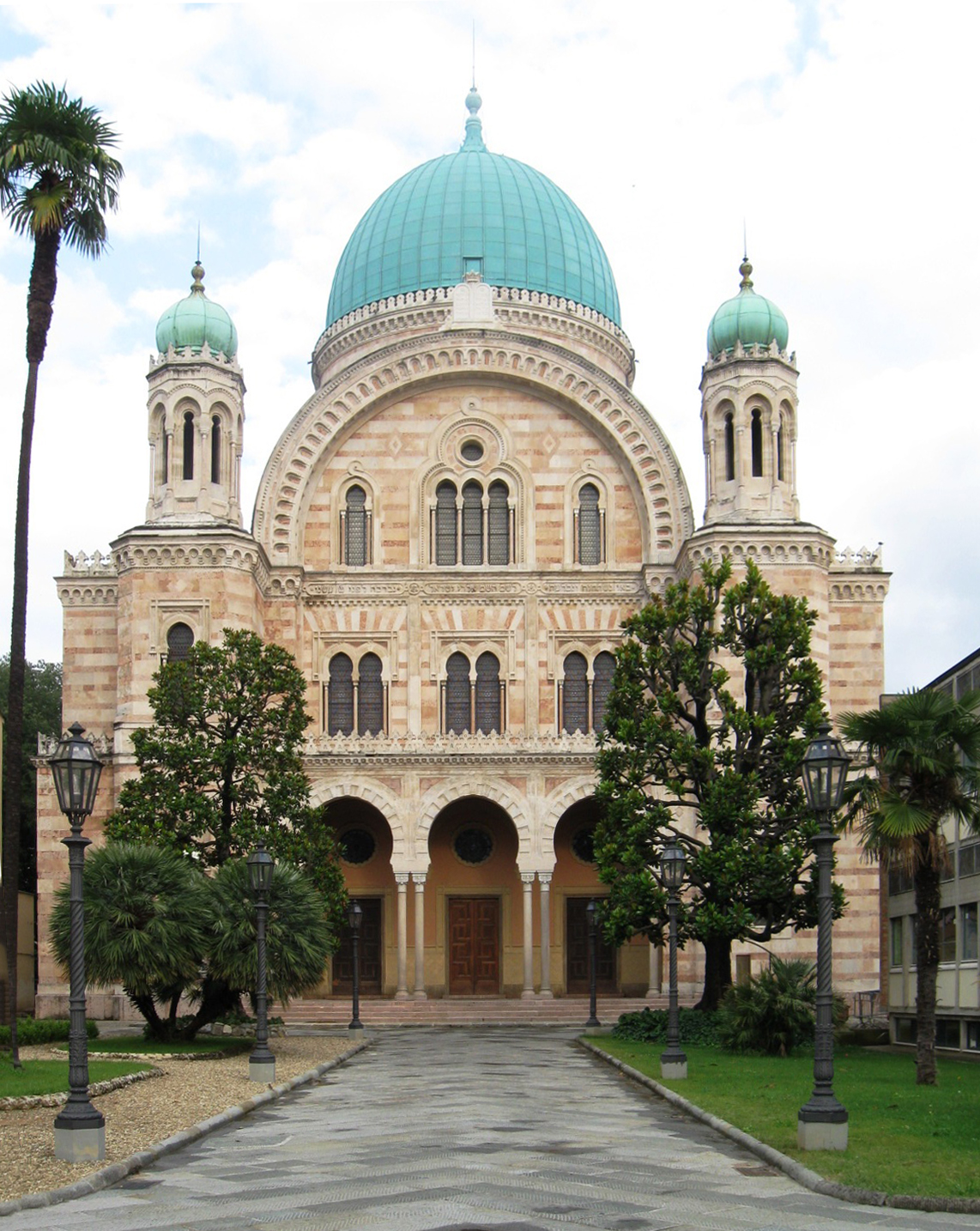
Great Synagogue of Florence
43.7727° N · 11.2663° E · Synagogue
Photo: דני · CC BY-SA 2.5 · Wikimedia Commons
Great Synagogue of Florence is a synagogue. It is in Florence, Italy. Florence's Jewish ghetto was created by Cosimo the First in 1571. The free Lokali audio guide runs 7 minutes.
✓ Published October 2026 · how we write these guides
Visitor facts
| Lokali audio guide | 7 min · free |
|---|---|
| Type | Synagogue |
| Location | Florence, Italy |
| Coordinates | 43.7727, 11.2663 |
| Languages | 50+, in the Lokali app |
The story
Stand at the iron gate and look up. Above the trees of a quiet garden, a broad green dome rises against the sky. It is the colour of old copper, soft and slightly chalky. Below it, the walls are striped in pale stone and warm pink. After the honey-coloured palaces of central Florence, this building looks almost foreign. It is meant to. Welcome to the Great Synagogue of Florence, which locals call the Tempio Maggiore, the Major Temple.
If you have climbed to a viewpoint above the city, you have probably seen this dome already. From Piazzale Michelangelo, the skyline shows Brunelleschi's terracotta cathedral dome, the bell towers, the fortress walls... and then one green dome, a little to the east. Many visitors never ask what it is. It belongs to one of the most important synagogues in Europe. Its story covers centuries of exclusion, a long-awaited freedom, and two near-disasters in the twentieth century.
To understand why this building matters, we need to go back to 1571. In that year, under pressure from the papacy, Grand Duke Cosimo the First de' Medici ordered the Jews of Florence into a ghetto. A ghetto was a walled, enclosed district where Jewish families were forced to live. Its gates were locked at night. For almost three hundred years, Florence's Jewish community lived, worked, and prayed inside those narrow streets. Their synagogues were small rooms, hidden from the public street.
That changed in the nineteenth century. As Italy moved toward unification, Jews gained full civil rights. They could live where they chose, own property, and enter public life. The old ghetto was later demolished. Its site became the large square you may already know: Piazza della Repubblica, with its carousel and grand cafés. Almost nothing of the ghetto survives there today. The memory of that community moved here, to this building.
The synagogue began with one man's wish. David Levi, a president of the Florentine Jewish community, left his fortune for the construction of a monumental temple worthy of Florence. The community took that request seriously. Building started in the 1870s and the synagogue was inaugurated in 1882. Three architects worked on the design: Marco Treves, Mariano Falcini, and Vincenzo Micheli. Their task was not small. They had to create a Jewish monument in a city full of Christian masterpieces.
Their answer was a style often called Moorish Revival. Moorish refers to the art of Islamic Spain and North Africa, with horseshoe arches, geometric patterns, and rich colour. Across Europe in this period, many new synagogues used this look. It gave Jewish communities a visual identity different from church architecture. Here, the architects mixed it with Byzantine ideas from the eastern Christian world. The central dome is often compared to Hagia Sophia, the great domed church of Constantinople.
Look closely at the façade now. The stripes are not painted. They are alternating layers of stone, pale travertine and a pinkish stone, laid in horizontal bands. Notice the horseshoe arches over the doors and windows, and the two smaller towers on either side, each with its own dome. And here is a small surprise: the dome was not always green. It was covered in copper, and copper slowly oxidises in the open air. Time turned it this colour.
When you step inside, the change is dramatic. Almost every surface is decorated. Walls, arches, and ceilings carry dense patterns of painted arabesques, which are interlacing, flowing designs of leaves and lines. Gold, deep blue, red, and ochre cover the space. Mosaics glitter in the curved areas. Because Jewish tradition avoids images of people in places of worship, there are no human figures here. The beauty comes entirely from pattern, colour, and light.
At the eastern end stands the Ark, the sacred cabinet that holds the Torah scrolls. The Torah is the handwritten scroll of the five books of Moses, the heart of Jewish worship. Now comes a detail that many visitors miss. Look at the doors of the Ark. They carry marks and gashes in the surface. These are scars from the Second World War, when soldiers tried to force the doors open with bayonets.
That war nearly destroyed the synagogue. During the German occupation of Florence, the building was damaged and misused. In August 1944, as German troops prepared to retreat from the city, they placed explosives inside the synagogue. Members of the Italian resistance managed to defuse most of the charges before they could bring the whole building down. Some damage was done, but the structure survived. Many members of the community did not. Florentine Jews were deported to the death camps, and memorial plaques here record their names.
The second disaster came from nature. In November 1966, the river Arno flooded Florence. Muddy water poured through streets, churches, libraries, and museums across the city. The synagogue was flooded too. Water and mud damaged the interior, the furnishings, and precious books and Torah scrolls. Volunteers from around the world came to help save the city's treasures. The restoration here took years, and the building you see today carries the results of that patient work.
Upstairs, the Jewish Museum of Florence tells the community's story in objects. Here you can see ritual silver, textiles, embroidered covers, and items used in festivals and family life. These pieces belonged to real families over many generations. A newer section of the museum continues the story into modern times. Take time with the small objects. A worn prayer book or a child's ceremonial item often says more than any grand wall.
A practical word before you leave. This is a working synagogue, not only a monument. Security checks at the entrance are careful, so bring identification and travel light. Dress modestly, and men may be asked to cover their heads. Be respectful of the rules about photography inside. And when you step back out into the garden, pause for a moment. Look up once more at that green dome, rising quietly above the trees. It stands here because a community chose to build it, and then chose, again and again, to save it.
Key facts
What to look for
Practical tips
Common questions
Is there a free audio guide to Great Synagogue of Florence?
Yes — the Lokali app narrates Great Synagogue of Florence free of charge in 50+ languages. The guide runs about 7 minutes, covers the history, what to look for on site and practical tips, and works offline once downloaded.
Where is Great Synagogue of Florence?
Great Synagogue of Florence is in Florence, Italy, at 43.7727, 11.2663. Tap the map link on this page for directions from where you are.
What is Great Synagogue of Florence known for?
Florence's Jewish ghetto was created by Cosimo the First in 1571. The synagogue was inaugurated in 1882 after years of construction.
What should you look for at Great Synagogue of Florence?
Horizontal bands of pale travertine and pinkish stone on the façade. The copper dome turned green by oxidation. Bayonet scars on the doors of the Ark.
What should you know before visiting Great Synagogue of Florence?
Bring photo identification for the security check at entry. Dress modestly with covered shoulders and knees.
On the map
Opens directions to Great Synagogue of Florence from your location.
More to see in Florence


Hear Great Synagogue of Florence in your language
The full story, narrated, in 50+ languages. Download it before you go and it plays offline, at your own pace, with no ticket and no tour group.