
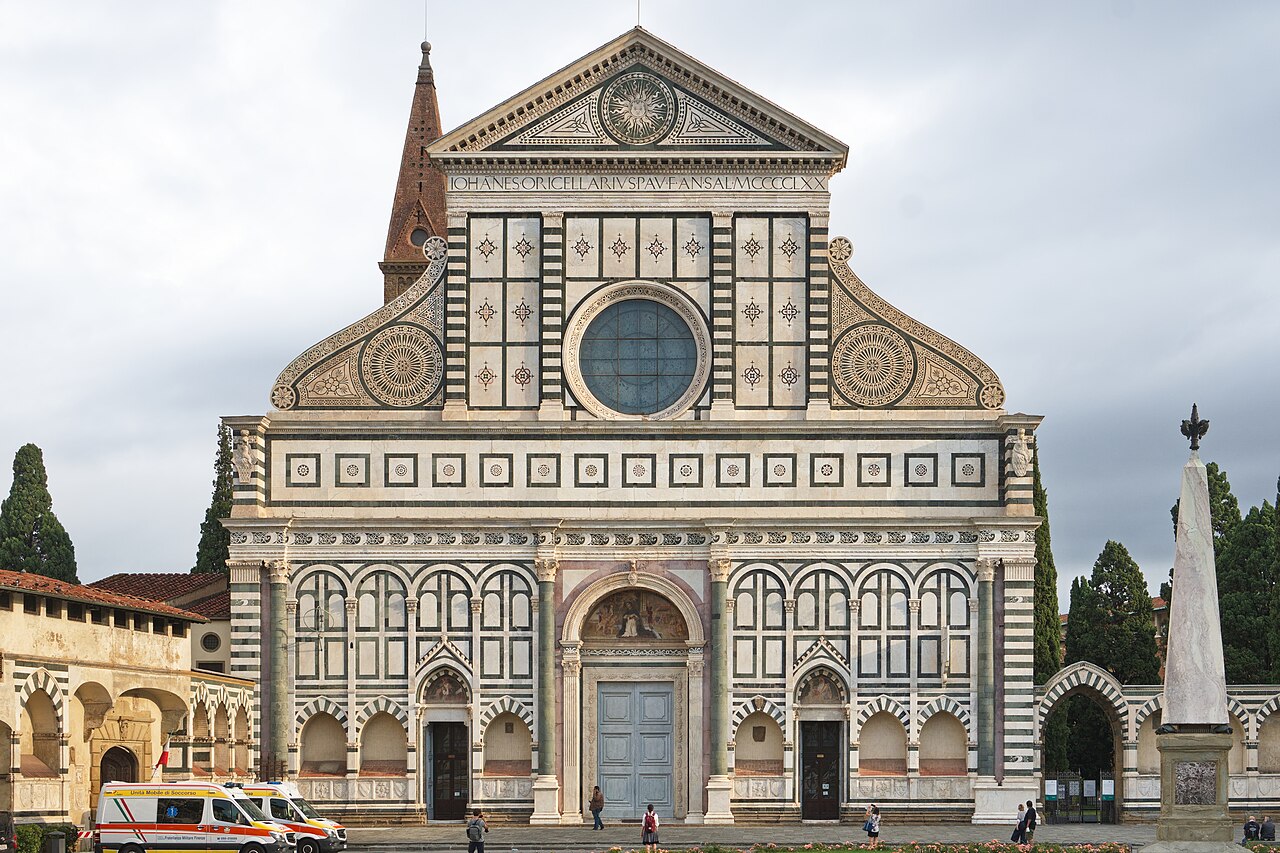
Photo: Lucarelli · CC BY-SA 3.0 · Wikimedia Commons
Ognissanti is a church in Florence. Founded by the Umiliati, a medieval order of wool workers. The free Lokali audio guide runs 7 minutes.
✓ Published October 2026 · how we write these guides
Visitor facts
| Lokali audio guide | 7 min · free |
|---|---|
| Type | Museum |
| Location | Florence, Italy |
| Coordinates | 43.7725, 11.2460 |
| Official website | chiesaognissanti.it |
| Languages | 50+, in the Lokali app |
The story
Stand for a moment in the open square and listen. Behind you, the Arno moves slowly between its stone embankments. Scooters hum along the riverside road. In front of you, a pale church front rises above a short flight of steps. Its surface is smooth and cool, a calm grey and cream. This is Ognissanti, the Church of All Saints. Most visitors walking between the old centre and the river pass it without stopping. Today, you are going to stop.
Begin with the name of the neighbourhood itself. This part of Florence grew up close to the water for a practical reason: wool. In the thirteenth century, a religious order called the Umiliati settled here. The name means 'the humble ones'. They were lay brothers and priests who lived simply and worked with their hands. Above all, they washed, dyed and finished wool, and the river gave them the water they needed. Their church became the heart of a working quarter.
Wool was the engine of medieval Florence. The city grew rich by turning raw fleece into fine cloth and selling it across Europe. So this church was not built for princes. It was built by people whose hands smelled of lanolin and dye. That is worth keeping in mind as you look around. Ognissanti began as a church of craftsmen, and later it became a church of some of the most famous names in the city.
Now look at the façade. It does not match the medieval story at all. The front you see today belongs to the seventeenth century, when the church was remodelled in the Baroque style. Baroque means the grand, theatrical manner of that period, with strong columns, curved shapes and dramatic stonework. Look up, though, and to one side. The slender bell tower is much older. It survived the remodelling, so medieval brick and Baroque stone stand side by side.
Above the main door, look for a glazed terracotta panel in white and blue. This kind of shiny, enamelled clay is a Florentine speciality, linked to the Della Robbia family and their workshop. Their glazes stayed bright for centuries, even in rain and sun. It is a small touch of colour on a sober front. Then step inside, and let your eyes adjust to the softer light.
In the sixteenth century, the Umiliati left, and Franciscan friars took over the church. They are still connected with it today. The Franciscans brought something that many visitors never notice. In one of the chapels, the friars keep a rough, simple robe. According to tradition, it was worn by Saint Francis of Assisi himself. Whether or not every detail of that story is certain, people still come here quietly to see it.
Now to the name that brings many curious travellers through these doors: Vespucci. This was the parish church of the Vespucci family. One member of that family was Amerigo Vespucci, the navigator whose first name was later given to two continents — America. Here is the first surprise. Among the paintings, there is a fresco by Domenico Ghirlandaio showing the Madonna sheltering the Vespucci family under her wide cloak. Many people believe one of the young faces is Amerigo himself.
Keep that image in your mind. A boy from a wool-trading neighbourhood in Florence, painted under the protection of the Virgin. Years later, his name ends up on maps of a world that the painter never knew existed. It is a strange thought to have in a quiet side chapel. The Vespucci family also had another famous member: Simonetta Vespucci, who married into the family and was admired as one of the great beauties of her age.
This brings us to Sandro Botticelli. He grew up in this neighbourhood, and Ognissanti was his parish too. Many people believe Simonetta inspired the faces of women in his paintings. Botticelli is buried here, in this church. Locals like to tell a romantic tale: that he asked to be buried near Simonetta's feet. It is a lovely story. Treat it as a legend, not as documented fact. But his grave is real, and it is here.
Now for the second surprise. In the main body of the church, two painted saints face each other across the space. One is Saint Augustine, painted by Botticelli. The other is Saint Jerome, painted by Ghirlandaio. Both men sit in their studies, surrounded by books and objects. The two artists painted them around the same time, almost like a friendly competition. Stand between them and compare. Botticelli's Augustine looks up, startled, with deep emotion. Ghirlandaio's Jerome is calm, careful, full of exact detail.
Ognissanti once held another famous painting: a large Madonna by Giotto, the artist who changed Italian painting in the early fourteenth century. That panel now hangs in the Uffizi Gallery, a short walk away. But the church still keeps a large painted crucifix linked to Giotto and his workshop. After a long restoration, it returned to the church. Look at the body of Christ. Its weight and sadness feel real, not flat — and that was new in Giotto's time.
One more treasure lies next to the church, in the old dining hall of the friars. Ghirlandaio painted a Last Supper on its wall. Look for the small details: birds in the trees behind the table, fruit, the patterned tablecloth. The refectory has its own entrance and keeps limited visiting days, so it is wise to check before you come. If it is closed, do not worry. The church itself holds more than enough to fill your visit.
When you step back outside, pause on the steps. The river is in front of you again, and the light on the water changes the colour of the stones. Think of the wool workers, the friars, the painter's grave, and the boy whose name went across the ocean. All of them knew this same small square. Take one last look at the old bell tower above the Baroque front. Then walk on slowly towards the Arno.
Key facts
What to look for
Practical tips
Common questions
Is there a free audio guide to Ognissanti?
Yes — the Lokali app narrates Ognissanti free of charge in 50+ languages. The guide runs about 7 minutes, covers the history, what to look for on site and practical tips, and works offline once downloaded.
Where is Ognissanti?
Ognissanti is in Florence, Italy, at 43.7725, 11.2460. Tap the map link on this page for directions from where you are.
What is Ognissanti known for?
Founded by the Umiliati, a medieval order of wool workers. Franciscan friars took over the church in the sixteenth century.
What should you look for at Ognissanti?
Glazed blue and white terracotta panel above the main door. Medieval bell tower rising beside the Baroque façade. Ghirlandaio's Vespucci family sheltered under the Madonna's cloak.
What should you know before visiting Ognissanti?
Check refectory visiting days before you come. Dress modestly with shoulders covered for this working church.
On the map
Opens directions to Ognissanti from your location.
More to see in Florence



Hear Ognissanti in your language
The full story, narrated, in 50+ languages. Download it before you go and it plays offline, at your own pace, with no ticket and no tour group.