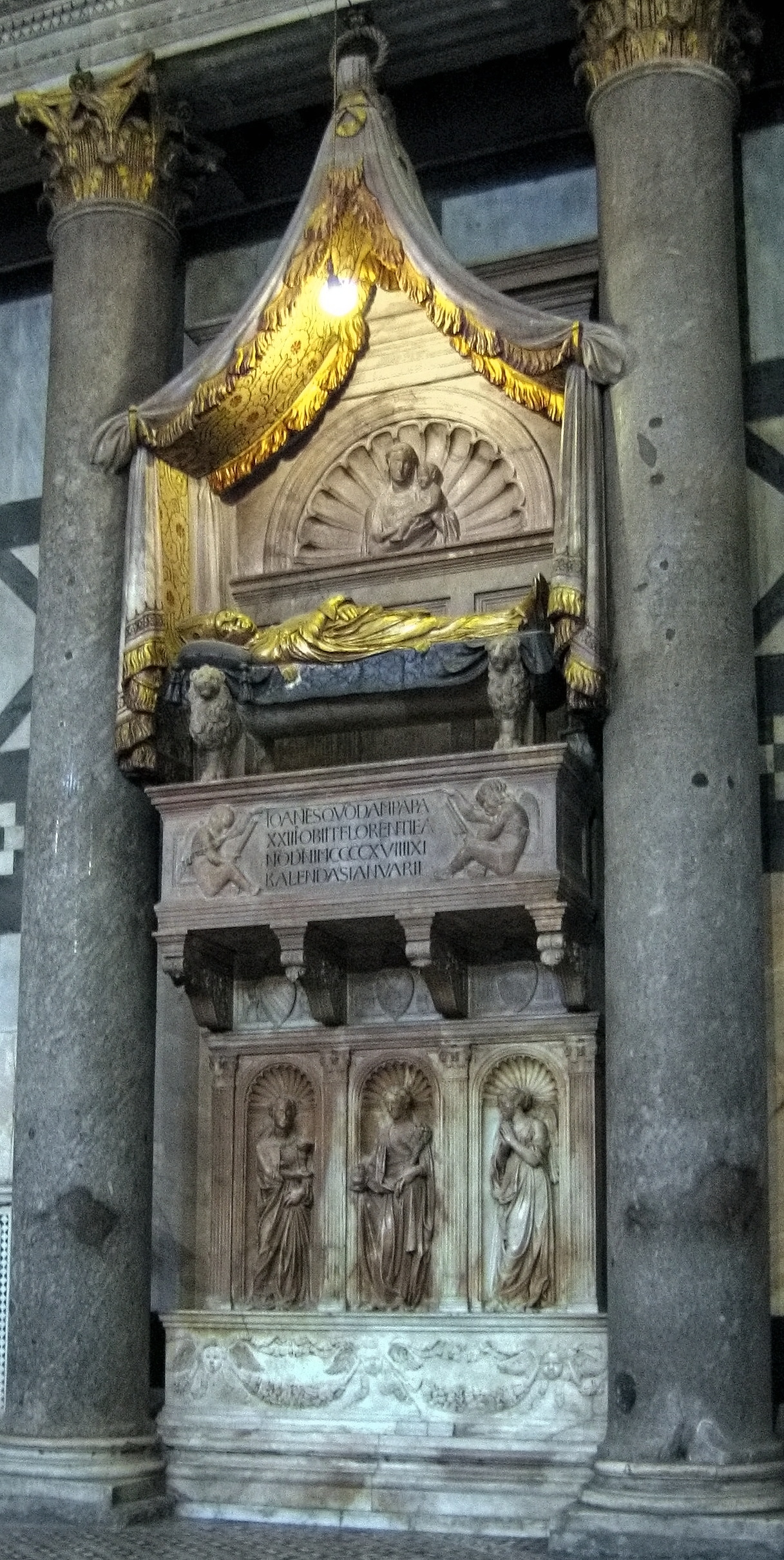
Tomb of Antipope John XXIII
43.7732° N · 11.2546° E · Monument
Photo: Wikimedia Commons contributor · CC BY-SA 3.0 · Wikimedia Commons
Tomb of Antipope John XXIII is a tomb monument of Baldassare Cossa created by Donatello and Michelozzo in the Baptistery, Florence, Italy. Commissioned by executors including Giovanni di Bicci de' Medici. The free Lokali audio guide runs 7 minutes.
✓ Published October 2026 · how we write these guides
Visitor facts
| Lokali audio guide | 7 min · free |
|---|---|
| Type | Monument |
| Location | Florence, Italy |
| Coordinates | 43.7732, 11.2546 |
| Languages | 50+, in the Lokali app |
The story
Step inside the Baptistery of San Giovanni and let your eyes adjust. Gold mosaics glow overhead, and the marble floor feels cool and slightly uneven underfoot. Voices soften here. Now turn toward the altar and look to the right, where two huge columns of grey granite stand close together. Between them, almost squeezed into the wall, rises a tall, narrow monument of marble and bronze. A man lies on top, asleep in gilded robes. This is the tomb of a pope that the Church no longer counts as a pope.
His name was Baldassarre Cossa. In the early fifteenth century, the Western Church was in crisis. Rival lines of popes claimed authority at the same time, and for a period there were three of them. This split is known as the Western Schism. Cossa was elected by one faction and took the name John the Twenty-Third. He had money, political skill, and powerful friends. One of those friends was a Florentine banker named Giovanni di Bicci de' Medici, the founder of the Medici family's great fortune.
Cossa's reign did not last. He agreed to the Council of Constance, a great church gathering in southern Germany, hoping it would confirm him. Instead, the council turned against him. He tried to flee, was caught, and was deposed in 1415. The council went on to end the schism, and a single pope was elected. Cossa spent time in captivity. Later he was released, made peace with the new pope, and came to Florence, where he died in 1419.
Before he died, his enemies had collected a long list of accusations against him. Some were very colourful. Popular tales say he had once been a pirate in his youth, and stories of his private life spread widely. How much of this is true is hard to say. Accusations at Constance were also a political weapon. Historians treat many of them with caution. What is clear is that Cossa ended his life as a fallen man, yet he still had loyal friends in this city.
Those friends paid for this tomb. The executors of his will, including Giovanni de' Medici, commissioned the work in the 1420s. For the job they chose two artists who were working together at the time: Donatello and Michelozzo. Donatello was already one of the boldest sculptors in Florence. Michelozzo was a sculptor and architect who later became the Medici family's favourite builder. Scholars still debate exactly which parts each man made. But the gilded bronze figure of Cossa is usually credited to Donatello.
Here is the first surprise. Look at how the tomb fits the space. The artists did not have a wide wall to fill. They had only the narrow gap between two ancient columns. So they built upward instead of outward. The monument stacks its parts like the floors of a tower. At the bottom are niches with figures. Above them sits the coffin, then the effigy, then a Madonna and Child, and finally a stone canopy. The design works with the building, not against it.
Start low, at the three female figures in shallow niches. They represent virtues, usually identified as Faith, Hope, and Charity. Each holds a symbol that helps you tell them apart. Above them, look for the long inscription carved across the front of the sarcophagus. It is in Latin. The key words describe Cossa as John the Twenty-Third, a former pope. That small word, former, carried a lot of weight. It was a careful compromise.
The compromise did not satisfy everyone. According to accounts from the period, the reigning pope, Martin the Fifth, was unhappy about the inscription. He did not like the idea of a man he had replaced being honoured with the title of pope inside one of the most important churches in Florence. The Florentines kept the wording anyway. It is a quiet act of loyalty, written in stone, and still readable today.
Now raise your eyes to the bronze figure itself. Cossa lies on a draped bier, his head turned slightly toward you. His face looks heavy and tired, not idealised. The folds of his robes fall in deep, soft ridges. Gilding catches the light from the doors and the lamps. Notice that the bier rests on carved lions. Above him, a marble curtain hangs from the canopy and appears to be pulled open, as if you have been allowed a private look at a sleeping man.
Here is the second surprise. This tomb was influential far beyond its odd story. Its stacked design, with a reclining figure under a curtain and a sacred image above, became a model for many wall tombs in fifteenth-century Italy. Later sculptors studied it closely. So this monument to a disgraced churchman helped shape how the Renaissance remembered its great men. The tomb of a loser became a pattern for the tombs of winners.
There is one more connection to the building around you. Cossa is said to have left the Baptistery a precious relic: a finger believed to belong to Saint John the Baptist, the patron of this church and of Florence. If that story is true, it helps explain why he was allowed to rest in such an honoured place. Gifts and favours often opened doors in Renaissance Florence, even for a deposed pope.
And the story did not end in the fifteenth century. In 1958, a newly elected pope chose the name John the Twenty-Third. That was Angelo Roncalli, later made a saint. By taking the same number, the Church made its position plain. Cossa's title did not count. So Florence holds the tomb of the first John the Twenty-Third, while official lists give that name to a pope of the twentieth century. Two men, one name, five centuries apart.
Before you move on, step back a few paces. See the whole monument at once, framed by those two great granite columns. Then let your gaze rise to the mosaic ceiling, full of saints and angels. Cossa lies here among them, still a pope in the words on his tomb, and only a former pope in the record books. As you walk back toward the bright doorway and the noise of the piazza, think of how many old arguments are still quietly carved into the stones of this city.
Key facts
What to look for
Practical tips
Common questions
Is there a free audio guide to Tomb of Antipope John XXIII?
Yes — the Lokali app narrates Tomb of Antipope John XXIII free of charge in 50+ languages. The guide runs about 7 minutes, covers the history, what to look for on site and practical tips, and works offline once downloaded.
Where is Tomb of Antipope John XXIII?
Tomb of Antipope John XXIII is in Florence, Italy, at 43.7732, 11.2546. Tap the map link on this page for directions from where you are.
What is Tomb of Antipope John XXIII known for?
Commissioned by executors including Giovanni di Bicci de' Medici. Created by Donatello and Michelozzo in the 1420s.
What should you look for at Tomb of Antipope John XXIII?
Two grey granite columns framing the narrow tomb. Gilded bronze effigy with a tired, realistic face. Marble curtain drawn open above the sleeping figure.
What should you know before visiting Tomb of Antipope John XXIII?
Stand between the altar and font for a full view. Bring binoculars to read the Latin inscription up close.
When is the best time to visit Tomb of Antipope John XXIII?
Visit early to avoid crowds blocking the narrow monument.
On the map
Opens directions to Tomb of Antipope John XXIII from your location.
More to see in Florence


Hear Tomb of Antipope John XXIII in your language
The full story, narrated, in 50+ languages. Download it before you go and it plays offline, at your own pace, with no ticket and no tour group.