
Giza pyramid complex
29.9761° N · 31.1328° E · Archaeological Site
Photo: KennyOMG · CC BY-SA 4.0 · Wikimedia Commons
Giza pyramid complex is an archaeological site on the Giza Plateau, Egypt. Built during Egypt's Fourth Dynasty, third millennium BCE. The free Lokali audio guide runs 7 minutes.
✓ Published October 2026 · how we write these guides
Visitor facts
| Lokali audio guide | 7 min · free |
|---|---|
| Type | Archaeological Site |
| Location | Giza, Egypt |
| Coordinates | 29.9761, 31.1328 |
| Languages | 50+, in the Lokali app |
The story
Feel the ground first. Under your shoes is a crust of limestone grit and wind-blown sand, warm even in the early morning. Listen, and you will hear a mix of sounds that belongs only here — car horns drifting up from the city, the soft thud of camel feet, a vendor calling a price, and under it all, the dry hiss of desert wind. Then lift your eyes. Three mountains of cut stone rise from the edge of the plateau, sharp against the sky.
You are standing on the Giza plateau, on the west bank of the Nile, where the green river valley ends and the Sahara begins. That line matters. Ancient Egyptians linked the east, where the sun rose, with life. They linked the west, where the sun set, with death and the journey beyond. So they buried their kings here, on high desert ground, above the floods and facing the setting sun.
The largest of the three is the Great Pyramid, built for the king Khufu during Egypt's Fourth Dynasty, around the middle of the third millennium before Christ. Its neighbour, slightly smaller but standing on higher ground, belongs to his son Khafre. The third and smallest was built for Menkaure. From some angles, Khafre's pyramid looks taller than his father's. That is an effect of the rising bedrock beneath it — and perhaps a little royal ambition.
Here is the first surprise. For nearly 3,800 years, the Great Pyramid was the tallest structure made by human hands anywhere on Earth. Medieval cathedral spires in Europe finally passed it. It is also the only one of the Seven Wonders of the Ancient World that still stands. The others, such as the lighthouse of Alexandria and the hanging gardens of Babylon, are gone or survive only in stories. This one is still here, and you can touch it.
Look closely at the surface of the stone. The pyramids did not always look rough and stepped like this. They were once covered in a smooth outer skin of fine white limestone, polished so that the faces would shine in the sun. Most of that casing is gone. Over many centuries, builders in medieval Cairo took the dressed stones and reused them in mosques, walls and houses. Part of the ancient pyramids is now inside the old city across the river.
Now turn toward Khafre's pyramid and look near its very top. You will see a cap of paler, smoother stone, sitting like snow on a summit. That is a surviving piece of the original casing. It is the best place on the plateau to imagine what all three pyramids once looked like — clean, bright, geometric surfaces, almost too perfect to belong to the desert around them.
The question everyone asks is simple. Who built this? An old and popular idea says that armies of slaves did the work. Archaeology tells a different story. Excavations just south of the plateau uncovered a settlement for workers — bakeries, breweries, sleeping quarters and evidence of large-scale cattle and fish supplies. Nearby, archaeologists found modest tombs of the workers themselves, buried with honour close to their kings. These were organised crews, fed and housed, not people in chains.
The second surprise comes from far away, on the coast of the Red Sea. At a site called Wadi al-Jarf, researchers found the oldest known inscribed papyri in Egypt. Among them is a logbook kept by an official named Merer. It records his team moving limestone blocks by boat from the quarries at Tura, across the river, toward Giza — during the reign of Khufu. It is a daily work diary from the building of the Great Pyramid itself.
Inside the Great Pyramid, passages climb toward a room known as the King's Chamber, lined with red granite. That granite did not come from nearby. It travelled down the Nile from Aswan, far to the south, a journey of many hundreds of kilometres. The Nile was the great highway of ancient Egypt. Stone, grain, workers and ideas all moved along it. The pyramids are as much a product of that river as of the desert they stand on.
Around the three big pyramids, look for smaller ones. These are often called the queens' pyramids, built for royal women of the court. Beyond them spread rows of low, flat-topped tombs called mastabas, from an Arabic word for a bench, because of their shape. Officials and family members were buried here, close to the king. The plateau was not just three monuments. It was a whole city of the dead, carefully planned around its rulers.
Then there is the Sphinx, lying below Khafre's pyramid, with a lion's body and a human head. Most scholars link it to Khafre's reign. Much of it was carved directly from the bedrock, shaped out of the plateau itself. Its nose is missing. Locals and guides often repeat the tale that Napoleon's soldiers shot it off. That story is false. Drawings of the noseless Sphinx were made long before the French army ever arrived in Egypt.
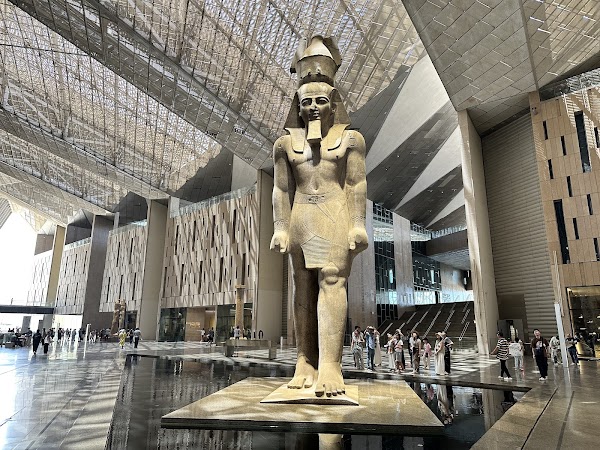
One more discovery sits close to Khufu's pyramid. In 1954, workers found a sealed pit holding the parts of a large wooden boat, taken apart and stored in pieces. It was rebuilt into a long, elegant vessel made of cedar. Its exact purpose is still debated — a funeral barge, or a boat for the king's journey with the sun god. The boat has now moved to the Grand Egyptian Museum, a short distance from the plateau.
As you walk, notice how close the modern city feels. On one side, the desert stretches toward the horizon in tones of gold and grey. On the other, apartment blocks, satellite dishes and minarets press right up to the edge of the site. Horses and camels wait for riders. Children sell postcards. This is not a ruin lost in empty sand. It is a monument that millions of people live beside every single day.
Before you leave, stand still for a moment and look up at the Great Pyramid's lowest courses. Each block is taller than many visitors' waists. Run your eyes up the slope until the stone meets the sky. Somebody cut this block, moved it, and set it in place, more than four thousand years ago. As you walk away, look back once. Watch how the three shapes line up and separate again as your angle changes — and take that view with you.
Key facts
What to look for
Practical tips
Common questions
Is there a free audio guide to Giza pyramid complex?
Yes — the Lokali app narrates Giza pyramid complex free of charge in 50+ languages. The guide runs about 7 minutes, covers the history, what to look for on site and practical tips, and works offline once downloaded.
Where is Giza pyramid complex?
Giza pyramid complex is in Giza, Egypt, at 29.9761, 31.1328. Tap the map link on this page for directions from where you are.
What is Giza pyramid complex known for?
Built during Egypt's Fourth Dynasty, third millennium BCE. Great Pyramid was Earth's tallest structure for nearly 3,800 years.
What should you look for at Giza pyramid complex?
Pale original casing stones near the peak of Khafre's pyramid. The Sphinx's missing nose and weathered layers of bedrock. Small queens' pyramids standing beside the Great Pyramid.
What should you know before visiting Giza pyramid complex?
Arrive early to avoid midday heat and the largest tour crowds. Bring water, sun hat and sturdy shoes for sandy uneven ground.
When is the best time to visit Giza pyramid complex?
Arrive early to avoid midday heat and the largest tour crowds.
On the map
Opens directions to Giza pyramid complex from your location.
More to see in Giza



Hear Giza pyramid complex in your language
The full story, narrated, in 50+ languages. Download it before you go and it plays offline, at your own pace, with no ticket and no tour group.