
Great Pyramid of Giza
29.9792° N · 31.1342° E · Archaeological Site
Photo: Nina · CC BY 2.5 · Wikimedia Commons
Great Pyramid of Giza is the oldest and largest of the three pyramids in the Giza Necropolis; one of the seven ancient wonders of the world. Built for Khufu, a Fourth Dynasty Egyptian king. The free Lokali audio guide runs 7 minutes.
✓ Published October 2026 · how we write these guides
Visitor facts
| Lokali audio guide | 7 min · free |
|---|---|
| Type | Archaeological Site |
| Location | Giza, Egypt |
| Coordinates | 29.9792, 31.1342 |
| Languages | 50+, in the Lokali app |
The story
Put your palm flat against one of the lower blocks. The stone is rough, pitted, and warm by mid-morning. Fine desert grit gathers in every seam. Somewhere behind you, a camel grumbles, a vendor calls out, and the wind carries sand across the plateau with a dry, hissing sound. Now look up. The steps of stone climb away from you, block after block, until they narrow into the pale sky. This is the Great Pyramid of Giza, and you are standing beside the largest of the three pyramids on this plateau.
This monument was built for a king called Khufu. The Greeks later knew him as Cheops. He ruled Egypt during the Fourth Dynasty, in the period historians call the Old Kingdom. Most Egyptologists place the completion of the pyramid around 2560 BCE, give or take a few decades. That makes it roughly four and a half thousand years old. To put that in perspective, the pyramid was already ancient when Cleopatra was alive. She lived closer in time to us than to the builders of this tomb.
The numbers are hard to hold in your head. Each side of the base runs for about 230 metres. When it was finished, the pyramid rose to about 146 metres. Today it stands closer to 138 metres, because the very top is missing. For nearly four thousand years, no human-made structure on Earth was taller. Engineers still admire one detail most of all. The four sides are aligned almost perfectly with north, south, east, and west, with an error that modern surveyors measure in fractions of a degree.
Here is the first thing most visitors miss. The pyramid you see is not the pyramid the ancient Egyptians saw. Originally, the whole surface was covered in smooth casing stones of fine white limestone. In strong sunlight, the monument would have shone bright against the desert. Over the centuries, most of that casing was stripped away. Much of it was carried off to build medieval Cairo, especially after a powerful earthquake in the early fourteenth century damaged the city. What remains today is the stepped inner core.
The core is made of limestone, mostly quarried right here on the plateau. Estimates suggest around two million blocks went into the structure. The finer white casing stone came from quarries at Tura, across the Nile to the east. Deep inside, the walls of the burial chamber are made of red granite. That granite was brought from Aswan, in the far south of Egypt, many hundreds of kilometres up the river. Some of those granite beams weigh many tonnes each.
So who did the work? For a long time, a popular image showed armies of slaves under the whip. The evidence now tells a different story. Archaeologists excavated a settlement just south of the plateau. They found bakeries, breweries, storage areas, and the remains of large quantities of cattle and fish. They also found the tombs of workers, buried with care near the pyramids they helped build. These were organised crews of labourers. Many were skilled, and they were fed, housed, and honoured in death.
The second surprise is a document. In 2013, archaeologists working at an ancient harbour on the Red Sea coast found fragments of papyrus. They are among the oldest inscribed papyri ever discovered. One set is a logbook kept by an official named Merer. It records his team transporting limestone blocks by boat from the Tura quarries to Giza. In other words, we have a written diary from someone who supplied stone for this very pyramid. It is a rare, direct voice from the building site.
Now think about the interior. The entrance used by most visitors today is not the original one. Tradition credits a ninth-century Arab ruler, the Caliph al-Ma'mun, with tunnelling into the pyramid in search of treasure. Whether he personally ordered it is debated, but the forced passage is real. Inside, narrow corridors lead upward. The most remarkable space is the Grand Gallery — a tall, sloping passage with a high corbelled ceiling, where each layer of stone steps slightly inward toward the top.
The Grand Gallery leads to the King's Chamber. It is a plain rectangular room lined with granite. At one end sits a lidless stone sarcophagus. There are no paintings, no inscriptions, and no treasure. Whatever was buried here was removed long ago. Above the chamber, builders placed a series of low stacked compartments. They are thought to relieve the enormous weight of stone pressing down from above. In one of those hidden spaces, painted marks left by work gangs include Khufu's name.
The pyramid is still giving up secrets. In recent years, an international project called ScanPyramids used particles from cosmic rays to look through the stone, a little like an X-ray. In 2017, the team announced a large empty space above the Grand Gallery. Later, researchers confirmed a hidden corridor behind the north face, near the original entrance. Nobody yet knows what purpose these spaces served. The oldest of the Seven Wonders of the Ancient World is also one of the least fully understood.
And here is a small irony. For a king who built the largest tomb on Earth, Khufu left very few images of himself. The only complete statue known to show him is a tiny ivory figure, small enough to sit in the palm of your hand. It was found far to the south, at Abydos, not here. The man behind the largest pyramid is known to us mainly through this one small carving.
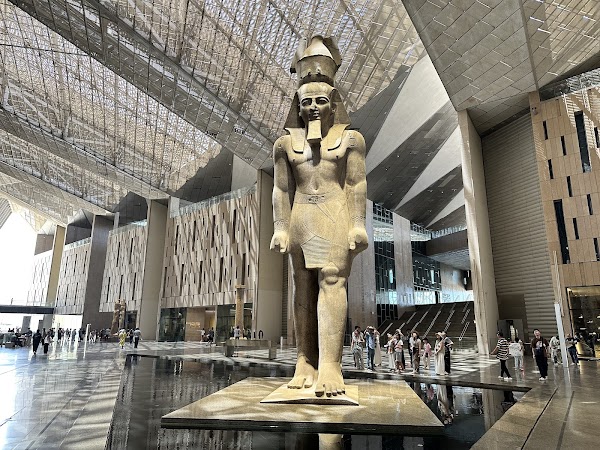
Look around the base, too. On the east side, you can see three much smaller pyramids, built for royal women of Khufu's court. Rows of flat stone tombs, called mastabas, line the ground nearby. They belonged to officials and family members who wanted to rest close to their king. Along the south side, a large wooden boat was found sealed in a pit in 1954. It was carefully rebuilt and is now displayed at the Grand Egyptian Museum.
Before you leave, step back far enough to take in the whole shape. Notice how the rough steps soften into a clean triangle from a distance. Notice the modern rooftops of Giza pressing up to the edge of the plateau, and the haze of the city beyond. The wind keeps moving the sand around your feet, just as it did when the stone was first laid. As you walk away, turn around once more. The pyramid looks different from every angle, and every visitor before you has turned to look back, just like this.
Key facts
What to look for
Practical tips
Common questions
Is there a free audio guide to Great Pyramid of Giza?
Yes — the Lokali app narrates Great Pyramid of Giza free of charge in 50+ languages. The guide runs about 7 minutes, covers the history, what to look for on site and practical tips, and works offline once downloaded.
Where is Great Pyramid of Giza?
Great Pyramid of Giza is in Giza, Egypt, at 29.9792, 31.1342. Tap the map link on this page for directions from where you are.
What is Great Pyramid of Giza known for?
Built for Khufu, a Fourth Dynasty Egyptian king. Completed around 2560 BCE, according to most Egyptologists.
What should you look for at Great Pyramid of Giza?
Remaining white casing stones near the pyramid's base. The tunnel entrance below the original northern doorway. Large stone chevrons above the original north entrance.
What should you know before visiting Great Pyramid of Giza?
Arrive early to avoid midday heat and crowds. Interior access requires a separate ticket at the site.
When is the best time to visit Great Pyramid of Giza?
Arrive early to avoid midday heat and crowds.
On the map
Opens directions to Great Pyramid of Giza from your location.
More to see in Giza


Hear Great Pyramid of Giza in your language
The full story, narrated, in 50+ languages. Download it before you go and it plays offline, at your own pace, with no ticket and no tour group.