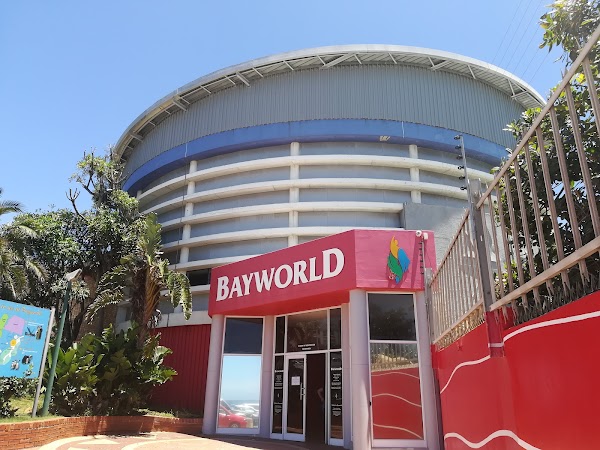
Bayworld is a marine science museum and aquarium complex on the beachfront featuring live dolphin and seal shows, an oceanarium, and a snake park. It is in Gqeberha, South Africa. Most visitors spend 2–3 hours here. The free Lokali audio guide runs 5 minutes.
✓ Verified August 2026 · how we write these guides
Visitor facts
| Time needed | 2–3 hours |
|---|---|
| Lokali audio guide | 5 min · free |
| Type | Museum |
| Best for | Family |
| Location | Gqeberha, South Africa |
| Coordinates | -33.9711, 25.5976 |
| Languages | 45, in the Lokali app |
The story
You step in off the beachfront road, out of the sea wind, into cool and quiet halls. The light is low. Glass cases line the walls. Inside them lie old bones, ship models, and the long skin of a snake. The air smells faintly of old wood and floor polish. This is Bayworld, a museum complex on the Humewood shore of the city.
Bayworld is not one museum but several gathered together. At its center is the Port Elizabeth Museum. This is one of the oldest museums in South Africa, the third oldest in the whole country. It has been collecting and showing the natural and human history of this coast for well over a century. Generations of this city have walked these same halls as children.
The museum keeps growing and changing. The foundation stone of the present building was laid on the eleventh of November, 1958. But parts of the collection are far older than that. A determined director named Fitzsimons was already gathering specimens here as early as 1906, building the heart of what you see today. He had a special love for snakes, and it shaped the whole museum.
It was Fitzsimons who started the snake park. The Bayworld Snake Park dates back to 1919. When it opened, it was the first of its kind anywhere in the world. People came to see living snakes kept and studied in one place, rather than only feared in the wild. Their slow movements behind the glass are strangely calming to watch.
You can still come close to those snakes today. They rest behind thick glass, some of them local to this coast. Read the signs beside each one. You learn which species to respect on a country walk, and which are harmless. The park was built to replace fear with knowledge.
Walk the museum halls slowly, and you pass through deep time. There are fossils and casts of dinosaurs that once moved across this land. There are bones of whales and other great creatures pulled from the bay. This coast has always lived between the land and the ocean, and the museum holds both sides at once. A single hall can carry you from ancient seas to dry inland plains.
Other rooms turn to human history. There are exhibits on the sea trade that built the city. Port Elizabeth grew as a harbor town, and ships shaped its whole story. You will see models, instruments, and objects that were carried here across the water from distant ports. Each object remembers a long voyage and the hands that brought it.
One part of the complex sits a little apart from the rest. It is called Number 7 Castle Hill. This is an old settler house, one of the oldest surviving homes in the city. It was brought into the museum complex in 1968. Inside, the rooms are set out to show how an early settler family once lived.
The complex also holds an oceanarium, built close to the sea. For many years it kept marine life drawn from the bay. At the time of writing, the oceanarium is closed and under redevelopment. Ask the staff what is open on the day you visit, since the site keeps changing from year to year. Even closed, the building behind it hints at the tanks once inside.
That habit of change is really the point of a place like this. A museum is never truly finished. New finds arrive. Old displays are taken down and rebuilt. What you see on your visit is only one stage in a long, slow project that began more than a hundred years ago.
Take your time with the small things. Read the handwritten labels. Look closely at the worn tools and everyday objects. Each one passed through real hands. A museum gathers the ordinary pieces of many lives and keeps them safe together in one cool, quiet building.
The setting matters too. Bayworld stands on Marine Drive, right on the Humewood beachfront. When you step back outside, the sea is there in front of you. The same bay that fills the cases inside stretches out wide and bright beyond the road. Gulls turn overhead, and the surf works steadily at the sand.
Stand for a moment between the doors and the water. Inside are the bones, the ships, and the snakes, the gathered memory of this whole coast. Outside is the living sea that made all of it. Bayworld is the quiet place where the two finally meet.
Key facts
What to look for
Practical tips
Common questions
How long do you need at Bayworld?
Plan 2–3 hours. That is the time most visitors spend at Bayworld. The free Lokali audio guide adds about 5 minutes of narration you can listen to as you walk, so it fits inside your visit rather than adding to it.
Is there a free audio guide to Bayworld?
Yes — the Lokali app narrates Bayworld free of charge in 50+ languages. It covers the history, what to look for on site and practical tips, and it works offline once downloaded.
Where is Bayworld?
Bayworld is in Gqeberha, South Africa, at -33.9711, 25.5976. Tap the map link on this page for directions from where you are.
What should you know before visiting Bayworld?
Ask staff which sections are open today.
What is Bayworld known for?
Port Elizabeth Museum is South Africa third oldest.
What is the best time to visit Bayworld?
The dolphin shows run on fixed schedules; check timing before arrival.
On the map
Opens directions to Bayworld from your location.
More to see in Gqeberha


Hear Bayworld in your language
The full story, narrated, in 50+ languages. Download it before you go and it plays offline, at your own pace, with no ticket and no tour group.