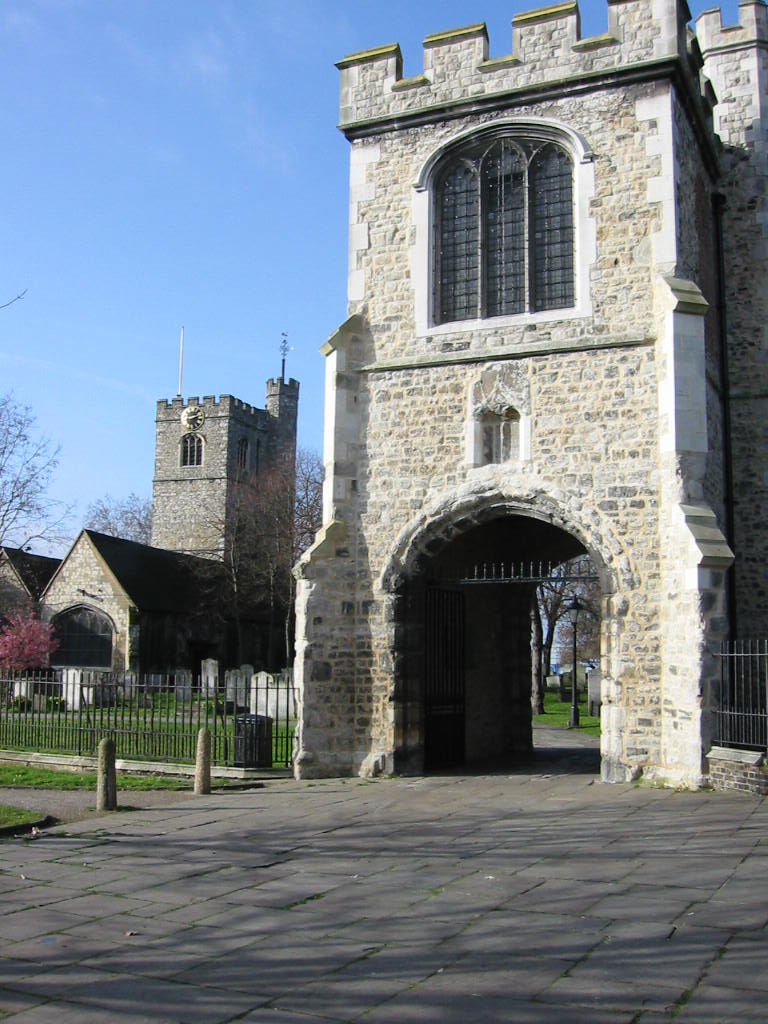
Photo: MRSC at English Wikipedia · Public domain · Wikimedia Commons
Barking Abbey is a building in London, England, UK. Founded in 666 by Erkenwald, later Bishop of London. The free Lokali audio guide runs 6 minutes.
✓ Published October 2026 · how we write these guides
Visitor facts
| Lokali audio guide | 6 min · free |
|---|---|
| Type | Monastery |
| Location | London, United Kingdom |
| Coordinates | 51.5359, 0.0754 |
| Languages | 50+, in the Lokali app |
The story
Grass grows here in neat, low rectangles. Lines of pale stone run through it at ankle height, crossing and turning like the outline of a plan drawn on the ground. Pigeons walk along the old walls. Behind you, traffic moves through Barking, and a church bell may mark the hour. This quiet green is all that remains above ground of one of the oldest and most powerful religious houses in England.
You are standing on the site of Barking Abbey. It was founded in the seventh century, in the year 666, by a churchman named Erkenwald. He later became Bishop of London and was honoured as a saint. He built the abbey for his sister, Ethelburga, who became its first abbess. Erkenwald founded a monastery for men at Chertsey, in Surrey, at about the same time. Barking was the house for women.
Here is the first thing many visitors miss. This was not a small country convent. For much of the Middle Ages, Barking was one of the richest and most respected nunneries in the kingdom. Its abbess ranked alongside the great landowners of England. She controlled large estates and collected rents. She owed duties to the crown, much as a powerful baron did. Several abbesses came from royal or noble families, and their position carried real political weight.
The early story of the abbey survives partly because of Bede. He was a monk and scholar in the north of England, and he finished his great history of the English church in the eighth century. Bede tells stories about the first years at Barking. They include lights seen in the sky and healings among the sisters. Read these as the faith and memory of the time, not as documented events. Still, they show that the community was already well known far beyond London.
Then came the Vikings. In the ninth century, Danish raiders attacked many monasteries along the rivers and coasts of eastern England. Barking stood close to the Thames, and the river gave raiders easy access. The abbey was destroyed, and religious life here seems to have stopped for a long period. In the tenth century the abbey was founded again, under King Edgar. It followed the Benedictine Rule, a pattern of prayer, work and study written by Saint Benedict in sixth-century Italy.
Now look at the outlines in the grass more closely. The stone lines you see are not original walls standing to full height. They mark foundations uncovered by excavation and then laid out for visitors. You can trace the long shape of the abbey church, which ran east to west, as most medieval churches did. Around it were the cloister, the dining hall and the dormitory, where the nuns spent their days and nights.
The second surprise concerns 1066. After his coronation in Westminster Abbey, William the Conqueror is said to have stayed at Barking. His builders were working on the first defences of what became the Tower of London. Some leading English nobles are reported to have come here to submit to him. Historians treat the details with some caution. But the story shows how close this abbey was to the centre of royal power.
The abbey also had a direct link to one of the most famous murders in English history. In 1170, Archbishop Thomas Becket was killed in Canterbury Cathedral by knights connected to King Henry the Second. A few years later, the king made Becket's sister, Mary, abbess of Barking. Many people saw this appointment as a public act of repair, a gesture toward the family of the murdered archbishop.
Barking was also a place of learning. In the twelfth century, a nun known as Clemence of Barking wrote a long poem about the life of Saint Catherine. She wrote it in Anglo-Norman French, the language of the ruling class in England after the Norman Conquest. She is one of the earliest named women writers in England whose work survives. The nuns here read, copied and composed texts, and the abbey was known for its literary culture.
The end came quickly. In 1539, during the reign of Henry the Eighth, the abbey was closed as part of the Dissolution of the Monasteries. In this process the crown took over religious houses across England and their wealth. Barking was among the last great nunneries to fall. The buildings were pulled down, and much of the stone was carried away for reuse. After nine centuries of prayer, the site was cleared within a few years.
One building did survive. Look for the stone gatehouse called the Curfew Tower, also known as the Fire Bell Gate. It dates from the fifteenth century and once led into the abbey grounds. Above the archway is a small chapel, the Chapel of the Holy Rood. It holds a stone carving of the crucifixion, much older than the tower itself. A rood is an old English word for the cross.
Beside the ruins stands the Church of Saint Margaret. It began as a chapel within the abbey precinct, serving the local people. It continued as the parish church after the nuns had gone. Inside, you can still see medieval stonework alongside later additions. Here is one more detail that surprises many visitors. In 1762, the explorer James Cook married Elizabeth Batts in this church, a few years before his voyages to the Pacific.
Before you leave, stand at the eastern end of the old church outline and look west along its length. Picture the walls rising high above you, the sound of the nuns singing their daily offices, and the smell of candle wax and damp stone. Then let the picture go. Listen to the buses, the children, the wind in the trees. The foundations stay quiet at your feet... a plan of a world that ended here, in the middle of an ordinary London town.
Key facts
What to look for
Practical tips
Common questions
Is there a free audio guide to Barking Abbey?
Yes — the Lokali app narrates Barking Abbey free of charge in 50+ languages. The guide runs about 6 minutes, covers the history, what to look for on site and practical tips, and works offline once downloaded.
Where is Barking Abbey?
Barking Abbey is in London, United Kingdom, at 51.5359, 0.0754. Tap the map link on this page for directions from where you are.
What is Barking Abbey known for?
Founded in 666 by Erkenwald, later Bishop of London. Ethelburga, Erkenwald's sister, served as the first abbess.
What should you look for at Barking Abbey?
Low stone lines in the grass marking excavated foundations. The fifteenth-century Curfew Tower gatehouse at the precinct edge. The small chapel room above the Curfew Tower archway.
What should you know before visiting Barking Abbey?
Walk the full church outline from east end to west. Visit Saint Margaret's Church to see surviving medieval stonework.
On the map
Opens directions to Barking Abbey from your location.
More to see in London


Hear Barking Abbey in your language
The full story, narrated, in 50+ languages. Download it before you go and it plays offline, at your own pace, with no ticket and no tour group.