Photo: John Salmon · CC BY-SA 2.0 · Wikimedia Commons
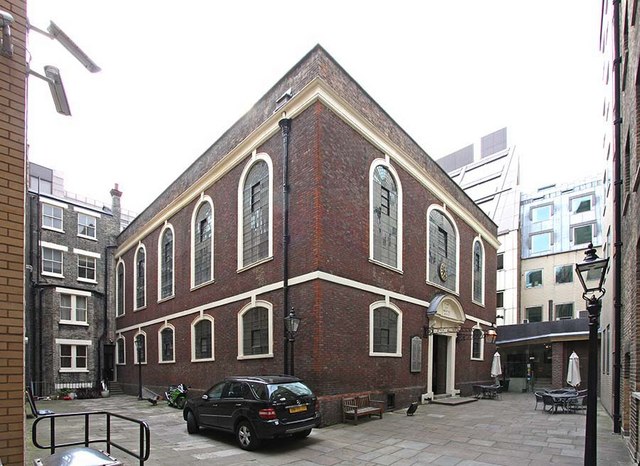
Bevis Marks Synagogue is a synagogue in the City of London. Opened in 1701 for London's Sephardi Jewish community. The free Lokali audio guide runs 7 minutes.
✓ Published October 2026 · how we write these guides
Visitor facts
| Lokali audio guide | 7 min · free |
|---|---|
| Type | Synagogue |
| Location | London, United Kingdom |
| Coordinates | 51.5145, -0.0790 |
| Official website | sephardi.org.uk |
| Languages | 50+, in the Lokali app |
The story
Step through the gateway and the noise of the City drops away. A minute ago there were taxis, sirens, the hum of glass towers. Now there is a quiet paved courtyard and a plain brick building with tall arched windows. Inside, the air is cool and smells faintly of old wood and polish. Light falls through clear glass onto dark oak benches. This is Bevis Marks Synagogue, and it has been a place of prayer since 1701.
That date matters. Bevis Marks is the oldest synagogue in the United Kingdom still in continuous use. For more than three centuries, services have been held in this room without a long break. Wars, fires, bombs and the slow rebuilding of the City around it have not stopped them. Few buildings in London of any faith can say the same. You are standing in a room that has been used for the same purpose, almost every week, since the reign of Queen Anne.
To understand why it is here, go back a little further. Jews were expelled from England in 1290. For more than three hundred years there was no open Jewish community in the country. In the 1650s, under Oliver Cromwell, Jews were again allowed to live and worship here. Most of the first families were Sephardi Jews. Sephardi means Jews whose ancestors came from Spain and Portugal. Many had fled the Inquisition and lived for a time in Amsterdam before crossing to London.
This community first prayed in a modest building in nearby Creechurch Lane. As the congregation grew, it needed something larger. The result was this synagogue. Its official name is Kahal Kadosh Sha'ar Hashamayim. That is Hebrew for Holy Congregation, Gate of Heaven. The congregation still uses the old Spanish and Portuguese traditions. Some prayers and announcements keep words of Portuguese and Spanish, carried here by families centuries ago.
Now look at the building itself. Notice how it sits back from the street, behind a gate and a courtyard. It is often said that Jews were not then permitted to build on a main public road. Whatever the exact reason, the effect is clear. The synagogue does not announce itself. Many people work for years in the offices nearby and never know it exists. That quietness is part of its character.
Here is the first surprise. The builder was not Jewish. The contract went to Joseph Avis, a Quaker. A popular story says that Avis returned his profit to the congregation, because he did not feel right earning money from building a house of God. It is a lovely tale, and it is often repeated. But treat it as tradition rather than proven fact. What is certain is that a Christian craftsman built this Jewish sanctuary, in a style many Londoners would have recognised.
That style is worth a closer look. The plain brick walls, the round-headed windows, the wooden galleries — they feel close to the City churches built after the Great Fire of 1666. Yet the plan follows a Jewish model. The design was inspired by the great Portuguese Synagogue in Amsterdam, built a generation earlier. So this room is a meeting point. It is Dutch Sephardi in its layout, and English in its materials and craftsmanship.
Lift your eyes to the ceiling. Seven large brass chandeliers hang down the length of the room. Many visitors read them as a symbol of the seven days of the week. The largest is believed to have been a gift from the Jewish community of Amsterdam. Here is the second surprise. These chandeliers still hold real candles. On special occasions, such as weddings and the most solemn evenings of the year, the candles are lit. The whole room then glows with soft, moving light.
Now look along the sides of the room. Wooden columns support the women's gallery above. There are twelve of them. They are traditionally understood to stand for the twelve tribes of Israel. At the east end stands the Ark, called the Hechal in this tradition. It holds the Torah scrolls, the handwritten scrolls of Jewish scripture. The Ark is made of carved and painted wood, with classical columns. It looks rather like the altar screen of a London church.
Facing the Ark, near the other end of the room, is the Tebah. This is the raised reading desk where the Torah is read aloud. Between the two, the floor is open. This arrangement, with the reading desk set apart from the Ark, is typical of Sephardi synagogues. The benches run along the length of the room and face the centre. Some of the woodwork is said to have come from the older synagogue in Creechurch Lane.
There is one more legend you may hear. It is said that Queen Anne gave an oak beam from a Royal Navy ship, and that it was built into the roof. No one can easily check this from the floor. Enjoy it as a story. What is well documented is the congregation's link with famous names. Moses Montefiore, the nineteenth-century philanthropist, belonged here. Isaac D'Israeli, father of the future prime minister Benjamin Disraeli, was a member before a quarrel with the synagogue.
The building has also survived real danger. In the early 1990s, two large IRA bombs exploded in the City of London, not far from here. Windows and parts of the structure were damaged. The synagogue was repaired with care, and the services continued. In recent years, the community has also campaigned against tall new towers nearby, worried that they would block the daylight that falls through these windows. Light, in this room, is not a small thing.
Before you leave, stand still for a moment near the back. Look down the long axis of the room toward the Ark. Notice the clear glass, the dark wood, the gleam of brass overhead. Outside, the City keeps moving at its usual speed. In here, the same prayers have been spoken for more than three hundred years. As you walk back through the courtyard and into the street, glance over your shoulder. The gate closes, and the synagogue goes quiet again — hidden in plain sight, exactly as it has always been.
Key facts
What to look for
Practical tips
Common questions
Is there a free audio guide to Bevis Marks Synagogue?
Yes — the Lokali app narrates Bevis Marks Synagogue free of charge in 50+ languages. The guide runs about 7 minutes, covers the history, what to look for on site and practical tips, and works offline once downloaded.
Where is Bevis Marks Synagogue?
Bevis Marks Synagogue is in London, United Kingdom, at 51.5145, -0.0790. Tap the map link on this page for directions from where you are.
What is Bevis Marks Synagogue known for?
Opened in 1701 for London's Sephardi Jewish community. Oldest UK synagogue still in continuous use.
What should you look for at Bevis Marks Synagogue?
Seven brass chandeliers still fitted with real candles. Twelve gallery columns linked to Israel's twelve tribes. Carved wooden Ark at the east end.
What should you know before visiting Bevis Marks Synagogue?
Check ahead, as visits pause during services and holidays. Dress modestly; men may be asked to cover heads.
On the map
Opens directions to Bevis Marks Synagogue from your location.
More to see in London


Hear Bevis Marks Synagogue in your language
The full story, narrated, in 50+ languages. Download it before you go and it plays offline, at your own pace, with no ticket and no tour group.