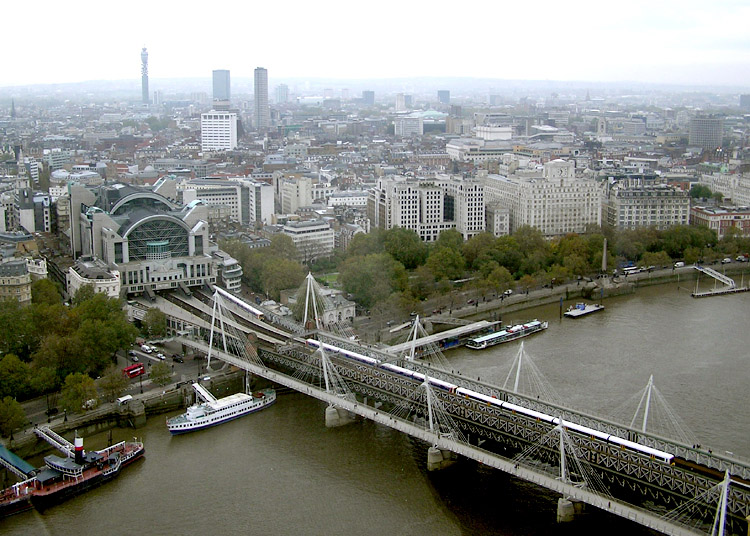
Hungerford Bridge and Golden Jubilee Bridges
51.5061° N · 0.1200° W · Bridge
Photo: No machine-readable author provided. Nichtbesserwisser assumed (based on copyright claims) · Public domain · Wikimedia Commons
Hungerford Bridge and Golden Jubilee Bridges is a railway bridge and footbridge over the Thames. It is in London, United Kingdom. Brunel's original suspension footbridge here opened in 1845. The free Lokali audio guide runs 7 minutes.
✓ Published October 2026 · how we write these guides
Visitor facts
| Lokali audio guide | 7 min · free |
|---|---|
| Type | Bridge |
| Location | London, United Kingdom |
| Coordinates | 51.5061, -0.1200 |
| Languages | 50+, in the Lokali app |
The story
Stand still for a moment and feel the deck under your feet. Every few minutes, a low rumble rolls through the steel as a train eases across the river beside you. The sound is heavy and close, almost like weather. Below, the Thames moves brown and quick, and the wind comes straight off the water. You are on one of the few places in London where you can walk, quite literally, alongside a working railway in the middle of a river.
What you are standing on is really three structures pressed together. In the centre runs Hungerford Bridge, the railway crossing that carries trains in and out of Charing Cross station. On either side, like two wings, are the Golden Jubilee Bridges, a pair of footbridges added at the start of this century. Many Londoners simply call the whole thing Hungerford Bridge. Others call the railway part Charing Cross Bridge. Both names are in common use.
The name Hungerford is older than any of the steel you can see. It comes from Hungerford Market, a market that once stood on the north bank, near where Charing Cross station is today. The market took its name from the Hungerford family, who owned land here. When a new market building was put up in the nineteenth century, its owners wanted a way to bring customers across from the south bank. A bridge was the answer.
And here is the first surprise. That first bridge was designed by Isambard Kingdom Brunel, the great Victorian engineer of railways, ships and tunnels. It opened in 1845 as a suspension footbridge, hanging from chains slung between two tall brick towers. It was a toll bridge for people on foot, not for trains. For a short time, Brunel's elegant span carried Londoners over the water to buy fish, meat and vegetables on the north side.
The footbridge did not last long. In the early 1860s, a railway company wanted to bring its line from the south directly into the West End. It bought the old market site for a new terminus, Charing Cross, and replaced Brunel's bridge with a railway bridge designed by the engineer John Hawkshaw. The station and the new bridge opened in 1864. The heavy iron girders you see beside you belong to that Victorian railway age.
But Brunel did not vanish completely. Look down at the brick piers that support the railway. Some of them are the bases of Brunel's original towers, kept and reused when Hawkshaw built the new crossing. Even better, Brunel's iron chains were taken down and sent west to Bristol. There they were used to complete the Clifton Suspension Bridge, which still crosses the Avon Gorge today. So part of this bridge now hangs over a valley more than a hundred miles away.
For much of the twentieth century, walking here was not a pleasant experience. A single narrow footpath was attached to the side of the railway bridge. It was cramped, dimly lit and noisy, and many people avoided it after dark. As the South Bank grew into a major cultural district, with concert halls, theatres and galleries, the city needed a better way to bring people across. The answer was a design competition in the 1990s.
The winning scheme came from the architects Lifschutz Davidson Sandilands, working with engineers. Their idea was to build two new footbridges, one on each side of the railway. The walkways would be held up by slender masts that lean outward, away from the trains, with thin steel cables fanning down to the deck. This kind of structure is called cable-stayed, meaning the deck hangs from straight cables running to the masts, rather than from swooping chains.
Building them was harder than it looks, and this is the second surprise. The riverbed here was bombed during the Second World War, and engineers had to plan for the risk of unexploded bombs lying in the mud below. Work also had to happen without stopping the trains, and without disturbing the London Underground tunnels that run beneath the river nearby. Every pile driven into the Thames had to be planned with great care. The bridges finally opened in 2002.
The opening year gave the bridges their name. 2002 marked fifty years since Queen Elizabeth the Second came to the throne, her Golden Jubilee. So the new walkways became the Golden Jubilee Bridges. At night, the masts and cables are lit, and from the embankments the whole structure looks light and almost weightless. Compare that with the dark, solid ironwork of the railway in the middle. In one glance you can see two very different centuries of engineering.
Now turn and use the bridges as a viewing platform, because that is what they do best. On the upstream side, facing west, you look toward Westminster. The Houses of Parliament and the clock tower of Big Ben stand along the river, with the slow wheel of the London Eye turning on the south bank. On the downstream side, facing east, Waterloo Bridge crosses the water, and beyond it the dome of Saint Paul's Cathedral rises over the City.
Painters have loved this spot too. Around the turn of the twentieth century, the French artist Claude Monet stayed at the Savoy Hotel, just downstream on the north bank. From his window he painted the railway bridge again and again, in fog, in smoke and in hazy sunlight. Those canvases are often called his Charing Cross Bridge paintings. On a misty morning, with the steam replaced by grey river air, you can still see some of what he saw.
As you walk, notice the people around you. Commuters hurry toward Embankment and Charing Cross. Concert-goers drift toward the Royal Festival Hall on the south side. Buskers sometimes set up near the stairs, and their music mixes with the sound of trains and wind. This is not a monument kept behind glass. It is a working piece of the city, crossed by thousands of people every day on their way to somewhere else.
Before you step off, pause at the rail and listen once more. Another train is probably coming, its rumble rising through the deck under your shoes. Beneath it stand bricks laid for Brunel's lost footbridge. Above you, white cables hold up a walkway barely a few decades old. And all around, the river keeps moving toward the sea. Take one last look along the water... then carry that view with you into the streets.
Key facts
What to look for
Practical tips
Common questions
Is there a free audio guide to Hungerford Bridge and Golden Jubilee Bridges?
Yes — the Lokali app narrates Hungerford Bridge and Golden Jubilee Bridges free of charge in 50+ languages. The guide runs about 7 minutes, covers the history, what to look for on site and practical tips, and works offline once downloaded.
Where is Hungerford Bridge and Golden Jubilee Bridges?
Hungerford Bridge and Golden Jubilee Bridges is in London, United Kingdom, at 51.5061, -0.1200. Tap the map link on this page for directions from where you are.
What is Hungerford Bridge and Golden Jubilee Bridges known for?
Brunel's original suspension footbridge here opened in 1845. Brunel's chains were reused on Bristol's Clifton Suspension Bridge.
What should you look for at Hungerford Bridge and Golden Jubilee Bridges?
Old brick piers below that once held Brunel's towers. White masts leaning outward, away from the railway. Thin steel cables fanning down to the walkway deck.
What should you know before visiting Hungerford Bridge and Golden Jubilee Bridges?
Walk the upstream side for views toward Parliament. Cross the downstream side for views of Saint Paul's.
On the map
Opens directions to Hungerford Bridge and Golden Jubilee Bridges from your location.
More to see in London


Hear Hungerford Bridge and Golden Jubilee Bridges in your language
The full story, narrated, in 50+ languages. Download it before you go and it plays offline, at your own pace, with no ticket and no tour group.