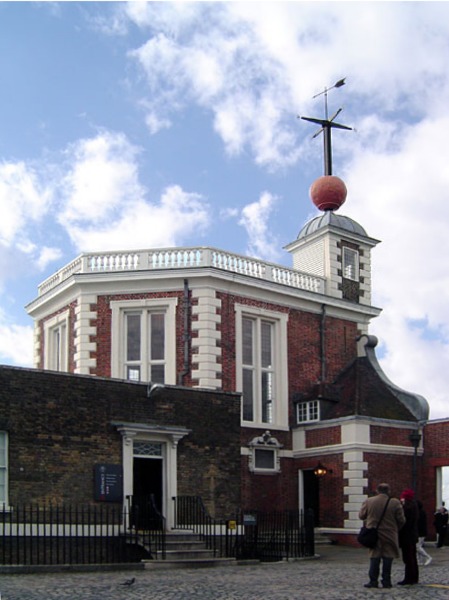
Photo: Wikimedia Commons contributor · CC BY-SA 3.0 · Wikimedia Commons
Royal Observatory is an observatory in Greenwich, London, UK. King Charles the Second founded the observatory in 1675. The free Lokali audio guide runs 7 minutes.
✓ Published October 2026 · how we write these guides
Visitor facts
| Lokali audio guide | 7 min · free |
|---|---|
| Type | Museum |
| Location | London, United Kingdom |
| Coordinates | 51.4778, -0.0014 |
| Official website | rmg.co.uk |
| Languages | 50+, in the Lokali app |
The story
Feel the slope under your feet. The path up through Greenwich Park climbs steadily, and by the top most people are a little out of breath. Then the view opens behind you. The white colonnades of the old naval buildings sit below, the river curves beyond them, and the towers of Canary Wharf rise in glass across the water. Up here, on this small green hill, people once worked out how to measure time and space for the whole planet.
The story starts with a practical problem: the sea. In the seventeenth century, sailors could find their latitude, their position north or south, from the height of the sun or the stars. But longitude, their position east or west, was guesswork. Ships ran aground. Cargo was lost. Crews died. King Charles the Second founded this observatory in 1675 with one clear purpose. He wanted astronomers to map the stars so precisely that sailors could use the sky to find their way.
Look at the red-brick building with the tall windows and the pale stone trim. This is Flamsteed House, the oldest part of the site. Christopher Wren designed it. Most people know Wren as the architect of Saint Paul's Cathedral, but he was also a trained astronomer, and that is a detail many visitors miss. Robert Hooke, a scientist of the same generation, worked with him on the project. The house is named after John Flamsteed, the first Astronomer Royal, who lived and worked here.
The building came together quickly and on a tight budget. Accounts from the time say that materials were reused from older structures, including brick and timber from elsewhere. The site itself had held a small fortified tower before the observatory replaced it. Inside, Wren placed the Octagon Room, a high, bright space with very tall windows. It was built to impress royal visitors as much as to watch the sky. Flamsteed did much of his real observing in smaller, plainer rooms nearby.
Now look up at the roof of Flamsteed House. On a mast at the top sits a large red ball. This is the time ball, and it has a quiet job that goes back to 1833. Each day, the ball rises halfway, then to the top, and then it drops at exactly one o'clock in the afternoon. Ships waiting on the Thames could watch it fall and set their clocks. It was one of the first public time signals in the world, and it still works today.
For sailors, an accurate clock mattered as much as an accurate star map. If you know the exact time at home, and you can measure the local time from the sun, the difference tells you how far east or west you have travelled. The trouble was that clocks of the period could not keep good time on a rolling ship. In 1714, the British Parliament offered a large prize to anyone who could solve the longitude problem.
The answer came from an unexpected person. John Harrison was a carpenter and self-taught clockmaker from the north of England, not a university astronomer. He spent decades building a series of marine timekeepers. The early ones are large and heavy, full of brass wheels and swinging bars. The later one is surprisingly small, about the size of a large pocket watch. Several of these machines are on display inside the observatory, and some of them still tick.
Of course, the reason most people climb this hill is a line. In 1851, the seventh Astronomer Royal, George Airy, set up a new telescope called the Transit Circle. The line through that instrument became the Prime Meridian, longitude zero. In 1884, delegates from many countries met at a conference in Washington and agreed to use Greenwich as the starting point for longitude around the world. From that decision came Greenwich Mean Time, and the system of world time zones grew from it.
In the courtyard, the meridian appears as a strip of metal set into the ground. Visitors line up to stand with one foot in the eastern hemisphere and one foot in the western. Here is the second surprise. If you check your phone's satellite navigation, it will not show zero exactly on this line. Modern satellite systems use a slightly different reference, and their zero sits roughly one hundred metres to the east. The old line is still historically correct for its own system.
By the gate, near the outer wall, there is a clock that many people walk straight past. It is the Shepherd Gate Clock, installed in the eighteen-fifties. Look closely at its face. It shows twenty-four hours, not twelve, so the hour hand goes round only once a day. This clock was one of the first to show Greenwich Mean Time to the public. Beside it, set into the wall, are official measures of length, so people could check their own rulers against a standard.
Above the site, you will see a brown, onion-shaped dome. It houses the Great Equatorial Telescope, a large refracting telescope from the late nineteenth century. It is the largest telescope of its kind in the United Kingdom. The dome itself has a curious history. It was damaged during the Second World War and later rebuilt. After the war, London's smoke and light made serious astronomy difficult here, so the working observatory moved to the Sussex countryside. Greenwich became a museum.
The hill has also seen darker moments. In 1894, a young man carrying a bomb was killed when it exploded in the park below the observatory. Historians still debate his exact target, but many believe he meant to attack the observatory itself, as a symbol of science and order. The writer Joseph Conrad later used the event as the basis for his novel The Secret Agent. Today, the site belongs to Royal Museums Greenwich, and it forms part of the Maritime Greenwich World Heritage Site.
Before you go, take a moment at the edge of the hill. Look down at the long view towards the river, and notice how the old buildings below line up with the observatory above. The time ball waits on its mast. The meridian line runs under the feet of strangers taking photographs. As you walk back down the slope, listen for the city again... and remember that the clock on your wrist still carries a small piece of this hilltop.
Key facts
What to look for
Practical tips
Common questions
Is there a free audio guide to Royal Observatory?
Yes — the Lokali app narrates Royal Observatory free of charge in 50+ languages. The guide runs about 7 minutes, covers the history, what to look for on site and practical tips, and works offline once downloaded.
Where is Royal Observatory?
Royal Observatory is in London, United Kingdom, at 51.4778, -0.0014. Tap the map link on this page for directions from where you are.
What is Royal Observatory known for?
King Charles the Second founded the observatory in 1675. Christopher Wren designed Flamsteed House, the oldest building.
What should you look for at Royal Observatory?
The red time ball on top of Flamsteed House. The metal Prime Meridian strip set into the courtyard. The twenty-four-hour face of the Shepherd Gate Clock.
What should you know before visiting Royal Observatory?
Walk up through Greenwich Park for the best approach view. Arrive early to avoid queues at the meridian line.
When is the best time to visit Royal Observatory?
Arrive early to avoid queues at the meridian line.
On the map
Opens directions to Royal Observatory from your location.
More to see in London


Hear Royal Observatory in your language
The full story, narrated, in 50+ languages. Download it before you go and it plays offline, at your own pace, with no ticket and no tour group.