
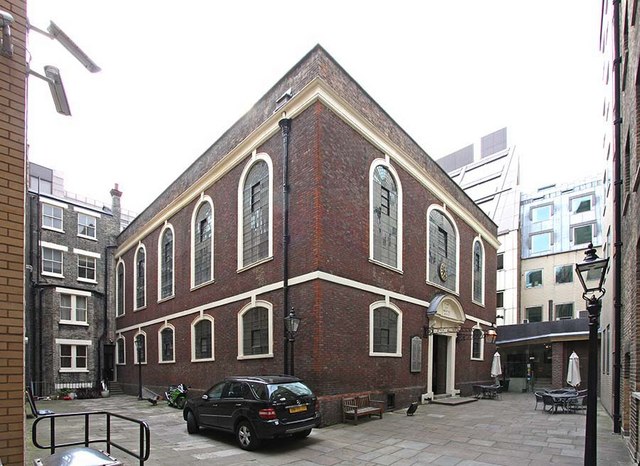
Photo: Jwslubbock · CC BY-SA 4.0 · Wikimedia Commons
The Theatre is an Elizabethan playhouse located in Shoreditch, London (1576-1598). Built in 1576 by joiner and actor James Burbage. The free Lokali audio guide runs 7 minutes.
✓ Published October 2026 · how we write these guides
Visitor facts
| Lokali audio guide | 7 min · free |
|---|---|
| Type | Theatre |
| Location | London, United Kingdom |
| Coordinates | 51.5246, -0.0800 |
| Languages | 50+, in the Lokali app |
The story
Stand still for a moment and listen. Traffic hums along Curtain Road. A delivery van idles. Footsteps tap past glass offices and old brick warehouses. It is an ordinary Shoreditch street. Yet somewhere close to where you are standing, more than four hundred years ago, a crowd of Londoners pressed into an open yard, looked up at a wooden stage, and waited for a play to begin. That building was called, simply, The Theatre. It needed no other name. Nothing in London had been built for this purpose before.
The Theatre went up in 1576. It is often described as the first purpose-built playhouse in London to last. Before it, players performed wherever they could find space — in the courtyards of inns, in great halls, in market squares. Acting was a travelling trade. Companies packed their costumes onto carts and moved from town to town. A permanent home for plays was a new and slightly risky idea. Someone had to believe that Londoners would come back, again and again, and pay to watch.
That someone was James Burbage. He had trained as a joiner, a craftsman who worked with wood, and later became an actor. So he understood both the timber and the stage. He built The Theatre with financial help from his brother-in-law, John Brayne. Their partnership was not a happy one. The two men later quarrelled over money, and the dispute ended up in the courts. It is a reminder that this first playhouse was a business venture as much as an artistic one.
Why here, and not in the heart of the old city? The answer is location and law. This land lay just outside the City of London, on ground that had once belonged to Holywell Priory, a religious house closed in the sixteenth century. Out here, the City authorities had less control. Many of them distrusted plays. They worried about crowds, disease, idle apprentices and disorder. By building beyond their reach, Burbage gave his stage room to breathe.
Picture the building itself. Archaeology suggests it was polygonal — many-sided, so it looked almost round from a distance. Timber galleries rose in tiers around an open yard. People who paid the least stood in that yard, close to the stage, under the open sky. Those who paid more sat in the galleries above. This layout would shape English playhouses for decades. If you have seen the reconstructed Globe on the South Bank, you already have a rough picture of its ancestor.
Here is the first surprise. In 2008, archaeologists from the Museum of London excavated a site just around here, near New Inn Broadway. They found the remains of The Theatre's foundations. The curve of its walls appeared in the soil. They also found traces of the yard surface, and objects from everyday life, such as fragments of pottery. For centuries the playhouse had been known only from documents. Suddenly, its real outline lay under the city, waiting beneath later buildings.
Now to the name that brings most visitors here. William Shakespeare worked with the acting company based at The Theatre in the 1590s. That company was the Lord Chamberlain's Men, and James Burbage's son Richard was its leading actor. Scholars agree that several of Shakespeare's early plays were performed on this stage. Exactly which ones had their very first performance here is harder to prove. So it is wise to say this simply: some of the most famous lines in English were spoken aloud on this ground.
The Theatre also had neighbours. A second playhouse, called the Curtain, opened nearby soon afterwards. Its remains were found by archaeologists too, not far from where you stand. Together they turned this edge of London into an early entertainment district. Imagine the noise on a performance afternoon. Crowds walked out from the city gates. Sellers offered food and drink. Trumpets or flags announced a play. This quiet corner was, for a time, the loudest place to spend an afternoon.
Then comes the second surprise — the strangest night in this building's life. The land under The Theatre was leased, not owned. The lease ran out, and the landlord, Giles Allen, refused reasonable terms. The Burbage family believed the timber building itself belonged to them. So, around the end of December 1598, Richard and his brother Cuthbert arrived with a master carpenter, Peter Street, and a team of workmen. They began to take The Theatre apart.
Piece by piece, the frame came down. The timber was carried away and, in time, taken south across the River Thames to Bankside. There, in 1599, it helped build a new playhouse. That playhouse was the Globe. So the beams that once stood here became part of the stage where Shakespeare's company performed many of its greatest works. The landlord was furious. He took the matter to court. But the building had already walked away, so to speak, in pieces.
After that, this site slowly faded from memory. Houses, workshops and, later, warehouses covered the ground. Shoreditch became a district of furniture makers and small industry. In more recent decades, it changed again into a place of studios, offices, bars and galleries. The street pattern around you has shifted many times. That is why the 2008 discovery mattered so much. It fixed a lost building to a real place on the map once more.
As you look around, notice how layered this neighbourhood is. Victorian brick sits beside steel and glass. Old loading doors now open into cafés. Street art covers walls that once held industrial signs. Commemorative plaques in the area mark the history of the playhouses. None of the original timber stands here now. What remains is the ground itself, and the idea that began on it — that a city could have a permanent home for stories performed live.
Before you move on, take one last look at the street. Watch the people walking past, many of them heading somewhere to be entertained tonight, to a bar, a gig, a show. In a sense, they continue a habit that began here in 1576. Crowds gathered just outside the old city walls to laugh, to gasp, to listen. As you walk away along Curtain Road, listen to the voices around you... and imagine, for a second, a trumpet sounding for the afternoon play.
Key facts
What to look for
Practical tips
Common questions
Is there a free audio guide to The Theatre?
Yes — the Lokali app narrates The Theatre free of charge in 50+ languages. The guide runs about 7 minutes, covers the history, what to look for on site and practical tips, and works offline once downloaded.
Where is The Theatre?
The Theatre is in London, United Kingdom, at 51.5246, -0.0800. Tap the map link on this page for directions from where you are.
What is The Theatre known for?
Built in 1576 by joiner and actor James Burbage. Stood on former Holywell Priory land outside the City.
What should you look for at The Theatre?
Commemorative plaques on buildings along Curtain Road. The narrow lane named New Inn Broadway near the excavation. Victorian brick warehouses beside modern glass offices.
What should you know before visiting The Theatre?
Pair this stop with the nearby Curtain playhouse site. Visit the reconstructed Globe on Bankside to complete the story.
When is the best time to visit The Theatre?
Come on a quiet weekday morning for calmer streets.
On the map
Opens directions to The Theatre from your location.
More to see in London


Hear The Theatre in your language
The full story, narrated, in 50+ languages. Download it before you go and it plays offline, at your own pace, with no ticket and no tour group.