Victoria and Albert Museum
51.4959° N · 0.1729° W · Museum
Victoria and Albert Museum is a museum in London, United Kingdom. 4.5 million objects spanning decorative arts, fashion, photography, and design. Most visitors spend 2–4 hours here. The free Lokali audio guide runs 5 minutes.
✓ Verified August 2026 · how we write these guides
Visitor facts
| Time needed | 2–4 hours |
|---|---|
| Lokali audio guide | 5 min · free |
| Type | Museum |
| Best for | Editors' pick |
| Location | London, United Kingdom |
| Coordinates | 51.4959, -0.1729 |
| Languages | 45, in the Lokali app |
The story
In the museum district of South Kensington, behind an ornate facade, lies a treasure house of human making — not paintings or fossils, but the things people have designed and crafted to use, wear, and admire. This is the Victoria and Albert Museum, the world's largest museum of decorative arts and design, and, like its neighbours, free to enter.
The museum grew out of optimism. It was founded in the years after the Great Exhibition of 1851, a celebration of design and industry, and named after Queen Victoria and her husband Albert, who championed it. Its founding purpose was practical: to gather the best of design and craft to inspire and educate makers and the public alike.
The range is enormous. Sculpture, furniture, fashion, textiles, ceramics, glass, jewellery, ironwork, photographs, and objects from across Asia and the Islamic world fill room after room. Where other museums sort by painting or period, this one is organised around the made object in all its forms, from a humble teapot to a royal gown.
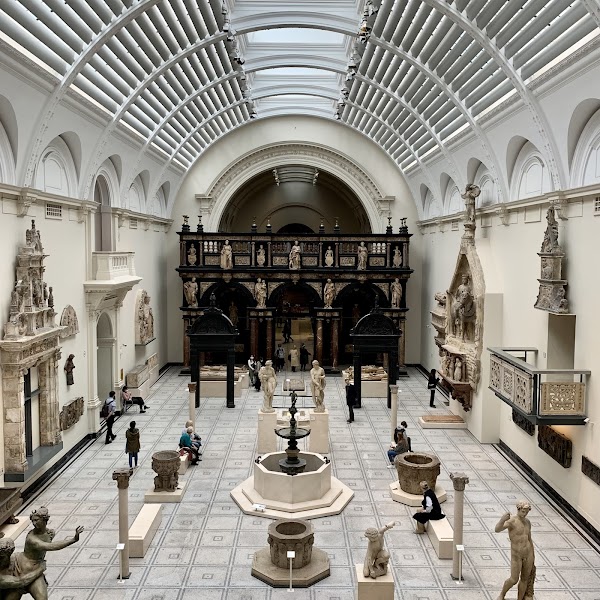
Among the most astonishing rooms are the Cast Courts, vast halls filled with full-size plaster copies of famous sculptures and monuments. Here a towering Roman column and a copy of a Renaissance giant stand together, made in the nineteenth century so that students who could never travel could still study the great works of Europe.
The fashion and jewellery galleries are perennial favourites. Centuries of clothing, from court dress to modern design, trace how people have presented themselves, while the jewellery gallery glitters with pieces spanning the ancient world to the present. Both show design as something worn close to the body, not just hung on a wall.
Some of the most striking objects came through the age of empire, including a famous mechanical tiger made for an Indian ruler. As with other great London collections, the presence of such things raises questions about how they were acquired, questions the museum increasingly addresses alongside the objects rather than leaving unspoken.
The building is an exhibit in its own right. Ornate Victorian halls, a domed entrance, decorated refreshment rooms among the first of their kind in any museum, and a peaceful central garden courtyard all reward attention. It is easy to spend time simply admiring the rooms that hold the collection.
That central garden, open in fine weather, is one of the calmest spots in the area, with a cafe in grand decorated rooms close by. Many visitors treat the courtyard as a place to pause and rest between galleries, children paddling at the shallow pool while the adults catch their breath.
Like the other great collections, this museum is too large to see whole. It works best if you choose a few areas that interest you — fashion, perhaps, or the Cast Courts, or the Asian galleries — and accept that you will leave much unseen for another visit. Free maps mark the main highlights.
A few notes. Entry to the permanent galleries is free, with ticketed special exhibitions that are often among the best in the city. The museum opens late on certain evenings, sometimes with events and music, which is a fine time to come. It connects directly to the Underground through a tunnel from the station.
It sits in a cluster of great museums built in the same spirit, with the natural history and science museums as near neighbours, so families and the curious can spend a whole day moving among them. The grand streets and gardens of South Kensington tie the area together.
The museum takes design right up to the present day. Alongside ancient ceramics and historic dress you will find modern product design, contemporary fashion, and digital work, so the collection argues that the chair you sit in and the phone in your pocket belong to the same long story as a medieval tapestry.
It is also one of the city's best museums for simply lingering. The grand rooms, the courtyard, and the decorated cafe invite you to slow down, and many visitors come as much to sit and soak up the surroundings as to study any single object on display.
Before you leave, sit in the garden courtyard or under a great hall ceiling and think about what the place is for. It was built to show that everyday things — cloth, clay, metal, glass — can be made with beauty and care, and that idea still runs through every room. You leave looking a little harder at the design of ordinary objects.
Key facts
What to look for
Practical tips
Common questions
How long do you need at Victoria and Albert Museum?
Plan 2–4 hours. That is the time most visitors spend at Victoria and Albert Museum. The free Lokali audio guide adds about 5 minutes of narration you can listen to as you walk, so it fits inside your visit rather than adding to it.
Is there a free audio guide to Victoria and Albert Museum?
Yes — the Lokali app narrates Victoria and Albert Museum free of charge in 50+ languages. It covers the history, what to look for on site and practical tips, and it works offline once downloaded.
Where is Victoria and Albert Museum?
Victoria and Albert Museum is in London, United Kingdom, at 51.4959, -0.1729 Tap the map link on this page for directions from where you are.
What should you know before visiting Victoria and Albert Museum?
Choose a few galleries rather than everything.
What is Victoria and Albert Museum known for?
The world's largest museum of decorative arts and design.
What is the best time to visit Victoria and Albert Museum?
The museum's layout can overwhelm—pick a wing (ceramics, fashion, or sculpture).
On the map
Opens directions to Victoria and Albert Museum from your location.
More to see in London



Hear Victoria and Albert Museum in your language
The full story, narrated, in 50+ languages. Download it before you go and it plays offline, at your own pace, with no ticket and no tour group.