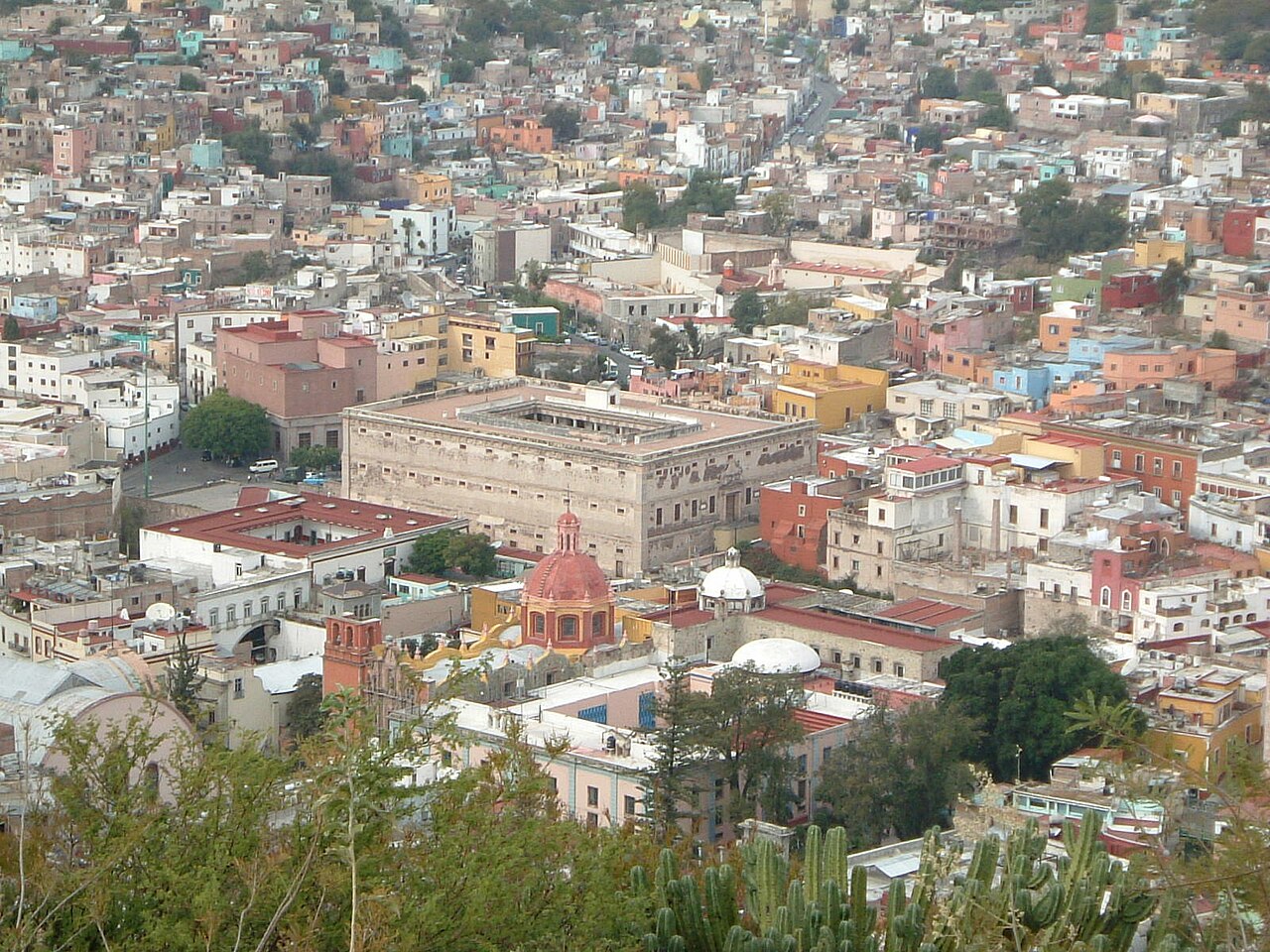
Alhóndiga de Granaditas
21.0187° N · 101.2604° W · Museum
Alhóndiga de Granaditas is a massive 18th-century grain warehouse turned fortress and now a regional history museum. It is in Guanajuato City, Mexico. Most visitors spend 1–2 hours here. The free Lokali audio guide runs 5 minutes.
✓ Verified August 2026 · how we write these guides
Visitor facts
| Time needed | 1–2 hours |
|---|---|
| Lokali audio guide | 5 min · free |
| Type | Museum |
| Best for | History |
| Location | Guanajuato City, Mexico |
| Coordinates | 21.0187, -101.2604 |
| Languages | 45, in the Lokali app |
The story
Stand before the heavy stone walls. They are tall, plain, and strong, more like a fort than a market. Run your eyes along the rows of windows and the great wooden doors. This building has seen one of the most violent days in Mexican history. Few buildings carry a heavier past. This is the Alhóndiga de Granaditas.
It was not built for war. It was built to store grain. Work finished in 1809, just before the trouble began. The name means, roughly, the public granary. Farmers and traders brought corn and seed here. The thick walls kept the grain cool and safe, and kept prices steady in hard years. In a hungry season, such a store could save many lives.
But the building is strong, and strong buildings can become forts. In 1810, Mexico rose up against Spanish rule. A priest named Miguel Hidalgo led a growing army of poor farmers and miners. They marched toward Guanajuato, then one of the richest mining cities in the world. Silver from its mines had flowed across the sea to Spain for centuries. Many who worked those mines had little to show for it.
The Spanish officials and loyal families were afraid. They gathered inside the Alhóndiga with their soldiers, their money, and their weapons. They closed the great doors and waited behind the thick walls. From the windows above, their guns could fire down on anyone who came near. They expected the walls to hold.
On the twenty-eighth of September, 1810, the insurgents attacked. The fighting was fierce. The defenders fired down from the high windows, and many attackers fell in the street. The army could not get through the heavy wooden doors. The narrow streets around the building rang with the noise of battle. The walls that kept grain safe now kept the rebels out.
Then comes the most famous part of the story. It is told that a young miner, known by the nickname El Pípila, found a way through. He tied a flat stone slab to his back as a shield. He crawled forward under the gunfire, carrying tar and a torch. The other fighters watched and waited. His name is still remembered in the city today.
El Pípila reached the great wooden doors. With the stone protecting his back from the bullets above, he smeared the tar and set the doors on fire. The wood burned through. The way was open. The insurgents poured inside, and the defenders were overcome. The city fell to the uprising that day. It was a turning point in the early war.
The victory did not last. Within months, Spanish forces struck back hard. The early leaders of the uprising were caught and executed in 1811. Hidalgo himself was among those put to death. Their war for freedom would go on for ten more years before Mexico became an independent country at last.
What happened next at this building was meant as a warning. The heads of four leaders, Hidalgo, Allende, Aldama, and Jiménez, were placed in iron cages. The cages were hung on the four outer corners of the Alhóndiga. They stayed there for about ten years, until independence came in 1821. It was a cruel and public punishment.
Look up at the corners of the building as you walk around it. You can still see where the cages once hung. For the people of Guanajuato, those grim cages became a different kind of symbol. They did not frighten the city into silence. Instead they kept the memory of the fight alive. A separate monument to El Pípila now looks down on the city from the hill above.
After independence, the building served other roles. For a time it was even used as a prison. Later the state turned it into a museum, to protect and explain its long story. Generations of students have come here to learn what happened. Today it stands as one of the most important historic sites in the region.
Inside, you can see art, history, and objects from the region's long past. Large painted murals climb the walls of the stairwells. They show scenes from the war and the people who fought it. Climb the stairs slowly and look at each one. The rooms that once held grain, and then held a battle, now hold the story of the state and its people.
Stand back once more and take in the whole building. It was made to store corn. It became a fortress, then a battlefield, then a place of grim warning, and finally a house of memory. Few walls have held so many different lives. Stand quietly here, and let the weight of that settle.
Key facts
What to look for
Practical tips
Common questions
How long do you need at Alhóndiga de Granaditas?
Plan 1–2 hours. That is the time most visitors spend at Alhóndiga de Granaditas. The free Lokali audio guide adds about 5 minutes of narration you can listen to as you walk, so it fits inside your visit rather than adding to it.
Is there a free audio guide to Alhóndiga de Granaditas?
Yes — the Lokali app narrates Alhóndiga de Granaditas free of charge in 50+ languages. It covers the history, what to look for on site and practical tips, and it works offline once downloaded.
Where is Alhóndiga de Granaditas?
Alhóndiga de Granaditas is in Guanajuato City, Mexico, at 21.0187, -101.2604. Tap the map link on this page for directions from where you are.
What should you know before visiting Alhóndiga de Granaditas?
Walk around the outside to see all four corners.
What is Alhóndiga de Granaditas known for?
The granary was completed in 1809.
What is the best time to visit Alhóndiga de Granaditas?
The rooftop offers an eagle-eye view of Guanajuato's chaotic street layout.
On the map
Opens directions to Alhóndiga de Granaditas from your location.
More to see in Guanajuato City


Hear Alhóndiga de Granaditas in your language
The full story, narrated, in 50+ languages. Download it before you go and it plays offline, at your own pace, with no ticket and no tour group.