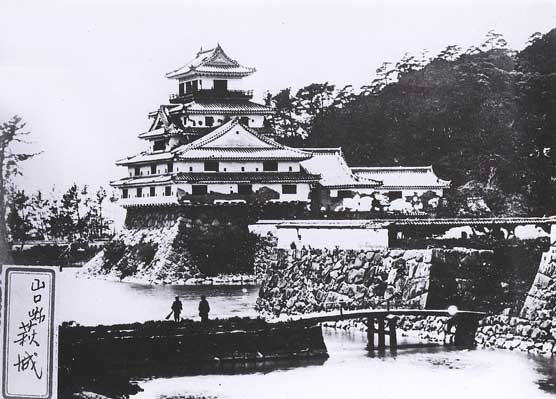
Photo: Unknown authorUnknown author · Public domain · Wikimedia Commons
Hagi Castle is a Japanese castle in Hagi, Yamaguchi prefecture. Construction began in 1604 under Mori Terumoto. The free Lokali audio guide runs 7 minutes.
✓ Published October 2026 · how we write these guides
Visitor facts
| Lokali audio guide | 7 min · free |
|---|---|
| Type | Castle |
| Location | Hagi, Japan |
| Coordinates | 34.4176, 131.3825 |
| Official website | hagishi.com |
| Languages | 50+, in the Lokali app |
The story
Listen first. Water laps softly against old stone, and somewhere above you the wind moves through pine branches. Under your feet, gravel crunches in a slow rhythm. In front of you, a broad moat holds the reflection of grey granite walls. Behind them, a green hill rises straight from the edge of the sea. There is no tower here now... and yet the shape of a castle is still everywhere around you.
This is Hagi Castle, also called Shizuki Castle, after the hill that stands behind it. It was built at the start of the seventeenth century, on the coast of the Sea of Japan, in what is now Yamaguchi Prefecture. For more than two and a half centuries, it was the seat of the Mori family, the lords of the Choshu domain. Today the grounds form Shizuki Park, a quiet place of stone, water and trees.
The story of this castle begins with a defeat. In 1600, the Battle of Sekigahara decided who would rule Japan. The Mori clan stood on the losing side. The victor, Tokugawa Ieyasu, became the founder of a new military government, the shogunate. He did not destroy the Mori, but he cut their lands sharply. Mori Terumoto, the head of the family, lost much of his territory and had to build a new home far from the centre of power.
He chose this spot, and construction began in 1604. Locals still tell a popular story about that choice. According to the tale, the Mori wanted a more central site, but the shogunate pushed them toward this remote coast, to keep them isolated. Historians debate how true that is. What is certain is the geography. The castle sits at the tip of a river delta, with the sea on one side and the hill on the other. It is a natural defensive position.
Look at the walls in front of you. These stone ramparts are the strongest link to the original castle. Notice how they slope outward at the base and then curve upward. Japanese castle builders shaped walls this way for strength and stability, especially in a country of frequent earthquakes. The large stones fit together without mortar. Their weight and careful placement hold them in place. Some of these blocks have stood here for about four hundred years.
Above the walls, imagine a five-storey keep with white plaster walls and layered tiled roofs. That tower really existed. In fact, photographs of it survive from the years before it was taken down. This is one of the surprises of Hagi. You can stand on the stone base where the keep once rose, then compare the view with an image of the building itself. Very few lost castles in Japan left such a clear record.
So why is the tower gone? The answer links this quiet park to one of the great turning points in Japanese history. In the nineteenth century, Choshu became a centre of opposition to the shogunate. Young samurai from this town helped lead the movement that ended shogun rule and restored power to the emperor. That change, in 1868, is known as the Meiji Restoration. It opened the way to the rapid modernisation of Japan.
There is an old legend about this rivalry. Locals say that every New Year, the senior retainers of Choshu would ask their lord a quiet question: is this the year to strike against the Tokugawa? And every year, the answer was that the time had not yet come. It is a tale, not a documented ritual. But it shows how long the memory of Sekigahara lived in this town... more than two hundred and fifty years.
After the Restoration, the new government had no need for feudal castles. Across Japan, many were dismantled. Here in Hagi, the keep and most buildings came down in 1874. The Mori family moved on to a new role in modern Japan. What remained were the stones, the moat and the hill. Over time, the site became a public park, and trees grew where soldiers once stood guard.
Now turn toward the hill. This is Mount Shizuki. Its summit once held a small inner fortress, a last line of defence if the lower castle fell. A path still climbs through the forest toward the top. It is steep in places, and the air under the trees feels cooler and damp. From higher ground, you can see the coastline and the blue water of the Sea of Japan. It helps you understand why the Mori built here.
Inside the grounds, you will also find later additions that keep the place alive. Shizuki Shrine honours the Mori lords, and its gate and roofs give you a sense of traditional architecture close at hand. Near it, a traditional tea house sits among the trees, with a small garden around it. These buildings are not part of the original castle. But they carry forward the quiet atmosphere that a lord's residence would once have had.
In spring, the park changes. Cherry trees bloom along the moat and around the old walls, and pale petals fall onto the water. Many local families come to walk here in that season. In other months, the park is calmer, and you may share the paths only with a few walkers and the sound of birds. Each season gives the stone a different frame.
The castle is only the anchor of a larger story. Beyond the park lies the old castle town, with its earthen walls, narrow lanes and samurai houses. In 2015, parts of Hagi became part of a UNESCO World Heritage listing linked to the industrial revolution of the Meiji era. The castle town is one of those parts. So when you leave the moat, you are walking into the same streets that shaped the men who changed Japan.
Before you go, stand still for a moment beside the water. Look at the curve of the stone wall, the dark green of the pines, and the hill rising behind it. No tower stands here now. Still, the outline of power, defeat and patience is all around you. As you walk back toward the town, listen for the sea... it has been the constant neighbour of this castle from the very first stone.
Key facts
What to look for
Practical tips
Common questions
Is there a free audio guide to Hagi Castle?
Yes — the Lokali app narrates Hagi Castle free of charge in 50+ languages. The guide runs about 7 minutes, covers the history, what to look for on site and practical tips, and works offline once downloaded.
Where is Hagi Castle?
Hagi Castle is in Hagi, Japan, at 34.4176, 131.3825. Tap the map link on this page for directions from where you are.
What is Hagi Castle known for?
Construction began in 1604 under Mori Terumoto. Built after the Mori lost lands at Sekigahara.
What should you look for at Hagi Castle?
Outward-sloping curve of the dry-stone castle walls. Stone base where the five-storey keep once stood. Reflections of granite walls in the wide moat.
What should you know before visiting Hagi Castle?
Wear sturdy shoes for the steep Mount Shizuki path. Visit in spring for cherry blossoms along the moat.
When is the best time to visit Hagi Castle?
Visit in spring for cherry blossoms along the moat.
On the map
Opens directions to Hagi Castle from your location.
More to see near Hagi Castle

Hear Hagi Castle in your language
The full story, narrated, in 50+ languages. Download it before you go and it plays offline, at your own pace, with no ticket and no tour group.