
Sites of Japan's Meiji Industrial Revolution: Iron and Steel, Shipbuilding and Coal Mining
34.4306° N · 131.4122° E · Memorial
Photo: TT mk2 · CC BY-SA 3.0 · Wikimedia Commons
Sites of Japan's Meiji Industrial Revolution: Iron and Steel, Shipbuilding and Coal Mining is a World Heritage Site in Japan. Inscribed as a UNESCO World Heritage Site in 2015. The free Lokali audio guide runs 6 minutes.
✓ Published October 2026 · how we write these guides
Visitor facts
| Lokali audio guide | 6 min · free |
|---|---|
| Type | Memorial |
| Location | Hagi, Japan |
| Coordinates | 34.4306, 131.4122 |
| Official website | japansmeijiindustrialrevolution.com |
| Languages | 50+, in the Lokali app |
The story
Listen for a moment. In Hagi, the loudest sounds are often small ones. A bicycle bell on a narrow lane. Wind moving through pine trees near the sea. The crunch of gravel underfoot. It is hard to imagine this quiet town as a starting point for industry. Yet that is exactly why you are here.
This World Heritage listing has a long name, and it covers a lot of ground. It was inscribed in 2015 and links many sites across Kyushu and western Honshu. Together they tell one story. In roughly half a century, Japan moved from feudal workshops to modern shipyards, steelworks and coal mines. Hagi holds the earliest chapter of that story.
Why Hagi? In the mid-nineteenth century, this was the castle town of the Choshu domain, one of the most powerful regions in Japan. Western warships were appearing off the coast. The country had been largely closed to the outside world for more than two centuries. Leaders in Choshu understood a hard truth. If Japan could not cast its own cannon and build its own ships, it would not stay independent for long.
Hagi contributes five pieces to this heritage listing. There is a reverberatory furnace, a shipyard site, a traditional iron works in the hills, the old castle town itself, and a tiny private school. Each one is modest on its own. Seen together, they show a society at the exact moment it began to experiment. This is industry before machines arrived — industry as an idea, tested with local hands.
Start with the reverberatory furnace. What survives today is a tall, narrow chimney of stone and brick, standing alone near the coast. A reverberatory furnace reflects heat off a curved roof to melt metal, and the goal here was iron for cannon. Officials from Choshu studied a working furnace in another domain and made sketches. This structure grew from those drawings. Most accounts suggest it was an experimental furnace, and it may never have run at full production.
That detail surprises many visitors. A World Heritage site that perhaps never worked properly? But that is the point. This chimney records a trial, not a triumph. It shows people trying to copy Western technology from books and notes, with no foreign engineers on hand. Look at the joins in the masonry. Some of the material is local stone, worked in a way that Japanese builders already knew well.
A short distance away is the Ebisugahana Shipyard site. Here, in the 1850s, the domain built its first Western-style sailing ships. The knowledge came by an unusual route. Shortly before, a Russian ship had been wrecked on the Japanese coast, and Japanese carpenters helped the crew build a replacement vessel. Some of that hard-won knowledge travelled to Hagi. Today, the visible remains are low and quiet — mainly a stone breakwater at the water's edge.
Stand by that stone line and look out at the sea. The scale is small. These were wooden ships, built by carpenters who had trained on traditional Japanese boats. Yet the leap in thinking was enormous. Within a few decades, Japanese yards elsewhere on this heritage list would build steel ships. Hagi is where the habit of trying began.
The third site lies in the hills outside town. Ohitayama was a tatara iron works. Tatara is the traditional Japanese method of making iron in a clay furnace, using iron sand and charcoal, over long days and nights of work. Iron from sites like this supplied nails and fittings for the shipyard. So the story here is a blend. Old Japanese craft fed the new Western-style projects. The two did not replace each other at first. They worked side by side.
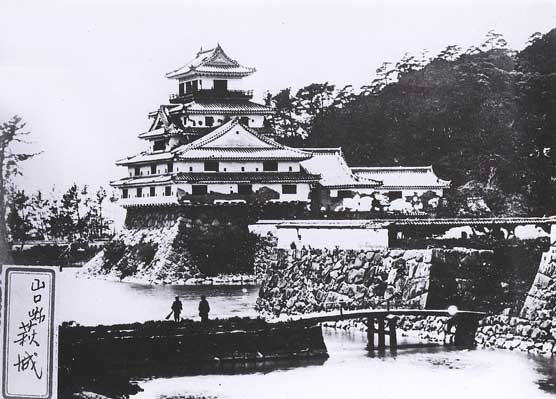
Now turn to the castle town. Hagi's old streets still follow the grid laid out for samurai families, merchants and townspeople. Earthen walls, white plaster and dark wooden gates line the lanes. The castle itself is gone, though its stone foundations remain by the sea. Why is a townscape part of an industrial listing? Because it shows the feudal world that came first — the social order that industrialisation would soon overturn.
The last site is the smallest, and perhaps the most powerful. Shokasonjuku Academy is a simple wooden building with only a few rooms. Here, the scholar Yoshida Shoin taught young men for a short period in the 1850s. Shoin had once tried to board an American warship to travel abroad and learn. He was caught and confined. He was executed in 1859, still a young man. But several of his students went on to lead Japan's transformation, including Ito Hirobumi, who later became the country's first prime minister.
Think about that for a moment. The chimney, the shipyard and the iron works are about technology. The academy is about people. It suggests that the Meiji industrial story did not begin with steam engines. It began with a teacher in a small room, telling students to look outward and ask difficult questions. Many visitors walk past this building in a few minutes. It deserves a slower look.
As you move between these sites, notice how ordinary the surroundings feel. Rice fields, quiet houses, the smell of salt from the sea. Nothing here roars or smokes. The great factories came later, far from Hagi. This town kept only the first sketches. So take one more look at whatever stands in front of you now — stone, timber or water — and remember that every large change starts as a small attempt, in a place much like this one.
Key facts
What to look for
Practical tips
Common questions
Is there a free audio guide to Sites of Japan's Meiji Industrial Revolution: Iron and Steel, Shipbuilding and Coal Mining?
Yes — the Lokali app narrates Sites of Japan's Meiji Industrial Revolution: Iron and Steel, Shipbuilding and Coal Mining free of charge in 50+ languages. The guide runs about 6 minutes, covers the history, what to look for on site and practical tips, and works offline once downloaded.
Where is Sites of Japan's Meiji Industrial Revolution: Iron and Steel, Shipbuilding and Coal Mining?
Sites of Japan's Meiji Industrial Revolution: Iron and Steel, Shipbuilding and Coal Mining is near Hagi, Japan, at 34.4306, 131.4122. Tap the map link on this page for directions from where you are.
What is Sites of Japan's Meiji Industrial Revolution: Iron and Steel, Shipbuilding and Coal Mining known for?
Inscribed as a UNESCO World Heritage Site in 2015. Hagi contributes five components to the serial listing.
What should you look for at Sites of Japan's Meiji Industrial Revolution: Iron and Steel, Shipbuilding and Coal Mining?
The lone stone-and-brick chimney of the reverberatory furnace. The low stone breakwater at Ebisugahana's water edge. White plaster walls and dark gates in the samurai lanes.
What should you know before visiting Sites of Japan's Meiji Industrial Revolution: Iron and Steel, Shipbuilding and Coal Mining?
Rent a bicycle to link the scattered town sites. Plan extra travel time for the Ohitayama hill site.
When is the best time to visit Sites of Japan's Meiji Industrial Revolution: Iron and Steel, Shipbuilding and Coal Mining?
Visit Shokasonjuku early to see it without crowds.
On the map
Opens directions to Sites of Japan's Meiji Industrial Revolution: Iron and Steel, Shipbuilding and Coal Mining from your location.
More to see near Sites of Japan's Meiji Industrial Revolution: Iron and Steel, Shipbuilding and Coal Mining
Hear Sites of Japan's Meiji Industrial Revolution: Iron and Steel, Shipbuilding and Coal Mining in your language
The full story, narrated, in 50+ languages. Download it before you go and it plays offline, at your own pace, with no ticket and no tour group.