
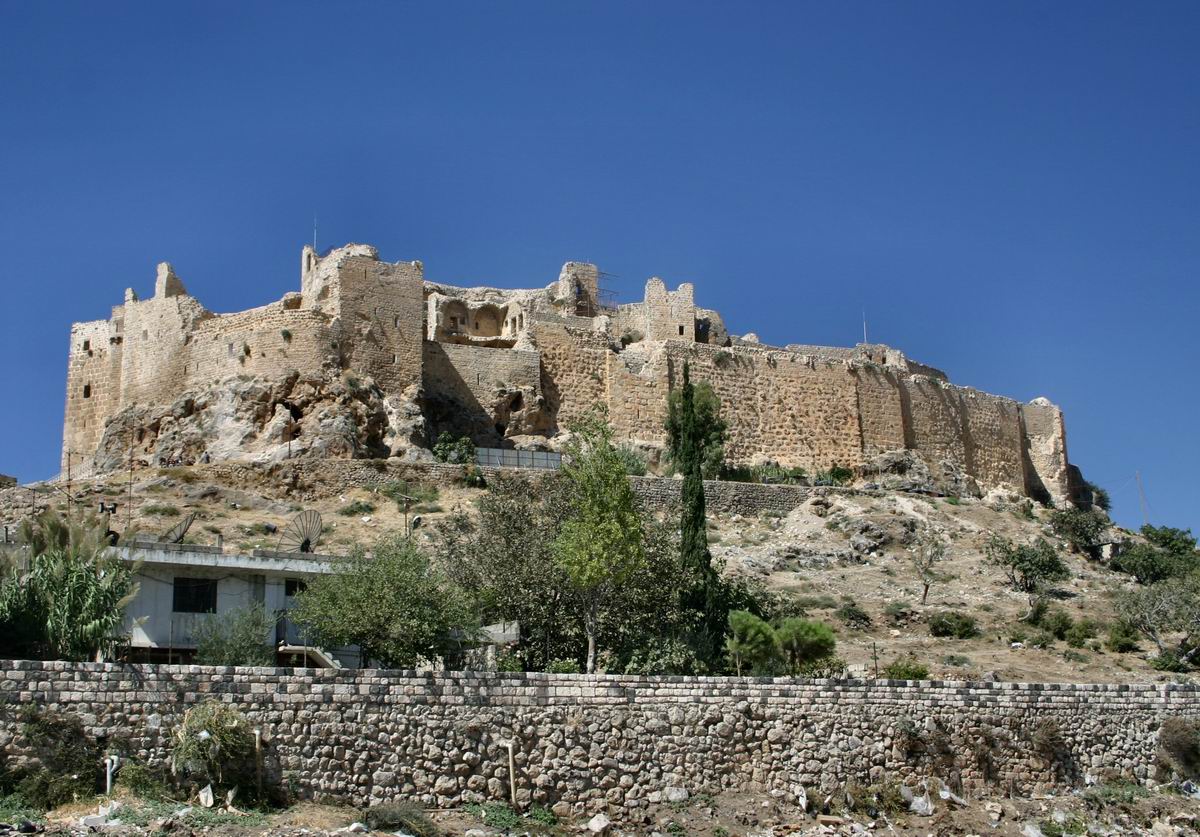
Photo: Bernard Gagnon · CC BY-SA 3.0 · Wikimedia Commons
Apamea is an ancient city in Al-Suqaylabiyah, Syria. Founded around 300 BCE by Seleucus the First. The free Lokali audio guide runs 7 minutes.
✓ Published October 2026 · how we write these guides
Visitor facts
| Lokali audio guide | 7 min · free |
|---|---|
| Type | Archaeological Site |
| Location | Hama, Syria |
| Coordinates | 35.4167, 36.4000 |
| Languages | 50+, in the Lokali app |
The story
Listen first. Wind moves across a wide, open plateau, and somewhere a dog barks from a village below. Under your feet, the paving stones are worn smooth and slightly uneven. Ahead of you, a line of grey columns runs straight toward the horizon. Some stand alone. Some still carry their heavy stone beams. The light here is wide and honest, and on a clear day the columns throw long shadows across the old road.
You are standing in Apamea, one of the great cities of the ancient Near East. It sits above the Orontes River valley in western Syria, looking down over the flat green farmland of the Ghab plain. Today the site feels quiet, almost empty. But for many centuries this was a crowded city of merchants, soldiers, philosophers and priests. The columns in front of you are what remains of its main street.
The story begins around 300 BCE, in the years after Alexander the Great died. His generals divided his empire among themselves. One of them, Seleucus the First, took much of the East and built a ring of new Greek-style cities in northern Syria. He named this one after his wife, Apama. She was not Greek. She was a noblewoman from Bactria, in the region of modern Afghanistan and Central Asia. That one name already tells you this was a meeting place of cultures.
Here is a detail many visitors miss. Apamea was not only a city. It was a military base. Ancient writers describe the Seleucid kings keeping their war elephants here, brought from India, together with large herds of cavalry horses. The rich pastures of the valley below could feed them. So imagine this plateau with the sounds and smells of elephants. It is hard to picture now, standing among the quiet stones, but it was real.
In the first century BCE, Rome arrived. The Roman general Pompey brought Syria under Roman control, and Apamea became a Roman city. It grew wealthy and large. Then, in the early second century, a powerful earthquake struck the region and badly damaged the city. Much of what you see now comes from the rebuilding after that disaster. The street you are walking along is largely a Roman creation, built on top of the older Greek plan.
That street is called the cardo, the main north-south avenue of a Roman city. At Apamea it runs for close to two kilometres. That makes it one of the longest colonnaded streets known from the Roman world. Walk a little way along it and the scale becomes clear. The columns once lined both sides, with covered walkways behind them and shops opening onto the pavement. People shaded themselves here from the summer sun.
Now look closely at the columns themselves. They are not all the same. Some are plain. Some have straight vertical grooves, called fluting. And some have fluting that twists around the shaft in a spiral, like a rope. These twisted columns are unusual, and they give this part of the street a sense of movement. Notice also the small stone brackets sticking out from some shafts. They once held statues of important citizens.
Much of this colonnade was lying on the ground in pieces when modern archaeologists arrived. A Belgian team began excavating here in the 1930s and worked at Apamea for decades. They carefully raised many fallen columns back into position. So what you see is part survival, part patient reconstruction. Look at the stone surfaces. You can sometimes see where old pieces meet newer repairs, and where cracks run through the original blocks.
Apamea was also a city of ideas. The Stoic philosopher Posidonius was born here, and he became one of the most respected thinkers of his age. Later, Apamea became known for Platonist philosophy. The thinker Numenius came from this city, and in late antiquity a circle of philosophers gathered here. When you walk this street, you walk where people argued about the soul, the stars and the nature of the gods.
In the Christian centuries, Apamea became an important bishop's seat. Churches rose inside the city, and fine mosaic floors covered many buildings. Then came war with Persia. In the sixth century, Persian armies captured the city. According to a story told by the Byzantine historian Procopius, the bishop displayed a relic of the True Cross to the frightened citizens, and a miraculous light appeared. Whether miracle or legend, the city did not survive those wars unchanged.
On the hill to the west stands Qalaat al-Mudiq, a medieval citadel built on the ancient mound. In the Crusader period, armies fought over this position. In the twelfth century, another great earthquake shook the region and brought down more of the old city. Below the citadel, an old Ottoman caravanserai, a walled roadside inn for traders, now serves as a museum. It has held many of the mosaics found at Apamea.
There is a harder chapter too. During the Syrian war, Apamea suffered heavy illegal digging. Satellite images showed the ground across the site covered with thousands of looters' pits. Many objects were lost to the black market, and parts of the ancient city were badly disturbed. When you see rough holes in the earth away from the main street, remember that they are not old ruins. They are recent damage.
Even so, the long view down the cardo is still one of the most powerful sights in Syria. Stand near the centre of the street and look in both directions. The columns shrink into the distance, and the road seems to point straight at the sky. Ancient builders wanted exactly this effect. They designed the street to impress travellers, to make them feel the wealth and order of the city they had entered.
Before you leave, stop for a moment. Feel the wind again, and the warmth rising from the stones. Look at the line of columns, the citadel on its hill, the green plain beyond. Cities rose here, fell, and rose again. Elephants, emperors and philosophers all passed this way. Now it is your turn to walk the old street... and to carry a small part of its story home with you.
Key facts
What to look for
Practical tips
Common questions
Is there a free audio guide to Apamea?
Yes — the Lokali app narrates Apamea free of charge in 50+ languages. The guide runs about 7 minutes, covers the history, what to look for on site and practical tips, and works offline once downloaded.
Where is Apamea?
Apamea is near Hama, Syria, at 35.4167, 36.4000. Tap the map link on this page for directions from where you are.
What is Apamea known for?
Founded around 300 BCE by Seleucus the First. Named after Apama, a Bactrian noblewoman and royal wife.
What should you look for at Apamea?
Columns with spiral fluting twisting around the shaft. Stone brackets on columns that once held statues. Joins between original blocks and modern reconstruction.
What should you know before visiting Apamea?
Check current travel advisories before planning any visit to Syria. Arrive early morning for softer light and cooler air.
When is the best time to visit Apamea?
Arrive early morning for softer light and cooler air.
On the map
Opens directions to Apamea from your location.
More to see near Apamea

Hear Apamea in your language
The full story, narrated, in 50+ languages. Download it before you go and it plays offline, at your own pace, with no ticket and no tour group.