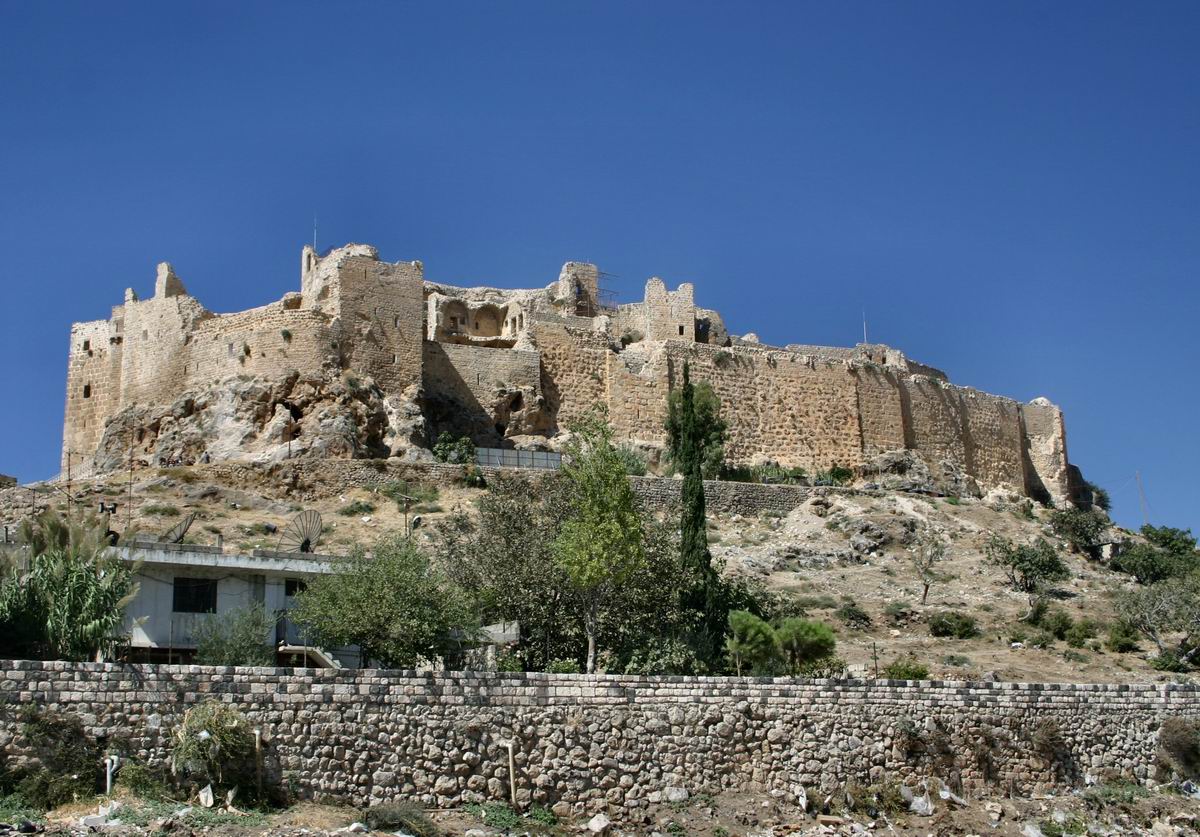
Photo: Mewes at German Wikipedia (Original text: de:Benutzer:Mewes) · Public domain · Wikimedia Commons
Masyaf Castle is a castle in Syria. Nizari Ismailis took control of the castle in the 1140s. The free Lokali audio guide runs 6 minutes.
✓ Published October 2026 · how we write these guides
Visitor facts
| Lokali audio guide | 6 min · free |
|---|---|
| Type | Castle |
| Location | Masyaf, Syria |
| Coordinates | 35.0662, 36.3433 |
| Languages | 50+, in the Lokali app |
The story
Put your hand on the stone. It is pale limestone, rough and warm in the sun, and it has been worn smooth in places by centuries of hands and weather. Above you the walls climb straight out of a rocky ridge. They follow every bump of the bedrock, as if the castle grew out of the mountain. Below, the town of Masyaf spreads across the slope, with its rooftops, minarets, and the sound of traffic coming up from the streets.
This is Masyaf Castle, in western Syria. It sits on the eastern edge of the coastal mountains, west of the city of Hama. The site matters for one reason above all others. In the Middle Ages it was the main Syrian stronghold of the Nizari Ismailis. They were a branch of Shia Islam, and their enemies gave them a name that still travels the world today: the Assassins.
The outcrop was fortified long before them. Historians believe that earlier builders, probably including the Byzantines, held a fortification here. The Byzantine Empire was the eastern continuation of the Roman Empire, and it ruled much of this region before the Arab conquests. The castle you see today, however, is mostly the result of medieval building and rebuilding. Many generations added towers, gates, and halls, often on top of older work.
The Nizari Ismailis took control of Masyaf in the 1140s. At that time they were building a network of mountain castles across this range. They were a small community surrounded by larger powers: the Seljuk Turks, the Crusader states, and later the Ayyubid dynasty of Saladin. Their survival depended on high walls, loyal followers, and a reputation that made powerful men nervous. Masyaf became the heart of that network.
Here is the first surprise. The word "Assassin" did not come from the Ismailis themselves. Their enemies used a label that is often linked to the Arabic word hashish. Hostile writers claimed that the Nizaris used the drug. Modern historians treat this story with deep suspicion. It was most likely an insult, not a description. Crusader chroniclers carried the name back to Europe, and over time it became the common word for a political killer.
The most famous leader connected with this castle is Rashid al-Din Sinan. He led the Syrian Nizaris in the second half of the twelfth century. Crusader writers called him the Old Man of the Mountain. He was known as a capable organiser and a sharp strategist. Under his leadership the Syrian community became powerful enough that kings and sultans had to take it seriously, or fear it.
In 1176, Saladin himself came here with an army and laid siege to Masyaf. Saladin was the sultan who later recaptured Jerusalem from the Crusaders. Yet he soon lifted the siege and withdrew. Why he left is still debated. Legend has it that Saladin woke one night to find a poisoned dagger and a warning note beside his bed, inside his guarded tent. Historians cannot confirm the tale. But it shows exactly the kind of fear the Nizaris wanted to create.
And here is the second surprise. The Nizaris used targeted killings very rarely compared with the legend. Most of their history was about faith, scholarship, farming, and quiet diplomacy. The independence of the Syrian castles ended in the thirteenth century. The Mamluk sultan Baybars, a ruler from Egypt, brought them under his control in the 1270s. The Ismaili community stayed in the region, and it still lives here today.
Now look at the walls themselves. As you walk, watch for stones of different sizes and colours sitting side by side. These show different building periods and many repairs. In some places you may notice round stone shafts set into the wall, lying sideways. These are old column pieces, taken from earlier buildings and reused. Builders in this region often laid them across a wall to tie the stones together and make it stronger.
The way in is not straight. Medieval castles here often used a bent entrance, which forced attackers to turn corners under fire. Inside, the castle is a maze of passages, stairways, vaulted rooms, and small courtyards. The ceilings in some halls are low and dark, and the air feels cool even on a hot day. Sounds change as you move. Footsteps echo in the vaults, and then the wind returns as you step back into the open.
In the early twenty-first century, the Aga Khan Trust for Culture led a major conservation project here, working with the Syrian authorities. The Aga Khan is the spiritual leader of the Nizari Ismailis today, so the work had a special meaning. The project stabilised walls, cleared rubble, and made the castle safer to explore. It also studied the site carefully, which helped historians understand its many building phases.
The castle has also found a second life far from Syria. Many younger visitors first meet Masyaf through the video game Assassin's Creed. The game shows a romantic, mountain-top version of the fortress. The real castle is smaller and more compact than the game suggests. But standing here, you can understand why designers chose it. It feels hidden, defended, and watchful, like a place that keeps its own secrets.
Before you leave, find a high point on the walls and look out. The town sits right at the castle's feet. Beyond it, the land opens towards the plains in the east, and the mountains rise behind you to the west. Listen for a moment. You may hear a call to prayer, a car horn, children playing below. The castle once watched these same roads for armies. Today it watches ordinary life go by, quietly, the way it has for nearly nine centuries.
Key facts
What to look for
Practical tips
Common questions
Is there a free audio guide to Masyaf Castle?
Yes — the Lokali app narrates Masyaf Castle free of charge in 50+ languages. The guide runs about 6 minutes, covers the history, what to look for on site and practical tips, and works offline once downloaded.
Where is Masyaf Castle?
Masyaf Castle is in Masyaf, Syria, at 35.0662, 36.3433. Tap the map link on this page for directions from where you are.
What is Masyaf Castle known for?
Nizari Ismailis took control of the castle in the 1140s. Rashid al-Din Sinan led from here in the twelfth century.
What should you look for at Masyaf Castle?
Old column shafts laid sideways inside the walls. Stones of different colours marking separate building phases. The bent entrance path designed to slow attackers.
What should you know before visiting Masyaf Castle?
Wear sturdy shoes for uneven stone steps and rubble. Bring a small torch for the darker vaulted passages.
When is the best time to visit Masyaf Castle?
Visit in late afternoon for softer light and cooler air.
On the map
Opens directions to Masyaf Castle from your location.
More to see near Masyaf Castle

Hear Masyaf Castle in your language
The full story, narrated, in 50+ languages. Download it before you go and it plays offline, at your own pace, with no ticket and no tour group.