
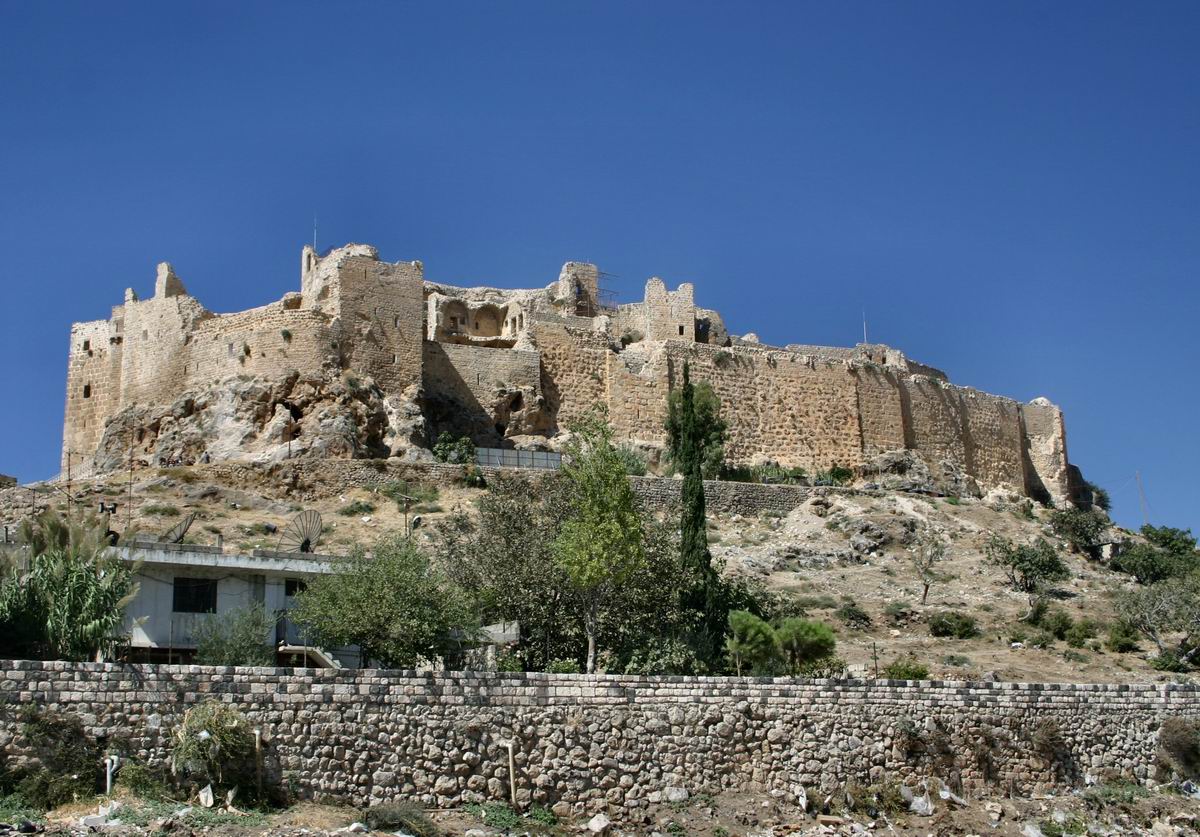
Photo: Bernard Gagnon · CC BY-SA 4.0 · Wikimedia Commons
Krak des Chevaliers is a crusader castle near Homs, Syria. Arabic name Hisn al-Akrad means Fortress of the Kurds. The free Lokali audio guide runs 7 minutes.
✓ Published October 2026 · how we write these guides
Visitor facts
| Lokali audio guide | 7 min · free |
|---|---|
| Type | Castle |
| Location | Talkalakh, Syria |
| Coordinates | 34.7569, 36.2947 |
| Languages | 50+, in the Lokali app |
The story
Feel the slope of the ramp under your feet. It climbs slowly, turning in the half-dark, and the stone is worn smooth by centuries of hooves and boots. Somewhere ahead, a slice of daylight falls through an opening in the vault. The air is cool here, even on a hot afternoon. You are inside the walls of Krak des Chevaliers, the medieval fortress that watches over the hills of western Syria.
Before we look at the walls, look at the land. The castle sits on a high ridge above the Homs Gap. This is a rare break in the coastal mountains, a natural corridor between the Mediterranean coast and the inland cities. For a long time, whoever held this ridge could watch traders, pilgrims and armies moving through the gap below. That single fact explains almost everything about this place. The fortress exists because of the view.
The Arabic name is Hisn al-Akrad, which means the Fortress of the Kurds. In the eleventh century, a ruler of Homs placed a garrison of Kurdish soldiers on this ridge, and the name stayed. The French name you probably know, Krak des Chevaliers, means the Fortress of the Knights. The word Krak most likely comes from an older local word for fortress. So the two names hold two different chapters of the same hilltop.
The knights in that name were the Knights Hospitaller. They began as a religious order caring for sick pilgrims in Jerusalem, and later became one of the great military orders of the Crusades. Crusader forces took the site early in the twelfth century. Around the middle of that century, the Count of Tripoli handed it to the Hospitallers. They had money, discipline and long experience of war. Over the following decades, they turned a modest hilltop fort into the structure around you now.
Here is the first thing many visitors miss. The castle you see is not one single design. Earthquakes struck the region more than once in the twelfth century and damaged the older walls. The Hospitallers rebuilt, and each rebuilding made the fortress stronger. Much of the strongest work dates from the late twelfth and thirteenth centuries. So when you see changes in the stone, in the shape of a tower or the style of a window, you are often looking at a different generation of builders.
The key idea is concentric defence. There are two rings of walls, one inside the other. If attackers broke through the outer wall, they found themselves in a narrow space, below a second and higher wall full of defenders. Between the rings on one side lies a large open water reservoir. Water was life in a siege. A garrison with full cisterns and full storerooms could hold out for a very long time.
Now find the great sloping base on the inner wall, on the southern side. Its steep stone face rises like a man-made cliff. Builders call this kind of slope a glacis or talus. It made the wall thicker at the bottom, so it was harder to undermine with tunnels. It also made ladders almost useless. Stones dropped from above bounced outward toward the attackers. It is a simple shape, but it solved several problems at once.
Walk into the inner courtyard and look for the Gothic loggia, a covered gallery with pointed arches and delicate carved stone. After all the heavy walls, this space feels almost gentle. This is the second surprise of the castle. The Hospitallers were soldiers, but they also built with the elegance of churches in France. Nearby is the great hall, and close by stands the chapel, which was later converted into a mosque. Look for a carved Latin inscription on the loggia, often read as a warning against pride.
The end of the knights' rule came in 1271. The Mamluk sultan Baybars, a ruler of Egypt and Syria who drove the crusaders from many strongholds, laid siege to the castle. His engineers broke into the outer defences, and the garrison withdrew to the inner ring. A popular story says that a forged letter, apparently from the knights' own commander, ordered them to surrender. Historians treat that tale with some caution. What is certain is that the knights left, and the castle passed into Mamluk hands.
The new owners did not simply occupy the castle. They repaired the damage from the siege and added their own work. On the southern side of the outer wall, look for a large square tower. Its shape differs from the rounded towers of the crusaders. That square tower is generally credited to the Mamluk period. Inscriptions in Arabic from the same era are carved into parts of the walls. So the fortress carries the work of both sides of a long war.
For centuries after that, the castle lost its military role. A village grew inside the walls. Families lived in the halls and courtyards and built homes among the towers. In the 1930s, under the French mandate, the villagers were moved out and the fortress was cleared and studied. Many earlier visitors also admired it deeply. The young T. E. Lawrence, later known as Lawrence of Arabia, studied crusader castles here and praised this one above the rest.
In 2006, the castle was listed as a UNESCO World Heritage Site, together with another Syrian fortress, the Citadel of Saladin. A few years later, during the Syrian war, the castle was occupied by fighters and was hit by shelling and airstrikes. Some towers and courtyards were damaged. Since then, restoration work has repaired parts of the structure. As you walk, you may notice newer stone beside older stone. That patchwork is now part of the castle's story too.
Before you leave, climb to the upper walls if the route is open, and look out over the Homs Gap. On a clear day, the hills fold away in layers of green and brown, and the wind moves steadily across the stone. Below you lies the corridor that made this ridge so valuable. Then walk back down the long vaulted ramp. Listen to your footsteps in the dark. Many people have walked this same slope before you, in armour, in sandals, and in work boots.
Key facts
What to look for
Practical tips
Common questions
Is there a free audio guide to Krak des Chevaliers?
Yes — the Lokali app narrates Krak des Chevaliers free of charge in 50+ languages. The guide runs about 7 minutes, covers the history, what to look for on site and practical tips, and works offline once downloaded.
Where is Krak des Chevaliers?
Krak des Chevaliers is near Talkalakh, Syria, at 34.7569, 36.2947. Tap the map link on this page for directions from where you are.
What is Krak des Chevaliers known for?
Arabic name Hisn al-Akrad means Fortress of the Kurds. Knights Hospitaller received the castle in the twelfth century.
What should you look for at Krak des Chevaliers?
The steep sloping stone base on the inner southern wall. Pointed Gothic arches of the loggia in the courtyard. The square Mamluk tower beside rounded crusader towers.
What should you know before visiting Krak des Chevaliers?
Check current travel advisories before planning your visit. Wear sturdy shoes for uneven stone and dark passages.
When is the best time to visit Krak des Chevaliers?
Arrive in late afternoon for softer light on stone.
On the map
Opens directions to Krak des Chevaliers from your location.
More to see near Krak des Chevaliers
Hear Krak des Chevaliers in your language
The full story, narrated, in 50+ languages. Download it before you go and it plays offline, at your own pace, with no ticket and no tour group.