
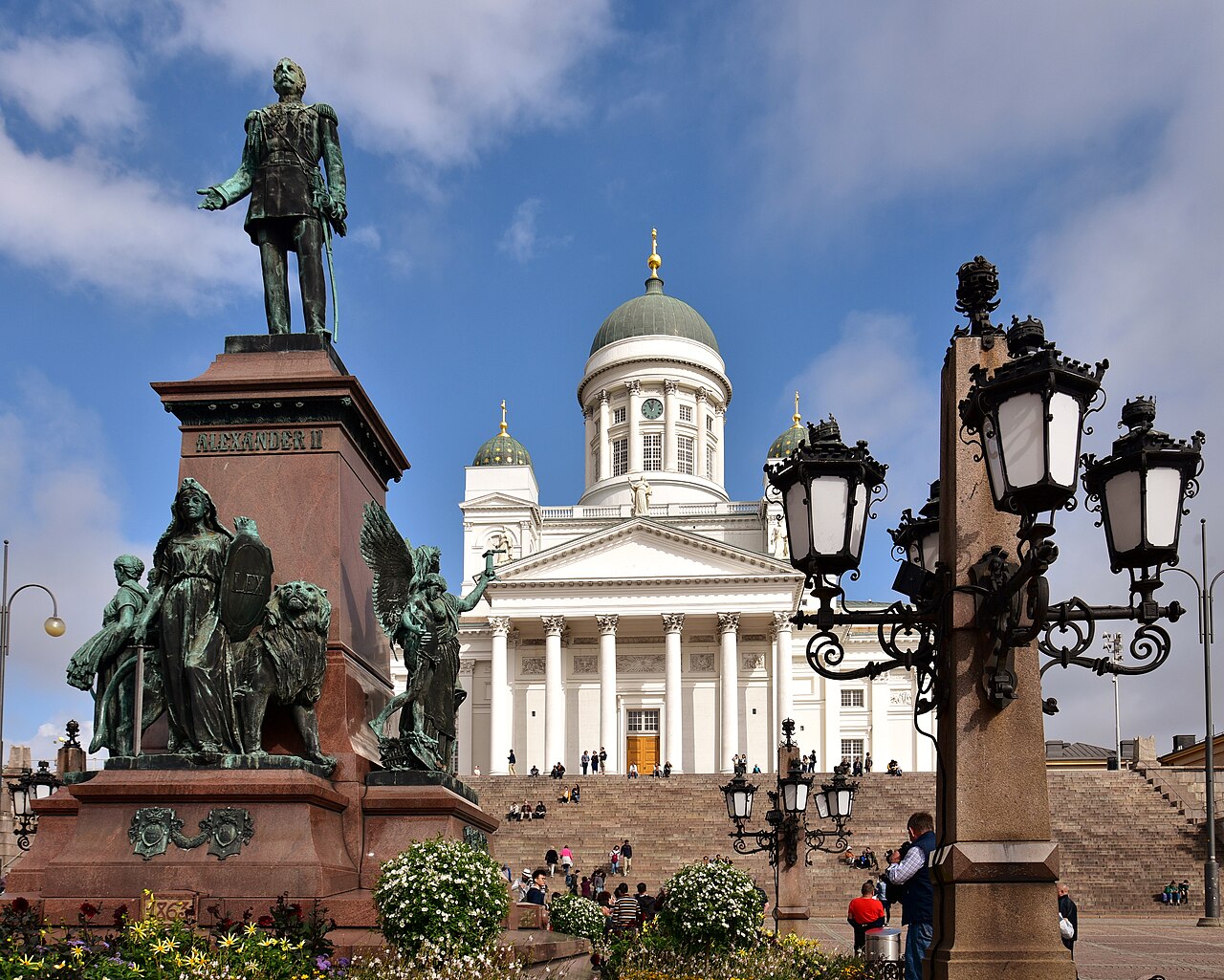
Presidential Palace, Helsinki
60.1684° N · 24.9563° E · Palace
Photo: Ad Meskens · CC BY-SA 4.0 · Wikimedia Commons
Presidential Palace, Helsinki is an administrative building in Helsinki, Finland. Built first as a merchant's townhouse in the early nineteenth century. The free Lokali audio guide runs 7 minutes.
✓ Published October 2026 · how we write these guides
Visitor facts
| Lokali audio guide | 7 min · free |
|---|---|
| Type | Palace |
| Location | Helsinki, Finland |
| Coordinates | 60.1684, 24.9563 |
| Official website | presidentti.fi |
| Languages | 50+, in the Lokali app |
The story
Stand at the edge of Market Square and listen for a moment. Gulls call over the harbour. Ferry engines rumble at the quay. Tram wheels squeal along the rails behind you. Underfoot, the cobbles are uneven and cold, worn smooth by two centuries of carts, boots and market stalls. Now turn toward the long, pale building with its tall windows and quiet columns. It does not shout for attention. Yet this is the Presidential Palace, and some of the most important moments in Finnish history happened behind that calm front.
The building did not begin life as a palace at all. It started as a private townhouse for a wealthy Helsinki merchant in the early nineteenth century. At that time Helsinki was still a modest port town. It had only recently become the capital of the Grand Duchy of Finland, a territory ruled by the Russian Empire. The merchant chose this spot for a clear reason. From here a man of business could watch the harbour, the ships and the trade that made his fortune.
That harbour view soon caught the attention of a far more powerful owner. In the late 1830s, the Russian state bought the house. It wanted a residence in Helsinki for the Emperor, who was also the Grand Duke of Finland. The task of converting it went to Carl Ludvig Engel. He was a German-born architect who shaped much of central Helsinki in the neoclassical style. Neoclassical means a style that borrows the columns, symmetry and calm proportions of ancient Greek and Roman buildings.
If you have already walked through Senate Square, you have seen Engel's hand there too. He designed the main university building, the government palace and the great white cathedral that rises above the square. Look at the palace again with that in mind. The same disciplined order is here. Windows line up in neat rows. The decoration is restrained. Nothing is wasted. Engel wanted Helsinki to look like a serious imperial capital, and this palace was one piece of that larger plan.
For the rest of the nineteenth century, the building served as the Imperial Palace. The emperors did not live here permanently. Instead, they stayed during visits to their Finnish lands. When an emperor arrived, the harbour in front of you became a stage. Ships came in, crowds gathered and officials waited in formal dress. For the rest of the year, the rooms stayed mostly quiet, kept ready for the next royal arrival.
Then the twentieth century broke that pattern. In 1917, the Russian Empire collapsed in revolution, and Finland declared its independence. The following year brought a short but bitter civil war. For a period, the old imperial palace had no clear role. The country had to decide what kind of state it would become, a monarchy or a republic. In the end, Finland chose to become a republic, and the building needed a new purpose.
Here is the first surprise for many visitors. The palace of the Russian emperors became the home of Finland's own head of state. From 1919, it served as the official residence of the President of the Republic. The first president, Kaarlo Juho Ståhlberg, moved in. So a building made for foreign rulers became the symbol of national independence. The same rooms that once welcomed a tsar now hosted the leaders of a free Finland.
For most of the twentieth century, presidents both lived and worked here. That was not always comfortable. The palace sits right on one of the city's busiest corners. Market traders set up stalls early in the morning. Tourists walk past all day, and the harbour stays noisy in summer. In the 1990s, presidents moved their private home to a newer residence called Mäntyniemi, by the sea in a quieter part of Helsinki. This palace stayed in use for official business.
Today the building is used for state ceremonies and official receptions. Foreign leaders are welcomed here. Important state occasions take place in its halls. Watch the main entrance for a while. You will often see a uniformed guard on duty. Their quiet presence is a reminder that this is still a working seat of the Finnish state. It is not a museum preserved behind glass. Decisions and diplomacy still happen inside these walls.
The palace is most famous in Finland for one evening each year. On 6 December, Finland's Independence Day, the president hosts a large reception here. Guests include veterans, politicians, artists, athletes and ordinary citizens chosen for their service. Each guest shakes hands with the president and their spouse in a long receiving line. The whole event is shown live on national television. Millions of Finns watch from their sofas and comment on the gowns, the guests and the dancing.
This is the second surprise. For many Finns, this reception is not just a state event. It is a shared winter ritual, a little like a national family gathering. People hold viewing parties at home. Newspapers review the outfits the next morning. Outside, the December night is long and dark, and candles glow in windows across the country. Inside, the main ceremonial hall fills with music and light. This is the room people often call the Hall of Mirrors.
Now look at the neighbourhood that frames the palace. To one side, the Esplanadi park runs west, lined with trees and benches. Across the water to the east, the red-brick Uspenski Cathedral stands on its rocky hill with golden domes. Behind you, the market sells berries, fish and coffee in summer. Ferries leave for the islands of Suomenlinna. Few heads of state have such an ordinary, lively front yard. Here power and daily life sit side by side.
Take one more look before you walk on. Notice how close the palace stands to the street, with no high wall and no long driveway. That openness says something about how Finland sees its leaders. They are close to the people, not hidden from them. As you move away across the square, listen again. You will hear the gulls, the trams and the voices of the market traders. The same sounds have drifted past these windows for two hundred years.
Key facts
What to look for
Practical tips
Common questions
Is there a free audio guide to Presidential Palace, Helsinki?
Yes — the Lokali app narrates Presidential Palace, Helsinki free of charge in 50+ languages. The guide runs about 7 minutes, covers the history, what to look for on site and practical tips, and works offline once downloaded.
Where is Presidential Palace, Helsinki?
Presidential Palace, Helsinki is in Helsinki, Finland, at 60.1684, 24.9563. Tap the map link on this page for directions from where you are.
What is Presidential Palace, Helsinki known for?
Built first as a merchant's townhouse in the early nineteenth century. Carl Ludvig Engel converted it into an imperial palace.
What should you look for at Presidential Palace, Helsinki?
Neat rows of tall windows across the restrained neoclassical front. Uniformed guard standing at the main palace entrance. Red-brick Uspenski Cathedral rising across the harbour water.
What should you know before visiting Presidential Palace, Helsinki?
Pair your visit with nearby Senate Square to compare Engel's buildings. Visit Market Square early morning to see stalls setting up.
When is the best time to visit Presidential Palace, Helsinki?
Walk the quay at dusk for softer light on the façade.
On the map
Opens directions to Presidential Palace, Helsinki from your location.
More to see in Helsinki



Hear Presidential Palace, Helsinki in your language
The full story, narrated, in 50+ languages. Download it before you go and it plays offline, at your own pace, with no ticket and no tour group.