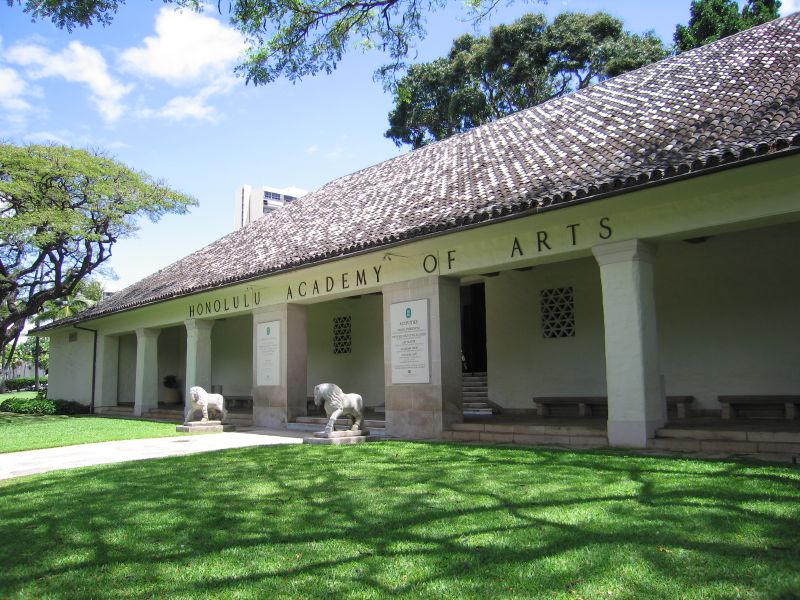
Honolulu Museum of Art
21.3039° N · 157.8487° W · Museum
Photo: LFL16 · CC BY-SA 2.0 · Wikimedia Commons
Honolulu Museum of Art is an art museum in Honolulu, Hawaii. Founded by collector Anna Rice Cooke, opened in 1927. The free Lokali audio guide runs 6 minutes.
✓ Published October 2026 · how we write these guides
Visitor facts
| Lokali audio guide | 6 min · free |
|---|---|
| Type | Museum |
| Location | Honolulu, United States |
| Coordinates | 21.3039, -157.8487 |
| Official website | honolulumuseum.org |
| Languages | 50+, in the Lokali app |
The story
Listen for a moment. Behind the traffic on Beretania Street, there is a softer sound. Water drips into a courtyard pool. Leaves shift in the trade wind. The air smells faintly of damp stone and green plants. You have stepped off a busy Honolulu road into a place built to slow you down. Welcome to the Honolulu Museum of Art.
This museum began with one woman and one idea. Her name was Anna Rice Cooke. She came from a missionary family and married into one of Hawaii's prominent business households. Over many years, she and her family collected art from across the world. They had pieces from Japan, China, Korea, Europe, and the Pacific. By the 1920s, Cooke wanted to share that collection with the people of the islands.
Her reasoning was simple and quite modern. Hawaii was home to children whose families came from many places — Hawaiian, Japanese, Chinese, Filipino, Portuguese, Korean, and more. Cooke believed these children should see beautiful things from their own heritage. She also believed they should see the art of their neighbours' cultures. A museum could be a shared room for a mixed society. That idea still shapes the galleries today.
The museum opened in 1927, on land where the Cooke family home once stood. At first it carried the name Honolulu Academy of Arts. Many longtime residents still call it simply the Academy. The current name, Honolulu Museum of Art, came much later, in 2012. So if an older local mentions the Academy, they mean this exact building around you.
Now look at the architecture itself. The design came from Bertram Goodhue, an American architect known for churches and public buildings. Goodhue died before construction finished, and his office completed the work. What they created is not a grand marble temple. Instead, it is low, calm, and open to the weather. White plaster walls rise to tiled roofs. Deep covered walkways — Hawaiians call such a porch a lanai — give shade from the sun.
Here is something many visitors miss. This building helped define what Hawaiian architecture could look like. Goodhue's design mixes ideas from several traditions. You can see sloping roofs that echo Asian temples. You can see courtyards and arches that recall the Mediterranean. Yet the whole thing is tuned for island life. Breezes move through the rooms. Light falls in from the sides. Later architects in Hawaii borrowed this style again and again.
The courtyards are the heart of the place. Each one has its own character. One has the feel of a Chinese garden, with plants and stone arranged for quiet contemplation. Another carries a Mediterranean mood, with tiles and open sky. The galleries are arranged around these spaces. So as you move through the collection, you keep stepping back out into air and greenery. Your eyes rest. Then you go back in, refreshed.
Inside, the collection is far larger than most people expect from a city in the middle of the Pacific. The museum holds tens of thousands of works. The Asian collections are especially strong. You will find Chinese ceramics, Korean pottery, Buddhist sculpture, and Japanese screens painted with gold. These rooms often feel hushed and dim. That low light protects fragile paper and silk from damage.
Here is the second surprise. The museum holds one of the most important collections of Japanese woodblock prints outside Japan. Much of it came from the writer James Michener. He is best known for his novel Hawaii and for Tales of the South Pacific. Michener loved ukiyo-e — the Japanese prints of actors, courtesans, and landscapes from the Edo era, roughly the seventeenth to nineteenth centuries. He gave thousands of them to this museum. Because prints fade in light, only a small selection is shown at any time.
The European and American galleries hold their own rewards. The museum owns works by painters such as Vincent van Gogh, Claude Monet, and Paul Gauguin. There is something quietly moving about seeing Gauguin here. He spent his last years in French Polynesia, painting the Pacific. In Honolulu, his work hangs only a few thousand kilometres from the islands that shaped it. Stand close and look at the brushwork. The paint sits thick on the canvas.
Do not skip the art of Hawaii and the wider Pacific. These galleries show how artists have seen these islands over time. Some works come from visiting painters who arrived on ships and steamers. Others come from people born and raised here. Together they tell a long conversation about land, ocean, and identity. Look for familiar shapes — the ridges of the Koolau mountains, the curve of a shoreline, the light over the water.
The museum is more than its galleries. It runs an art school where locals take classes in painting, ceramics, and printmaking. It also has a theatre named for Doris Duke, the American heiress who loved Islamic art. The museum organises tours to Shangri La, the home Duke built near Diamond Head, which is now a museum of Islamic art and design. Those tours need advance booking, so plan ahead if that interests you.
Before you leave, step back into one of the courtyards. Sit for a minute on a bench in the shade. Notice how the street noise fades behind the walls. Notice the play of light on the white plaster and the dark tiles. When you walk out onto Beretania Street, look across at Thomas Square, with its broad banyan trees. Then glance back at the low roofs behind you. Anna Rice Cooke's shared room is still open, nearly a century later.
Key facts
What to look for
Practical tips
Common questions
Is there a free audio guide to Honolulu Museum of Art?
Yes — the Lokali app narrates Honolulu Museum of Art free of charge in 50+ languages. The guide runs about 6 minutes, covers the history, what to look for on site and practical tips, and works offline once downloaded.
Where is Honolulu Museum of Art?
Honolulu Museum of Art is in Honolulu, United States, at 21.3039, -157.8487. Tap the map link on this page for directions from where you are.
What is Honolulu Museum of Art known for?
Founded by collector Anna Rice Cooke, opened in 1927. Originally named the Honolulu Academy of Arts.
What should you look for at Honolulu Museum of Art?
Dark tiled roofs sloping over white plaster walls. Deep shaded lanai walkways framing the courtyards. Thick visible brushstrokes on the Post-Impressionist canvases.
What should you know before visiting Honolulu Museum of Art?
Pause in the courtyards between galleries to rest your eyes. Book Shangri La tours well in advance through the museum.
When is the best time to visit Honolulu Museum of Art?
Visit on a weekday morning for quieter galleries.
On the map
Opens directions to Honolulu Museum of Art from your location.
More to see in Honolulu

Hear Honolulu Museum of Art in your language
The full story, narrated, in 50+ languages. Download it before you go and it plays offline, at your own pace, with no ticket and no tour group.