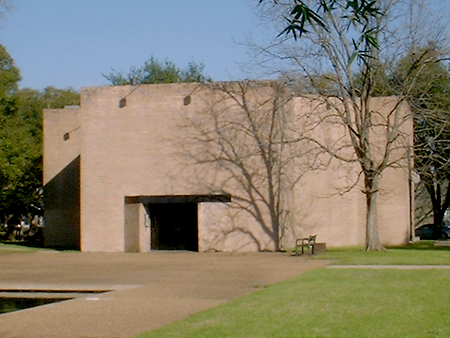
Photo: Wikimedia Commons contributor · Public domain · Wikimedia Commons
Rothko Chapel is a building in Houston, Harris County, Texas. John and Dominique de Menil commissioned the chapel. The free Lokali audio guide runs 7 minutes.
✓ Published October 2026 · how we write these guides
Visitor facts
| Lokali audio guide | 7 min · free |
|---|---|
| Type | Museum |
| Location | Houston, United States |
| Coordinates | 29.7375, -95.3961 |
| Official website | rothkochapel.org |
| Languages | 50+, in the Lokali app |
The story
Step inside, and the first thing you notice is the hush. The air feels cooler, and the sounds of the street fall away behind you. Your eyes need a moment to adjust. Soft daylight falls from above, and on every wall hang great dark canvases. At first they look black. Give them a minute... and they start to change. Deep plum, maroon, a bruised violet. This is the Rothko Chapel, and it asks one thing of you before anything else. Slow down.
This quiet room sits in a leafy residential corner of Houston's Montrose neighbourhood. Low bungalows painted grey line the streets nearby. Live oaks shade the sidewalks. It does not feel like a place for a major work of modern art. That contrast is deliberate. The chapel belongs to a small campus of art and reflection built up over decades by two collectors. Their names were John and Dominique de Menil, and this building was one of their boldest ideas.
The de Menils were French-born collectors who settled in Houston and became important patrons of modern art. Dominique in particular cared about the meeting of art and spirituality. In the 1960s they invited the painter Mark Rothko to create a set of works for a meditative space. Rothko was then one of the leading figures of Abstract Expressionism, the American movement that turned paint, colour and gesture into the subject itself. He accepted, and he treated it as the most important commission of his life.
Rothko did not want his paintings to hang in a building designed by someone else's rules. He wanted the room and the paintings to work as one. He built a mock-up of the space inside his New York studio, and he adjusted the light there to test the canvases. The architect Philip Johnson worked on early designs. But Rothko and Johnson disagreed, especially about light, and Johnson eventually stepped away. The Houston architects Howard Barnstone and Eugene Aubry completed the building.
Here is the part many visitors do not know. Rothko never saw the chapel finished. He took his own life in New York in February 1970. The building was dedicated in 1971, about a year later. So this room is in a sense a conversation the artist could not finish. Everything you see was arranged according to his plans. Yet the experience of standing here, in Houston light, was something he could only imagine in his studio.
Look around at the shape of the room. It is an octagon, with eight sides. Rothko drew inspiration from early Christian and Byzantine buildings, especially an old church on the island of Torcello, near Venice. In those buildings, the floor plan gathers people toward the centre. The same thing happens here. There is no altar, no pulpit, no single place you are meant to face. Instead, the paintings surround you on all sides.
There are fourteen paintings in total. Some are grouped as triptychs, which means three panels hung together as one work. Others hang alone. Some show a field of dark colour inside a slightly different border. Others look like a single, even surface. Rothko kept the images very spare. No figures, no symbols, no story. The idea is that you bring the meaning yourself. Many people say the paintings feel like doorways, or like the night sky just after sunset.
The light is the other half of the artwork. It enters through the skylight above and shifts through the day. On a bright Texas afternoon the canvases look warm and reddish. When clouds pass, they sink into near-black. For years, the light here was a problem. Too much sun washed out the paintings, and different fixes were tried. A major restoration project reopened the chapel in 2020 with a redesigned skylight, meant to bring the room closer to what Rothko intended.
Now a word about who this place is for. The chapel is not tied to any single religion. People of every faith come here, and people of no faith at all. The de Menils wanted it to be a space for all, a place where different traditions could meet. Over the years it has hosted interfaith gatherings, quiet prayer, and public conversations. You may see someone sitting on a bench with closed eyes. Someone else may sit on a cushion on the floor. Both are welcome.
Outside, before the entrance, you will find a reflecting pool. Rising from it is a tall steel sculpture called Broken Obelisk, by the artist Barnett Newman. It shows an upside-down obelisk balanced on the point of a pyramid. The top edge looks torn. The de Menils dedicated this sculpture to Martin Luther King Junior, after his assassination in 1968. So the space carries a public message about justice even before you go inside.
That link to justice continues today. The chapel gives an award in honour of Oscar Romero, the archbishop of San Salvador who was killed in 1980 while speaking out for the poor. The award recognises people around the world who defend human rights. A surprising fact for many visitors... this quiet room is also a working platform for activism. The silence inside and the public work outside are two sides of the same idea.
The chapel has also inspired other artists. The American composer Morton Feldman wrote a piece of music titled Rothko Chapel, first performed here in the early 1970s. It is slow and spare, with a viola, voices and percussion. If you listen to it later, you may recognise the same feeling you have now. Long pauses. Soft edges. Nothing rushed. It is a good way to carry this room home with you.
Before you leave, choose one painting and stay with it. Sit down if you can. Let your eyes rest on the dark surface for a few minutes. Notice how the edges seem to soften, and how the colour seems to rise from inside the canvas. Then walk outside, past the still water and the steel obelisk, into the green streets of Montrose. Listen to the birds in the oaks. The quiet you found inside... you can take it a little way with you.
Key facts
What to look for
Practical tips
Common questions
Is there a free audio guide to Rothko Chapel?
Yes — the Lokali app narrates Rothko Chapel free of charge in 50+ languages. The guide runs about 7 minutes, covers the history, what to look for on site and practical tips, and works offline once downloaded.
Where is Rothko Chapel?
Rothko Chapel is in Houston, United States, at 29.7375, -95.3961. Tap the map link on this page for directions from where you are.
What is Rothko Chapel known for?
John and Dominique de Menil commissioned the chapel. Mark Rothko painted fourteen canvases for this room.
What should you look for at Rothko Chapel?
The eight-sided floor plan with no altar. Triptychs of three panels hung together as one work. Subtle plum and maroon tones inside the dark canvases.
What should you know before visiting Rothko Chapel?
Sit for several minutes so your eyes adjust. Keep conversation silent once inside the room.
On the map
Opens directions to Rothko Chapel from your location.
More to see near Rothko Chapel
Hear Rothko Chapel in your language
The full story, narrated, in 50+ languages. Download it before you go and it plays offline, at your own pace, with no ticket and no tour group.