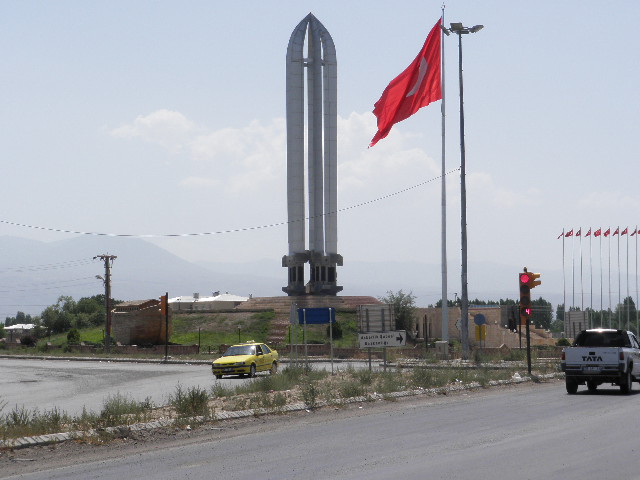
Iğdır Genocide Memorial and Museum
39.9368° N · 44.0795° E · Museum
Photo: Sabri76 · Public domain · Wikimedia Commons
Iğdır Genocide Memorial and Museum is a museum in Iğdır District. The memorial opened to the public in 1999. The free Lokali audio guide runs 7 minutes.
✓ Published October 2026 · how we write these guides
Visitor facts
| Lokali audio guide | 7 min · free |
|---|---|
| Type | Museum |
| Location | Iğdır, Türkiye |
| Coordinates | 39.9368, 44.0795 |
| Languages | 50+, in the Lokali app |
The story
Wind comes first here. It crosses the open plain with nothing to stop it, and it pulls at your jacket as you walk toward the monument. The ground is flat in every direction. On a clear day, the light is hard and bright, and far to the north and east, the white shape of a great mountain sits above the haze. Then you lift your eyes, and the memorial fills the sky in front of you.
This is the Iğdır Genocide Memorial and Museum, at the edge of a small city in the far east of Turkey. The monument rises more than forty metres above the plain. Its form is a cluster of tall, sharp blades, shaped like swords, pressed together and pointing upward. It is one of the tallest monuments in the country. Up close, it is hard to take in all at once. Most visitors walk a slow circle around the base before they say anything at all.
Before we go further, it helps to understand what this place is, and what it is not. The memorial was built by the Turkish state and opened in 1999. It commemorates Turks and Azerbaijanis who, according to the official Turkish account, were killed by Armenian armed groups in this region during and after the First World War. That period covers roughly the 1910s and the years just after, when this whole frontier was in chaos.
This is a contested memory, and an honest guide should say so. Most historians and many governments recognise the mass killing and deportation of Armenians in the Ottoman Empire, beginning in 1915, as genocide. The Turkish state rejects that term. This memorial presents a different side of that period — the deaths of Muslim civilians in the eastern borderlands. Many observers see the monument as a direct answer to the international recognition of the Armenian Genocide. You are standing inside a living argument about history.
It also helps to know the geography. Iğdır sits in a low, fertile plain, close to the borders of Armenia, Iran, and the Nakhchivan region of Azerbaijan. In the early twentieth century, this land changed hands between empires. The Russian Empire held it for decades. Then came war, revolution, and the collapse of old borders. Armies, militias, and refugees moved back and forth across these fields. Civilians of every community suffered here — Armenian, Turkish, Kurdish, and Azerbaijani alike.
Walk closer to the base and look at the surfaces. The blades are smooth and pale, and they catch the light differently through the day. In the morning, one side glows while the other stays in shadow. At midday, the whole structure looks almost white against the sky. Around the base, you will find relief carvings and inscriptions. These scenes show suffering, struggle, and grief, carved in a heavy, dramatic style. The designers clearly wanted the monument to be felt, not only read.
Here is a detail many visitors miss. The memorial is not only a sculpture. There is a museum space connected to it, where photographs, documents, and objects present the official narrative of the period. Exhibits tell stories of villages and families, mostly through the Turkish state's interpretation of events. If you go inside, read the panels with care, and remember that each memorial in this region, on every side of every border, chooses which stories to tell.
Now turn around, and look toward the horizon. If the air is clear, you may see Mount Ararat, the great snow-capped volcano that rises above the plain. In Turkish, it is called Ağrı Dağı. For Armenians, Ararat is a national symbol, even though it stands inside Turkey. It appears on Armenian art, on bottles, on postcards, and on the coat of arms. The same mountain looks down on both sides of this argument.
That is the second surprise of this place. Just across the border, not far from here, is the Armenian capital, Yerevan. It has its own genocide memorial, called Tsitsernakaberd, on a hill above the city. On a clear day, people in Yerevan look at the same mountain you can see now. Two memorials, two nations, two very different accounts of the same years — and one mountain between them.
Take a moment to listen. Out here, the sounds are simple. Wind against the stone. The occasional car on the nearby road. Perhaps a family speaking quietly, or schoolchildren on a visit, their voices carried away across the open ground. The site is often quiet, especially outside national days of commemoration. The emptiness around the monument is part of its effect. There is no old town around it, no café terraces, only space and sky.
The city of Iğdır itself is worth a few words. It is a farming town, known across Turkey for its apricots and its warm, sheltered climate, which is unusual for this high eastern region. The plain lies lower than the land around it, so summers here can be hot. In the markets, you may hear Turkish, Kurdish, and Azerbaijani spoken side by side. This mix of languages tells you a lot about how many peoples have lived on this border.
So how should you look at a place like this? Perhaps as a document in stone — a record of how one state chose to remember a painful time, and how it wanted that memory to look. You do not have to accept its message to find it worth seeing. Ask yourself what it includes, what it leaves out, and who it was built to speak to. Those questions apply to every memorial, everywhere.
Before you leave, stand at the foot of the blades one more time. Feel the wind again, and notice how small a person looks beside them. Then let your eyes travel past the monument, across the flat green plain, to the mountain on the horizon. The fields, the border, and the people beyond it are all still there. As you walk back toward the road, the blades will stay visible behind you for a long time.
Key facts
What to look for
Practical tips
Common questions
Is there a free audio guide to Iğdır Genocide Memorial and Museum?
Yes — the Lokali app narrates Iğdır Genocide Memorial and Museum free of charge in 50+ languages. The guide runs about 7 minutes, covers the history, what to look for on site and practical tips, and works offline once downloaded.
Where is Iğdır Genocide Memorial and Museum?
Iğdır Genocide Memorial and Museum is in Iğdır, Türkiye, at 39.9368, 44.0795. Tap the map link on this page for directions from where you are.
What is Iğdır Genocide Memorial and Museum known for?
The memorial opened to the public in 1999. The monument rises more than forty metres above the plain.
What should you look for at Iğdır Genocide Memorial and Museum?
Relief carvings of grieving figures around the monument's base. Shifting light and shadow across the pale vertical blades. The snow-capped cone of Mount Ararat on the horizon.
What should you know before visiting Iğdır Genocide Memorial and Museum?
Come on a clear morning for the best Ararat views. Bring a windproof layer; the open plain is often gusty.
When is the best time to visit Iğdır Genocide Memorial and Museum?
Pair this visit with Iğdır's apricot markets in summer.
On the map
Opens directions to Iğdır Genocide Memorial and Museum from your location.
More to see near Iğdır Genocide Memorial and Museum


Hear Iğdır Genocide Memorial and Museum in your language
The full story, narrated, in 50+ languages. Download it before you go and it plays offline, at your own pace, with no ticket and no tour group.