
Photo: User:Darwinek · CC BY-SA 3.0 · Wikimedia Commons
Bayezid II Mosque is a mosque in İstanbul, Turkey. Oldest surviving imperial mosque in Istanbul. The free Lokali audio guide runs 7 minutes.
✓ Published October 2026 · how we write these guides
Visitor facts
| Lokali audio guide | 7 min · free |
|---|---|
| Type | Mosque |
| Location | Istanbul, Türkiye |
| Coordinates | 41.0103, 28.9653 |
| Languages | 50+, in the Lokali app |
The story
Listen first. Pigeons beat their wings across the square. A tram bell rings somewhere behind you. Students cross the paving stones toward a tall university gate. Under all of this is the quiet of a stone courtyard, cool even on a warm afternoon. You are standing at the Bayezid II Mosque, on one of the oldest public squares in Istanbul. People have gathered on this spot for more than fifteen centuries.
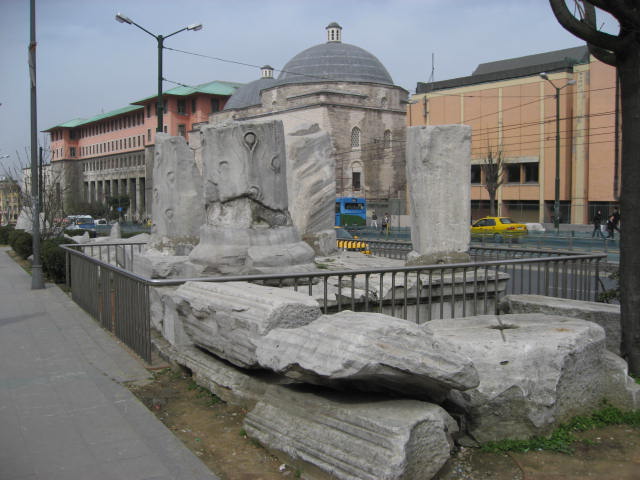
This ground had a public role long before the mosque. In the Byzantine era, this was the site of the Forum of Theodosius, a large ceremonial square of the late Roman city. Columns, arches and processions once filled the space. Fragments of that forum still turn up in the neighbourhood today. Keep this in mind as you walk. The Ottoman city did not replace the Roman one. It was built on top of it, and often from it.
The mosque carries the name of Sultan Bayezid the Second. He was the son of Mehmed the Second, the sultan who conquered Constantinople in 1453. Bayezid reigned in the late fifteenth and early sixteenth centuries. His temperament was very different from his father's. Ottoman tradition remembers him as pious and reflective, and gave him the title "Veli", meaning "the saint" or "the friend of God". The mosque was completed in the first decade of the sixteenth century.
Here is the first surprise. Many visitors assume the great imperial mosques on the hills, like the Süleymaniye or the Blue Mosque, are the oldest. They are not. Mehmed the Conqueror's own mosque was largely destroyed in an earthquake in the eighteenth century and later rebuilt. That makes this building the oldest surviving imperial mosque in the city. It is the earliest one still standing in close to its original form.
Step back and look at the shape of the main hall. A large central dome rises over the prayer space. A half-dome sits in front of it, and another sits behind it, along the line that faces Mecca. If that arrangement looks familiar, it should. The same idea of a central dome supported by half-domes appears in Hagia Sophia, just down the hill. Here the Ottoman builders took that Byzantine model and made it lighter, clearer and more compact.
Historians still debate who designed the mosque. Several names appear in the sources, and none has been confirmed with full certainty. What is certain is the result. It is a building of calm proportions and clean lines, with very little excess decoration. Later on, the great architect Mimar Sinan would refine this Ottoman style to its peak. Many scholars see this mosque as an important step on the road toward his work.
Now look at the two minarets. Most imperial mosques place their minarets close to the main building. Here they stand far apart, at the outer ends of two side wings. This gives the façade an unusually wide, stretched silhouette. The side wings once served as hostels for travelling dervishes and scholars, which is part of the reason the plan spreads so far sideways. From the square, try to take in both minarets at once. You will need to turn your head.
Walk into the courtyard if it is open. Columns of different stones line the arcade around it. There is pale marble, dark granite, and deep reddish porphyry, a hard stone prized by Roman emperors. Several of these columns were almost certainly taken from older Byzantine buildings. At the centre stands a domed fountain for washing before prayer. Many people find this courtyard among the most beautiful in Istanbul. Stand still in it for a moment and notice how the noise of the square fades.
The pigeons are not here by accident. For centuries, people have called this place the Pigeon Mosque. According to one popular tale, a poor widow gave the sultan a pair of pigeons. He accepted them and let them settle in the courtyard. Their descendants supposedly never left. It is a legend, not a recorded fact. Still, the birds remain loyal to the square, and feeding them is a small ritual for many visitors.
A second legend concerns the sultan himself. Locals say that Bayezid wanted his mosque built only with money he had earned honestly. Another tale says he collected the dust from his clothes after his military campaigns. A brick was made from that dust and placed in his tomb. Nobody can prove it. But the story tells you how Istanbul remembers this ruler, as a man of conscience rather than conquest. His tomb stands in the garden behind the mosque.
The mosque was never meant to stand alone. It was the heart of a complex, which in Turkish is called a külliye. That word means a group of buildings for religion, learning and charity. Around it stood a religious school, a public kitchen for the poor, and a bathhouse. Several of these buildings survive. The old bathhouse sits a short walk away on the main avenue. If you look closely at its walls, you can spot carved Byzantine stones built into the Ottoman masonry.
Look around the square and you will see how this neighbourhood still does what the complex once did. The grand gate of Istanbul University rises on one side. Through a small arched passage you can reach the old book market, a quiet lane of booksellers shaded by trees. Just beyond it lies the Grand Bazaar. Prayer, study, trade and charity have shared these few hundred metres for more than five hundred years.
Before you leave, turn once more toward the façade. Notice the grey lead of the domes against the sky. Notice the long line between the two minarets, and the pigeons lifting off the stones. The tram will ring again. Students will keep crossing the square. As you walk toward the bazaar or the booksellers, remember that the paving under your feet once belonged to a Roman forum. Five centuries ago, a quiet sultan chose this busy crossroads, and Istanbul has kept gathering here ever since.
Key facts
What to look for
Practical tips
Common questions
Is there a free audio guide to Bayezid II Mosque?
Yes — the Lokali app narrates Bayezid II Mosque free of charge in 50+ languages. The guide runs about 7 minutes, covers the history, what to look for on site and practical tips, and works offline once downloaded.
Where is Bayezid II Mosque?
Bayezid II Mosque is in Istanbul, Türkiye, at 41.0103, 28.9653. Tap the map link on this page for directions from where you are.
What is Bayezid II Mosque known for?
Oldest surviving imperial mosque in Istanbul. Built for Sultan Bayezid II, son of Mehmed the Conqueror.
What should you look for at Bayezid II Mosque?
Two minarets set unusually far apart at the wings. Reddish porphyry columns among the courtyard arcade. Domed ablution fountain at the centre of the courtyard.
What should you know before visiting Bayezid II Mosque?
Dress modestly; women should bring a scarf to cover their hair. Avoid visiting during the five daily prayer times.
When is the best time to visit Bayezid II Mosque?
Visit the courtyard early for quiet and soft light.
On the map
Opens directions to Bayezid II Mosque from your location.
More to see in Istanbul


Hear Bayezid II Mosque in your language
The full story, narrated, in 50+ languages. Download it before you go and it plays offline, at your own pace, with no ticket and no tour group.