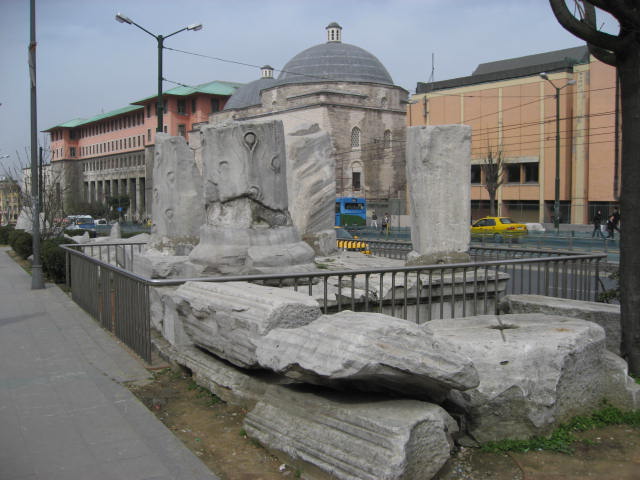
Forum of Theodosius
41.0097° N · 28.9636° E · Archaeological Site
Photo: Gryffindor · CC BY-SA 4.0 · Wikimedia Commons
Forum of Theodosius is a roman forum and triumphal column in Constantinople (Istanbul, Turkey). Built by Emperor Theodosius the First in the late fourth century. The free Lokali audio guide runs 6 minutes.
✓ Published October 2026 · how we write these guides
Visitor facts
| Lokali audio guide | 6 min · free |
|---|---|
| Type | Archaeological Site |
| Location | Istanbul, Türkiye |
| Coordinates | 41.0097, 28.9636 |
| Languages | 50+, in the Lokali app |
The story
Listen first. Trams hum along the rails of Ordu Avenue. Pigeons scatter across the open paving of Beyazıt Square. Street vendors call out beside the university gate. Now look down at the edge of the road, just below street level. There, among the traffic noise, lie broken columns of pale marble, lying in the dust like fallen trees. This is what remains of the Forum of Theodosius, one of the great public squares of Byzantine Constantinople.
To understand this place, imagine the city around the end of the fourth century. Constantinople was still young. It had been founded as a new imperial capital only a few generations earlier. Emperors wanted it to match Rome, and in some ways to replace it. Theodosius the First, one of the last emperors to rule both halves of the Roman world, gave the city this grand forum. It is usually said to have been dedicated in the 390s.
The model was clear. Theodosius looked to Rome, and especially to the Forum of Trajan, a vast square built three centuries earlier by one of Rome's most admired emperors. Like Trajan, Theodosius placed a tall column at the heart of his forum. Like Trajan's column, it carried a band of carved reliefs that wound upward in a spiral. The carvings showed the emperor's military campaigns. It was a statement in stone: this new city was the true heir of Rome.
The forum also had another name. People called it the Forum Tauri, which means the Forum of the Bull. The reason is not fully certain. One common explanation is that a large bronze statue of a bull stood here. Some accounts say the bull was linked to a furnace or an old place of execution, but these stories belong more to legend than to clear record. What is certain is that the name stayed in use for centuries.
Now think about the road beside you. In Byzantine times, the city's main ceremonial street ran straight through this spot. It was called the Mese, which simply means the Middle Street. Lined with colonnades and shops, it carried emperors, soldiers, merchants, and religious processions across the city. Ordu Avenue follows much of the same line today. So the trams you hear are moving along one of the oldest routes in Istanbul.
Look closely at the fallen columns near the road. Some have a strange surface. They are covered in carved shapes that look like teardrops, or eyes, or knots on a tree trunk. People describe them in different ways. Some see the eyes of a peacock's feathers. Others see a club or a branch with the twigs cut off. Either way, the pattern is unusual, and most visitors walk past without noticing it.
These pieces almost certainly belonged to a monumental triumphal arch at the western end of the forum. An arch like this was a gateway of power. Processions passed through it, and the decoration announced the glory of the emperor. Here is a quiet surprise: for many centuries, these fragments were simply lost. They lay buried under later buildings and streets, and the city grew over them.
They came back to light in the twentieth century. Some pieces appeared in the 1920s. Many more were uncovered in the 1950s, when Ordu Avenue was widened to carry modern traffic. Workers digging the road found the remains of the arch and its columns. Instead of removing everything, the authorities left a number of fragments in place along the roadside. That is why they sit here now, between cars and trams, rather than inside a museum.
And the great column itself? It did not survive. Over the centuries, earthquakes and decay weakened it. By the Ottoman period it had come down. Here is the second surprise. Pieces of its carved reliefs were reused as building material. If you walk a few steps to the old Ottoman bathhouse of Sultan Bayezid the Second, close to this square, you can see marble blocks with carved figures set into its walls. Some of the figures are upside down.
Those carved figures likely came from the spiral column that once rose above this forum. Builders in the Ottoman city treated old marble as a useful resource. This was common across the Mediterranean world. Stone from older monuments went into foundations, walls, and new structures. So the story of the column did not end when it fell. It continues, sideways and upside down, inside another building just across the street.
Today the square around you carries layers of later history too. The large mosque nearby was built by Sultan Bayezid the Second. The grand gate of Istanbul University faces the square. The Grand Bazaar lies only a short walk away. For many centuries, this area has remained a place of commerce, learning, and gathering. The buildings changed. The empires changed. But people kept coming to this same open ground.
That continuity is perhaps the most remarkable thing about the Forum of Theodosius. Very little of the original square remains. You will not find a complete arch or a standing column. Instead, you find fragments, and you must use your imagination. Picture marble paving, tall colonnades, a towering carved column, and crowds moving along the Middle Street. Then look again at the trams, the students, and the shoppers. The function of the place has stayed almost the same.
Before you move on, stand for a moment beside the broken columns. Notice the way the marble has weathered, with soft edges and patches of grey. Run your eye along the teardrop pattern carved by hands more than 1,500 years ago. Then lift your eyes to the busy avenue in front of you. As you walk toward the bazaar or the bathhouse, remember that you are following the path of emperors, on a road the city has never stopped using.
Key facts
What to look for
Practical tips
Common questions
Is there a free audio guide to Forum of Theodosius?
Yes — the Lokali app narrates Forum of Theodosius free of charge in 50+ languages. The guide runs about 6 minutes, covers the history, what to look for on site and practical tips, and works offline once downloaded.
Where is Forum of Theodosius?
Forum of Theodosius is in Istanbul, Türkiye, at 41.0097, 28.9636. Tap the map link on this page for directions from where you are.
What is Forum of Theodosius known for?
Built by Emperor Theodosius the First in the late fourth century. Modelled on the Forum of Trajan in Rome.
What should you look for at Forum of Theodosius?
Teardrop-shaped carvings covering the surface of fallen columns. Marble fragments lying below street level along Ordu Avenue. Upside-down carved figures set into the bathhouse walls.
What should you know before visiting Forum of Theodosius?
Take the tram to the Beyazıt stop to arrive beside the ruins. Visit the nearby Bayezid the Second bathhouse to see reused reliefs.
When is the best time to visit Forum of Theodosius?
Come in the morning when the roadside is calmer for viewing.
On the map
Opens directions to Forum of Theodosius from your location.
More to see in Istanbul



Hear Forum of Theodosius in your language
The full story, narrated, in 50+ languages. Download it before you go and it plays offline, at your own pace, with no ticket and no tour group.