
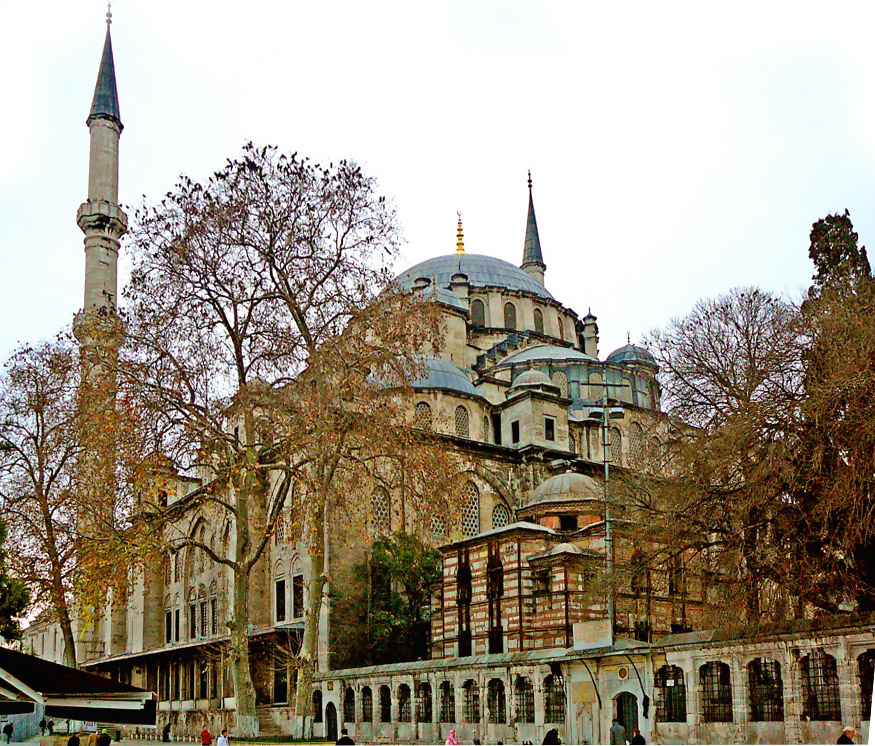
Photo: User:Ggia · CC BY-SA 3.0 · Wikimedia Commons
Fenari Isa Mosque is a mosque in İstanbul, Turkey. Founded by Byzantine official Constantine Lips in the early tenth century. The free Lokali audio guide runs 6 minutes.
✓ Published October 2026 · how we write these guides
Visitor facts
| Lokali audio guide | 6 min · free |
|---|---|
| Type | Mosque |
| Location | Istanbul, Türkiye |
| Coordinates | 41.0154, 28.9440 |
| Languages | 50+, in the Lokali app |
The story
Listen for a moment. Behind you, traffic runs along one of the wide modern avenues of Fatih. In front of you stands something much older and much quieter. A long wall of thin red bricks and pale stone, laid in alternating bands like layers in a cake. The brick is warm in the sun and rough under the fingertips. This is the Fenari Isa Mosque, and before it was a mosque, it was a monastery. One of the oldest working buildings in this part of Istanbul.
What you are looking at is really two churches standing side by side. They were built centuries apart, then joined together. The older one, to the north, dates from the early tenth century. The younger one, to the south, came roughly four hundred years later. Later still, Ottoman builders turned the whole complex into a mosque. So one roof covers three chapters of the city's story. Each chapter left marks you can still see.
The first chapter begins with a man called Constantine Lips. He was a high official at the Byzantine court, the Christian empire that ruled from this city for more than a thousand years. Around the start of the tenth century, he founded a monastery here and dedicated its church to the Virgin Mary. The chronicles say the emperor Leo the Sixth attended the inauguration. For centuries afterwards, people knew this place simply as the monastery of Lips.
That northern church is important to historians for a simple reason. It is one of the earliest surviving examples in Istanbul of a plan called the cross-in-square. Imagine a square room with a cross drawn inside it, and a dome rising over the centre where the arms meet. This layout became the standard shape for Orthodox churches across the Balkans, Greece, and Russia. Many of those later churches follow the same idea that you see here.
Here is a detail most visitors miss. The northern church was built with small extra chapels up at roof level, tucked into the corners. Look at the roofline and you may pick out small domes and shapes that seem too many for one building. These upper chapels were unusual even in Byzantine times. Scholars still discuss exactly how monks used them. Perhaps for private prayer, perhaps for the memory of particular people.
The second chapter came in the late thirteenth century. By then the city had passed through a hard period. Crusader armies had captured Constantinople in 1204, and the Byzantines only took it back in 1261. Soon after, Empress Theodora, the widow of Emperor Michael the Eighth, restored the old monastery. She added a new church to the south, dedicated to Saint John the Baptist. She also made it a place of burial for her family.
That southern church is the side where the brickwork becomes playful. Walk around to the east end if you can. The rounded apses there are decorated with arches, niches, and patterns made only from brick and mortar. Builders of this late Byzantine era loved this kind of surface ornament. They used no paint and no marble, just the careful placing of thin bricks. The effect changes through the day as the shadows inside the niches move.
Inside the southern church, the burials tell their own story. Empress Theodora was laid to rest here, and so were other members of the ruling Palaiologos family, the last dynasty of Byzantium. During excavation and restoration in the twentieth century, researchers found tomb niches and fragments of fine carved decoration. Some pieces showed coloured stone inlay set into marble. Most of those finds are now in museum collections, but the empty tomb recesses remain part of the building.
The third chapter is Ottoman. After the conquest of the city in 1453, many churches were gradually turned into mosques. This one was converted around the end of the fifteenth century by a religious scholar from the Fenari family. That is where the first part of the name comes from. The second part, Isa, is less certain. Isa is the Arabic and Turkish name for Jesus, though some accounts link it to a local religious figure instead.
The conversion brought practical changes. A prayer niche, called a mihrab, was set to face Mecca. A minaret rose beside the building. The interior was arranged for Muslim prayer, with open floor space for rows of worshippers. Over the following centuries, fires damaged the complex more than once, including a serious one in the early twentieth century. Each time, the walls survived better than the roofs and the decoration.
In the second half of the twentieth century, specialists studied and repaired the building with great care. Teams recorded the brickwork, the carved stone, and the tombs before further work began. A later restoration, completed in the early twenty-first century, gave the mosque the clean, cared-for look you see today. Fresh mortar sits beside old brick. If you look closely, you can often tell which bricks are original and which are new.
Today this is an active neighbourhood mosque, not a museum. Men come in for the daily prayers. Shoes line up at the entrance. Children cut across the small garden on their way somewhere else. The call to prayer rises from the minaret and drifts over the avenue. Visitors are welcome outside prayer times, as long as they dress modestly and move quietly. Women will want a scarf to cover their hair before going in.
Before you leave, step back and take in the whole length of the wall once more. Thin bricks from the tenth century. Decorative arches from the thirteenth. A minaret from the Ottoman city. Modern repairs holding it all together. The traffic still runs past, and most drivers never turn their heads. But you know now what this quiet red wall carries. As you walk away, watch for other banded brick walls in Fatih. Some of them have stories just as long.
Key facts
What to look for
Practical tips
Common questions
Is there a free audio guide to Fenari Isa Mosque?
Yes — the Lokali app narrates Fenari Isa Mosque free of charge in 50+ languages. The guide runs about 6 minutes, covers the history, what to look for on site and practical tips, and works offline once downloaded.
Where is Fenari Isa Mosque?
Fenari Isa Mosque is in Istanbul, Türkiye, at 41.0154, 28.9440. Tap the map link on this page for directions from where you are.
What is Fenari Isa Mosque known for?
Founded by Byzantine official Constantine Lips in the early tenth century. Northern church is an early cross-in-square plan in Istanbul.
What should you look for at Fenari Isa Mosque?
Alternating bands of thin red brick and pale stone. Decorative brick arches and niches on the eastern apses. Small extra domes along the roofline of the northern church.
What should you know before visiting Fenari Isa Mosque?
Visit outside the five daily prayer times to look inside. Bring a scarf; women should cover their hair indoors.
When is the best time to visit Fenari Isa Mosque?
Come in late afternoon when shadows deepen the brick niches.
On the map
Opens directions to Fenari Isa Mosque from your location.
More to see in Istanbul


Hear Fenari Isa Mosque in your language
The full story, narrated, in 50+ languages. Download it before you go and it plays offline, at your own pace, with no ticket and no tour group.