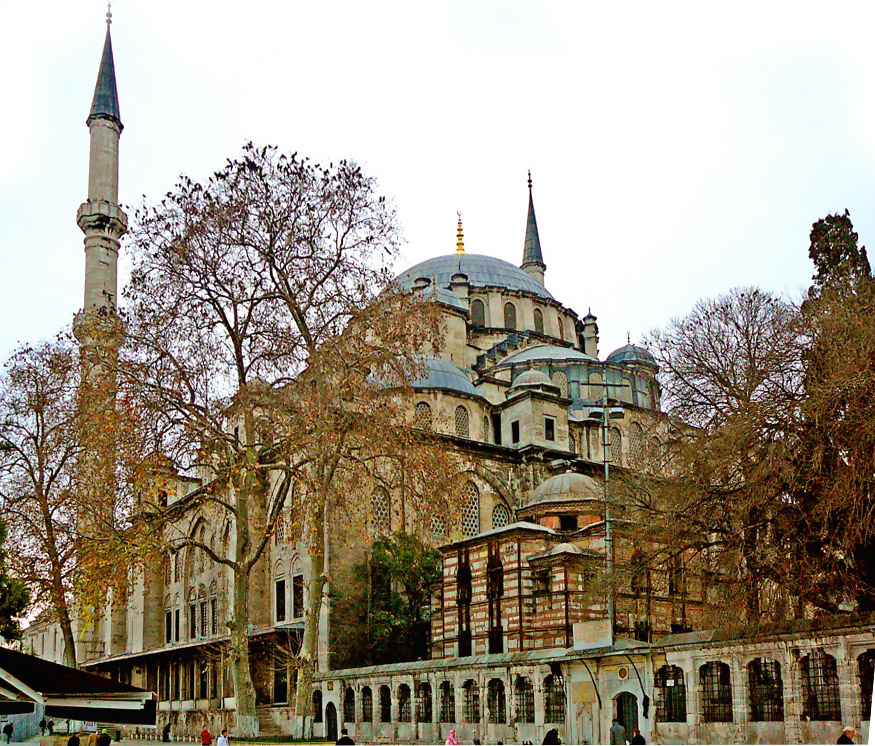
Photo: Muscol · CC BY-SA 3.0 · Wikimedia Commons
Fatih Mosque is a mosque in İstanbul, Turkey. It is in Istanbul, Türkiye. Built for Sultan Mehmed the Second after the 1453 conquest. The free Lokali audio guide runs 6 minutes.
✓ Published October 2026 · how we write these guides
Visitor facts
| Lokali audio guide | 6 min · free |
|---|---|
| Type | Mosque |
| Location | Istanbul, Türkiye |
| Coordinates | 41.0197, 28.9497 |
| Languages | 50+, in the Lokali app |
The story
Start with your feet. The stone paving of the courtyard is cool and smooth, worn down by more than five centuries of footsteps. Around you, a colonnade of grey and pale columns holds up a ring of small domes. Pigeons move between the arches. Somewhere near the centre, water runs from the taps of a fountain where people wash before prayer. Above it all rises a great lead-grey dome, and the city noise feels suddenly far away.
You are standing in Fatih Mosque, the Mosque of the Conqueror. The name honours Sultan Mehmed the Second, the young Ottoman ruler who captured Constantinople in 1453. In Turkish he is remembered simply as Fatih, which means the Conqueror. The whole district around you carries his title. This mosque was his great statement in stone. It was the first imperial mosque complex the Ottomans built in their new capital.
Here is the first thing many visitors miss. This hill was already sacred long before the mosque. It held the Church of the Holy Apostles, one of the most important churches of the Byzantine Empire. For centuries, Byzantine emperors were buried there, and tradition links its founding to Constantine the Great himself. By the time of the conquest, the church was in poor condition. Mehmed chose this exact spot to build his own monument.
That choice carried a clear message. A new empire was placing its foundation on top of the old one. The Byzantine church is gone now. Very little of it is visible above ground. But when you stand here, you are standing on one of the oldest layers of imperial Istanbul. The ground under this courtyard holds the memory of two empires, one Christian and one Muslim, in the same place.
The original mosque was finished around 1470. Its architect is usually named as Atik Sinan. Please do not confuse him with the more famous Mimar Sinan, who worked about a century later. Legend has it that Mehmed was angry because the new dome was smaller than the dome of Hagia Sophia. According to one popular tale, the architect paid with his hands, or even his life. Historians treat this story with caution. It is folklore, not documented fact.
The mosque was never meant to stand alone. It sat at the heart of a large complex, which the Ottomans called a külliye. Think of it as a mosque with a whole town of services around it. There were schools of higher learning, a library, a hospital, a bathhouse, a guesthouse for travellers, and a public kitchen that served food to students and the poor. Religion, education and charity all grew from one centre.
The schools were especially important. Eight colleges stood in rows on either side of the mosque. For generations they trained scholars, judges and teachers for the empire. If you walk around the outer grounds, you can still see long, low buildings with small domes lined up like beads. These rows show you the shape of that old university. Many of the buildings are still used today.
Now the second surprise. The mosque you see is not the one Mehmed built. In 1766, a powerful earthquake struck Istanbul. It badly damaged the original mosque and brought down its dome. Sultan Mustafa the Third ordered it rebuilt, and the new mosque was finished in the early 1770s. The builders did not copy the old design. They gave it a central dome supported by four half-domes, a plan that was more common by the eighteenth century.
So you are looking at a mixture of two eras. Parts of the courtyard and the main entrance are believed to survive from the earlier building. The prayer hall itself belongs to the later rebuilding. Look closely at the decoration inside and you may notice a lighter, more eighteenth-century style in places. It is a quiet reminder that Istanbul has always repaired itself, layer after layer, after fire and earthquake.
When you step inside, take a moment before you look up. Leave your shoes at the entrance. Women are asked to cover their hair, and everyone should dress modestly. The carpet is soft underfoot, and the space feels wide and open. Light comes through many rows of windows. Hanging lamps sit low on long cables, close to the heads of people at prayer. Speak softly. This is a working mosque, and people come here to pray every day.
Behind the mosque, in the garden on the side facing Mecca, stands the tomb of Mehmed the Conqueror. It was also damaged in the earthquake and rebuilt afterwards. Visitors often stand quietly at the door, and some offer a short prayer. For many Turks, this is a deeply meaningful place. The man who changed the history of this city rests only a few steps from the mosque he founded. Nearby, other members of his family are buried too.
The neighbourhood around the mosque has its own character. Fatih is one of the more traditional and religious parts of central Istanbul. You will see families, students, older men sitting on benches, and small shops selling prayer beads, books and headscarves. The streets around the complex feel lived-in rather than staged for tourists. Walk a few blocks in any direction and you will find bakeries, tea houses and small local restaurants.
Before you leave, return to the courtyard. Stand by the fountain and listen. You may hear water, a few birds, perhaps the call to prayer rising from the minarets above you. Look at the dome one more time, and then down at the stones under your feet. Somewhere below them lie the foundations of an emperors' church. Above them stands a sultan's mosque, rebuilt after an earthquake. The city keeps building on itself, and you are standing right in the middle of that story.
Key facts
What to look for
Practical tips
Common questions
Is there a free audio guide to Fatih Mosque?
Yes — the Lokali app narrates Fatih Mosque free of charge in 50+ languages. The guide runs about 6 minutes, covers the history, what to look for on site and practical tips, and works offline once downloaded.
Where is Fatih Mosque?
Fatih Mosque is in Istanbul, Türkiye, at 41.0197, 28.9497. Tap the map link on this page for directions from where you are.
What is Fatih Mosque known for?
Built for Sultan Mehmed the Second after the 1453 conquest. First imperial Ottoman mosque complex built in Istanbul.
What should you look for at Fatih Mosque?
The ring of small domes above the courtyard colonnade. The ablution fountain in the centre of the courtyard. Four half-domes supporting the large central dome.
What should you know before visiting Fatih Mosque?
Avoid visiting during the five daily prayer times. Bring a scarf so women can cover their hair inside.
On the map
Opens directions to Fatih Mosque from your location.
More to see in Istanbul

Hear Fatih Mosque in your language
The full story, narrated, in 50+ languages. Download it before you go and it plays offline, at your own pace, with no ticket and no tour group.