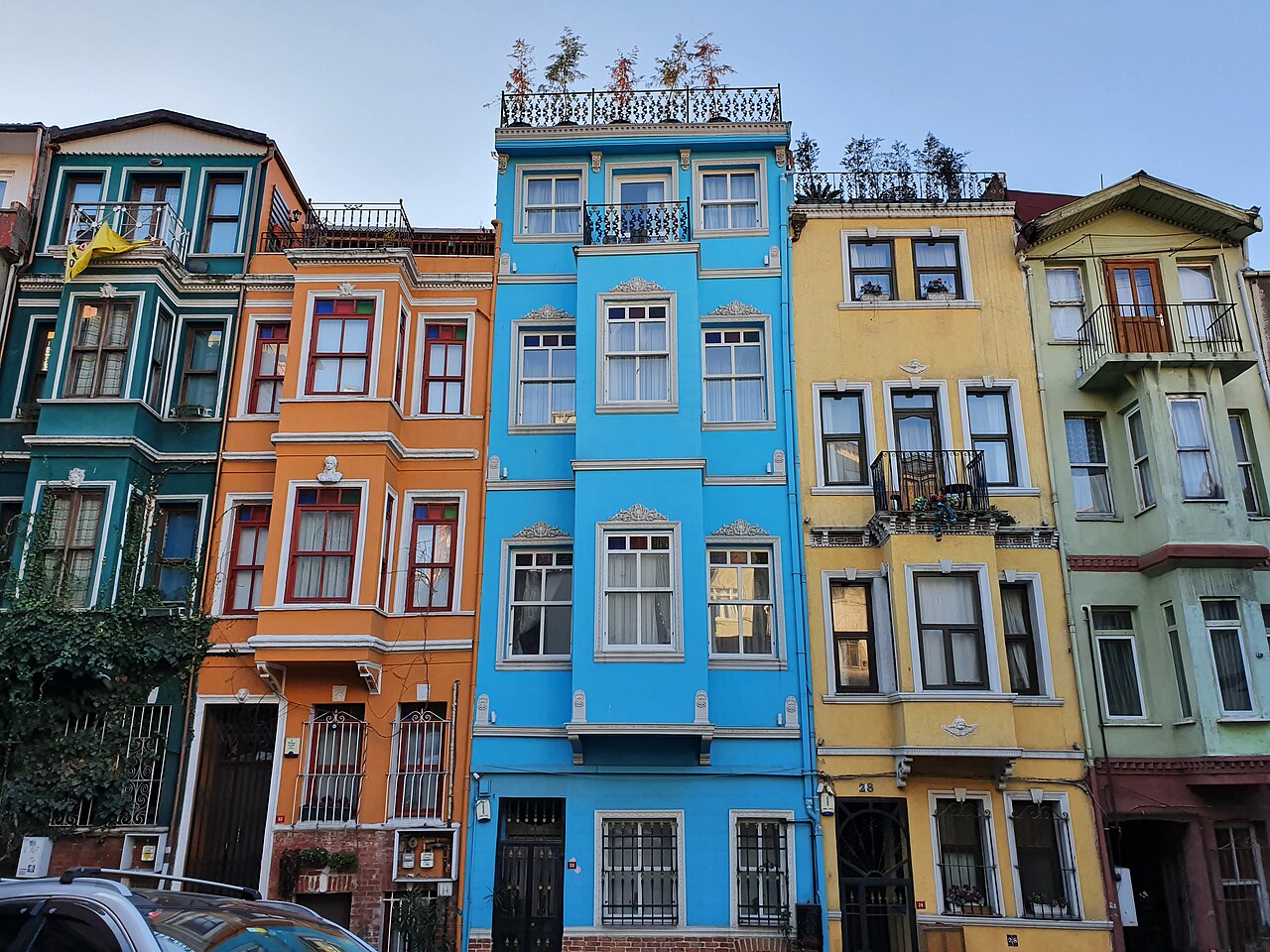
Fener and Balat is a neighborhood in Istanbul, Türkiye. Two adjacent historic quarters along the Golden Horn, known for steep cobbled lanes, pastel-painted houses, and layered religious heritage. Most visitors spend 2–3 hours here. The free Lokali audio guide runs 9 minutes.
✓ Verified August 2026 · how we write these guides
Visitor facts
| Time needed | 2–3 hours |
|---|---|
| Lokali audio guide | 9 min · free |
| Type | Neighborhood |
| Best for | Photography |
| Location | Istanbul, Türkiye |
| Coordinates | 41.0286, 28.9486 |
| Languages | 45, in the Lokali app |
The story
The cobblestones underfoot are uneven, worn smooth in the centres where centuries of footsteps have passed. Paint peels from wooden shutters in shades of ochre, dusty rose, and faded turquoise — colours that shift with the slant of afternoon light coming off the Golden Horn. This is Fener and Balat, two neighbouring districts on Istanbul's European shore where the city's layered past remains visible in every crumbling facade and every iron balcony sagging under the weight of potted geraniums.
These streets were once the heart of Istanbul's Greek and Jewish communities. Fener — the name comes from the Greek word for lantern, "fanari" — became home to the Greek Orthodox Patriarchate in the fifteenth century, after the Ottoman conquest. The Patriarchate still stands here today, a modest compound behind high walls, its administrative authority reaching Greek Orthodox communities worldwide. Balat, just south along the waterfront, welcomed Sephardic Jews expelled from Spain in fourteen ninety-two. Sultan Bayezid the Second offered refuge, and the community built synagogues, schools, and workshops in these narrow lanes.
Walk slowly here. The architecture tells the story of people who arrived with little and built lives in vertical space. Houses lean toward each other across alleyways barely wide enough for two people to pass. Ground floors were often workshops — tailors, cobblers, tinsmiths — with living quarters stacked above. Timber frames sag with age, and many buildings show the scars of fires that swept through these dense neighbourhoods in the nineteenth and early twentieth centuries. Restoration has been uneven. Some houses gleam with fresh paint and Instagram-ready charm. Others remain half-collapsed, their interiors open to the sky.
The Greek Orthodox College of Fener — known locally as the Red School — dominates the hillside. Built in eighteen eighty-one, this massive brick structure rises five stories, its red facade punctuated by rows of arched windows. It was designed by Ottoman Greek architect Konstantinos Dimadis and served as one of the most prestigious Greek schools in the empire. The building has been closed since the early nineteen-seventies, its future uncertain, but its silhouette still commands the skyline. Stand at the base and look up — the sheer scale of it speaks to the ambitions and resources of the Greek community at the height of its influence here.
Balat's streets feel narrower, more intimate. Synagogues are tucked behind unmarked doors — Ahrida Synagogue, the oldest in the district, dates to the late fifteenth century and features a unique boat-shaped bimah, a wooden platform in the centre of the prayer hall. The symbolism is layered: some say it recalls Noah's ark, others the boats that carried refugees from Spain. The Jewish population of Balat has dwindled to a handful of families, but the buildings remain, many converted to other uses or left empty.
In recent years, artists and young entrepreneurs have moved into Fener and Balat, drawn by low rents and the texture of decay. Cafes occupy former workshops. Galleries open in ground-floor rooms with original tile floors and pressed-tin ceilings. This gentrification is slow and patchy — the districts have not yet tipped into full-scale tourism. You will still see elderly residents sitting on stoops, children playing football in dead-end alleys, laundry strung between buildings. The rhythm of daily life persists alongside the newcomers.
Notice the details as you wander. Iron grilles over windows, many worked into floral or geometric patterns. Stone lintels carved with dates and monograms. Wooden doors painted in layers — scrape the surface and you might see a dozen colours beneath. Stray cats everywhere, napping in doorways and on car hoods. The smell of simmering lentils or roasting peppers drifts from open windows. In spring, wisteria vines cascade from upper balconies, their purple blooms heavy and fragrant.
The waterfront along the Golden Horn has changed more than the interior streets. Old warehouses have been demolished or converted. A promenade runs along the water now, popular with joggers and families in the evenings. Ferries chug past, heading to the Asian shore or up the Bosphorus. From here, you can see the old city rising across the water — the domes and minarets of Sultanahmet, the grey bulk of Topkapi Palace. The view reminds you that Fener and Balat, for all their distinct character, are still part of this vast, complex city.
The light changes quickly here, especially in late afternoon when the sun drops toward the west. Shadows lengthen across the cobblestones. The pastel facades take on a warmer glow. If you are carrying a camera, this is the hour to shoot — the contrast between decaying grandeur and soft light is striking. But even without a lens, just stand still for a moment. Listen to the sounds: the call to prayer echoing from a distant mosque, a radio playing Turkish pop from an open window, the scrape of a metal shutter being pulled down for the evening.
These neighbourhoods are fragile. Buildings continue to collapse. Families move away. The balance between preservation and development remains unresolved. But for now, Fener and Balat offer something rare in a city as large and relentless as Istanbul — a sense of pause, of time moving at a different speed. The past is not packaged here. It is simply present, in the stones and the wood and the worn steps beneath your feet.
Key facts
What to look for
Practical tips
Common questions
How long do you need at Fener and Balat?
Plan 2–3 hours. That is the time most visitors spend at Fener and Balat. The free Lokali audio guide adds about 9 minutes of narration you can listen to as you walk, so it fits inside your visit rather than adding to it.
Is there a free audio guide to Fener and Balat?
Yes — the Lokali app narrates Fener and Balat free of charge in 50+ languages. It covers the history, what to look for on site and practical tips, and it works offline once downloaded.
Where is Fener and Balat?
Fener and Balat is in Istanbul, Türkiye, at 41.0286, 28.9486. Tap the map link on this page for directions from where you are.
What should you know before visiting Fener and Balat?
Walk slowly and explore narrow side alleys.
What is Fener and Balat known for?
Fener name derives from Greek word fanari meaning lantern.
What is the best time to visit Fener and Balat?
Climb the alley beside the Bulgarian Church to reach rooftop cafés with Golden Horn views.
On the map
Opens directions to Fener and Balat from your location.
More to see in Istanbul


Hear Fener and Balat in your language
The full story, narrated, in 50+ languages. Download it before you go and it plays offline, at your own pace, with no ticket and no tour group.