
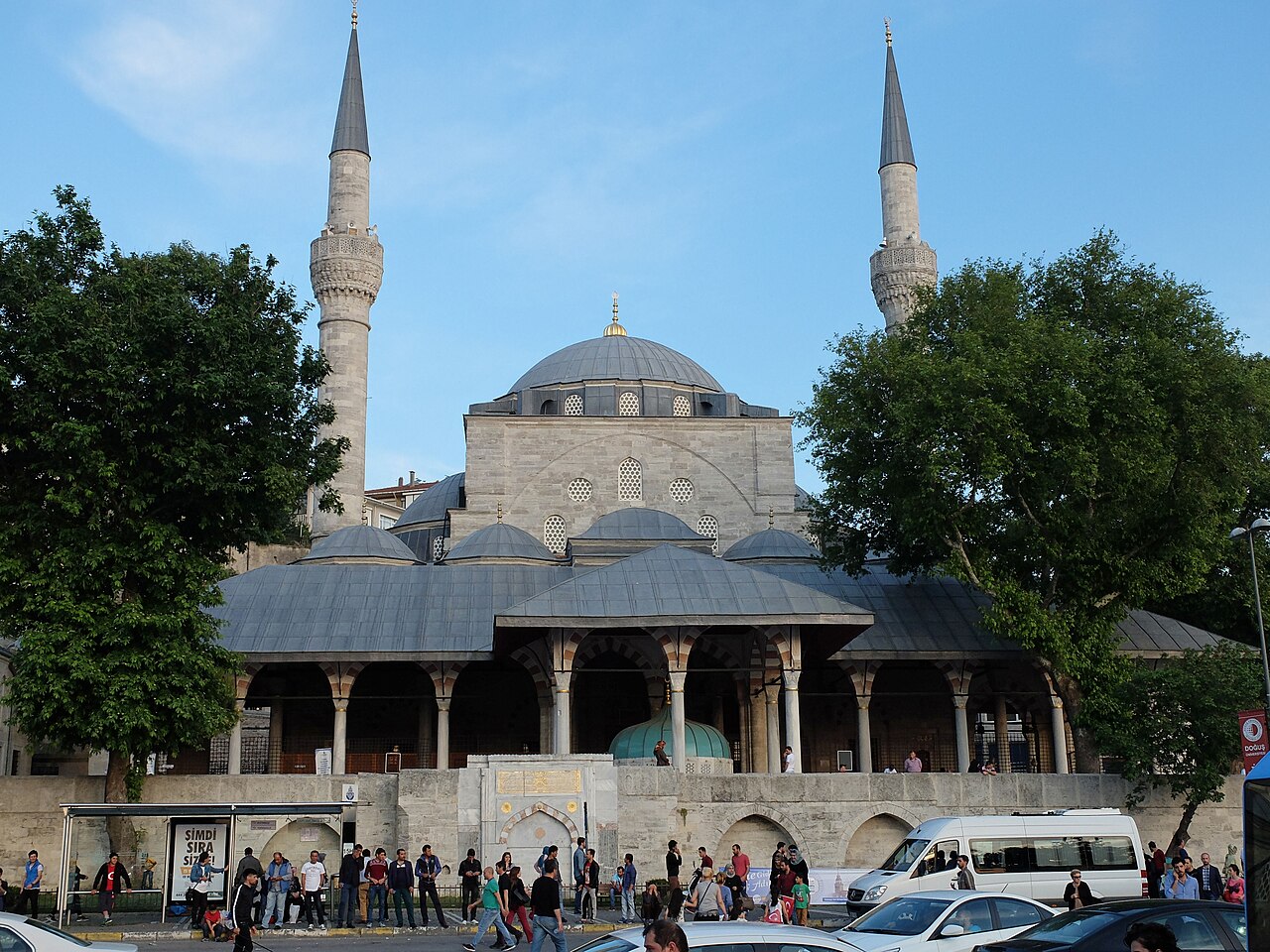
Photo: Gryffindor · Public domain · Wikimedia Commons
Palace of Blachernae is a palace. It is in Istanbul, Türkiye. Komnenos emperors made Blachernae their main residence. The free Lokali audio guide runs 7 minutes.
✓ Published October 2026 · how we write these guides
Visitor facts
| Lokali audio guide | 7 min · free |
|---|---|
| Type | Palace |
| Location | Istanbul, Türkiye |
| Coordinates | 41.0339, 28.9403 |
| Languages | 50+, in the Lokali app |
The story
Stand still for a moment and listen. Gulls call over the Golden Horn, a car climbs the steep lane, and somewhere a door bangs in an old wooden house. Under your feet the ground slopes down toward the water. Around you, thick walls of brick and pale stone rise in layers. They are cracked, patched, and softened by weeds. This quiet corner of Istanbul, in the district now called Ayvansaray, was once the home of Byzantine emperors.
The word Blachernae is older than the palace. It was the name of a suburb outside the first city walls. In the fifth century a church was built here for the Virgin Mary. Byzantine writers say it kept one of the most treasured relics of the Christian east: a robe believed to have belonged to the Virgin herself. For centuries, people in Constantinople believed this relic protected their city from attack.
Here is a detail many visitors miss. The holy spring connected to that ancient church still flows. A short walk downhill, a small Greek Orthodox church stands over the spring. Locals and pilgrims still come to drink the water and light candles. The church you see there is much more recent, but the spring belongs to the same sacred site. In a city of great domes, this small sanctuary links today's visitors to a very old tradition.
For most of Byzantine history, emperors lived in the Great Palace. That vast complex stood near Hagia Sophia, at the opposite end of the old city. Then, in the late eleventh century, the Komnenos dynasty began to favour Blachernae. Emperor Alexios the First and his successors turned the hillside into their main residence. Later, Emperor Manuel the First enlarged it. The centre of imperial power moved to this corner, close to the land walls and the harbour.
Why move here? The position was practical. The palace sat at the point where the great land walls meet the Golden Horn. From these heights, an emperor could watch the countryside to the west and the ships on the water below. Visitors from abroad wrote with amazement about rich halls, gold, and mosaics. Very little of that splendour survives. So use your imagination as you look at the bare brick in front of you.
The best-preserved building in the area is the one Turkish speakers call Tekfur Sarayı. The name roughly means the palace of the Christian lord. It is usually dated to the late thirteenth or early fourteenth century. Look at its facade. Bands of red brick alternate with courses of white stone. The pattern forms arches, checkerboards, and stripes. This style was typical of the last centuries of Byzantium. It is one of the best surviving examples of Byzantine palace architecture anywhere.
The building has three levels. On the ground floor, arches open onto a courtyard. The upper floors have wide windows that once looked out from grand rooms. The roof and the wooden floors disappeared long ago. For many years, only the stone shell remained. In recent years, the building was restored and opened as a museum. Inside, displays tell the story of the palace and of the workshops that later used this space.
And those workshops are the second surprise. After the Ottoman conquest, this imperial building had many ordinary lives. At one time, it reportedly held animals from the sultan's collection. In the early eighteenth century, it became a workshop for glazed tiles. Its kilns produced tiles for mosques and other buildings in the city. Later, glassmakers also worked here. The halls of emperors became places of fire, clay, and labour. The building survived because it remained useful.
In 1204, armies of the Fourth Crusade attacked Constantinople. The crusaders were Western European knights who had set out for the Holy Land. They broke into the city, and the walls in this area saw heavy fighting. The city was looted, and a Latin empire ruled here for decades. When Byzantine emperors returned in 1261, the Palaiologos dynasty again made Blachernae their home. But the empire was smaller and poorer. The palace never fully recovered its earlier glory.
Near here, look for the tall, solid towers set into the walls. Tradition calls them the Prison of Anemas. The name comes from a nobleman who was imprisoned, according to the chronicles, after plotting against Alexios the First. Dark vaulted chambers lie inside the structure. Their original purpose is still debated by scholars. Some see a prison, while others see the foundations of palace buildings. Either way, the massive stonework shows how strongly this hillside was fortified.
The final chapter came in 1453. The Ottoman sultan Mehmed the Second besieged the city. His army attacked the land walls for weeks. Legend has it that a small gate near here, called the Kerkoporta, was left open. According to the story, Ottoman soldiers came through it and raised their flag on a tower. Historians still argue about how much of this tale is true. What is certain is that the city fell, and the age of Byzantium ended.
After the conquest, the palace slowly faded into the neighbourhood. Houses were built against the old walls. Gardens grew between the ruins. A sixteenth-century Ottoman mosque stands close to the Anemas towers. Today, laundry hangs from windows near Byzantine brick. Children play football in small squares. Tea houses serve customers in the shade. This is not a museum city, sealed behind glass. People live here among the remains of the empire, as they have for centuries.
Before you leave, look once more at the walls. Notice the different repairs: brick next to stone, old blocks next to modern mortar. Each patch is a decision made by someone who wanted to keep this place standing. As you walk down toward the water, the noise of the modern city slowly returns. But the slope under your feet and the view of the Golden Horn are the same ones the emperors knew.
Key facts
What to look for
Practical tips
Common questions
Is there a free audio guide to Palace of Blachernae?
Yes — the Lokali app narrates Palace of Blachernae free of charge in 50+ languages. The guide runs about 7 minutes, covers the history, what to look for on site and practical tips, and works offline once downloaded.
Where is Palace of Blachernae?
Palace of Blachernae is in Istanbul, Türkiye, at 41.0339, 28.9403. Tap the map link on this page for directions from where you are.
What is Palace of Blachernae known for?
Komnenos emperors made Blachernae their main residence. The Church of Blachernae held a robe linked to Mary.
What should you look for at Palace of Blachernae?
Red brick and white stone bands on Tekfur Sarayı. Wide upper windows of the palace's vanished halls. Massive towers traditionally called the Prison of Anemas.
What should you know before visiting Palace of Blachernae?
Visit the Tekfur Palace Museum for context on the ruins. Walk downhill to the holy spring church afterwards.
When is the best time to visit Palace of Blachernae?
Dress modestly when entering the spring church.
On the map
Opens directions to Palace of Blachernae from your location.
More to see in Istanbul



Hear Palace of Blachernae in your language
The full story, narrated, in 50+ languages. Download it before you go and it plays offline, at your own pace, with no ticket and no tour group.