
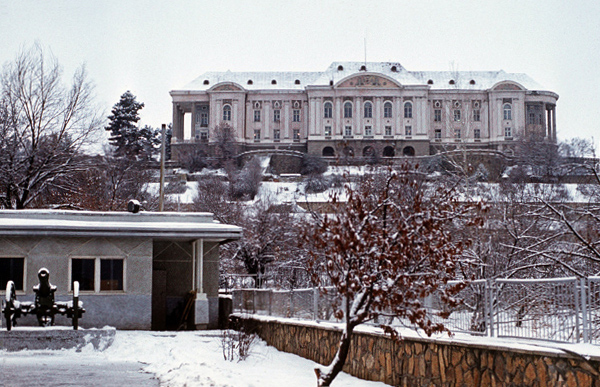
Photo: Jim Kelly · CC BY 2.0 · Wikimedia Commons
Gardens of Babur is a park in Kabul, Afghanistan. Babur founded the Mughal Empire in the sixteenth century. The free Lokali audio guide runs 7 minutes.
✓ Published October 2026 · how we write these guides
Visitor facts
| Lokali audio guide | 7 min · free |
|---|---|
| Type | Park |
| Location | Kabul, Afghanistan |
| Coordinates | 34.5030, 69.1600 |
| Languages | 50+, in the Lokali app |
The story
Listen first. Water moves somewhere below you, running in a narrow stone channel. Above it, leaves stir on the slope. The ground underfoot is not flat. It climbs, terrace by terrace, toward the bare brown shoulder of the mountain behind you. The air here feels a little cooler than the streets you just left. That small change in temperature is the whole idea of this place. A garden like this was built to be a refuge, a green room set against a dry land.
You are standing in the Gardens of Babur, known locally as Bagh-e Babur. They rise on the western slopes of the Sher Darwaza mountain, above the old heart of Kabul. The man who gave the garden its name is one of the great figures of Asian history. His name was Zahir-ud-din Muhammad Babur. In the early sixteenth century he founded the Mughal Empire, the dynasty that would later rule much of the Indian subcontinent and build the Taj Mahal.
Here is the first surprise. Babur did not die here. He died in Agra, in northern India, in 1530, at the height of his new empire. Yet he asked to be buried in Kabul. Some years after his death, his body was carried back across the mountains and laid to rest on this hillside. Of all the lands he had conquered, this was the city he chose for eternity. To understand why, you have to know how he wrote about it.
Babur left behind a memoir, the Baburnama. It is one of the earliest autobiographies in the Islamic world, written in Chagatai, a Turkic language of Central Asia. In its pages he describes Kabul with real affection. He writes about its climate, its fruit, its flowers, and its gardens. He clearly preferred these cool valleys to the heat of the Indian plains. For a conqueror, his voice is often personal, curious, and honest about his own doubts.
The garden follows a Persian tradition. Persian gardens were usually laid out as a chahar bagh, which means four gardens. The plan uses water channels and paths to divide the ground into ordered sections. In many traditions this design stood for the idea of paradise. Here, on a slope, the plan becomes a series of terraces. The water runs down the central axis, step by step, so that you hear it at almost every level.
As you walk up, notice how the view opens behind you. Each terrace lifts you a little higher above the city. The rooftops of Kabul spread out below, and on a clear day the mountains ring the horizon. This framing was deliberate. A Mughal garden was not only a place to look at. It was a place to look out from, a way of placing yourself between the earth and the sky.
Near the upper part of the garden stands a small mosque of white marble. It was built in the seventeenth century on the orders of Shah Jahan, the Mughal emperor who later built the Taj Mahal. He was Babur's descendant, several generations removed. The mosque is modest in size, but the marble is fine and carefully cut. Look at how the pale stone catches the light against the darker hillside. It is a small piece of imperial India, set in the mountains of Afghanistan.
Above the mosque is the grave of Babur himself. And here is the second surprise. For an emperor, the tomb is very simple. There is no great dome and no towering mausoleum. The grave sits in the open, surrounded by a carved marble screen. Many people say Babur wished to lie beneath the open sky, with rain and sunlight falling on his grave. Whatever the exact wording of his wish, the plainness of this spot feels intentional. Nearby are the graves of several members of his family.
The garden has not always looked like this. Over the centuries, rulers of Kabul altered and added to it. In the late nineteenth and early twentieth centuries, Afghan rulers built new structures here, including a pavilion often called the Queen's Palace. The garden became a place where city families came to walk and rest. For generations it was part of ordinary life in Kabul, a green space for picnics, conversation, and quiet afternoons.
Then came years of war. During the fighting of the 1990s, Kabul suffered terrible damage, and this hillside lay close to the front lines. Trees were cut down for firewood. Walls collapsed. The water stopped running. Photographs from that time show a bare, broken slope where the terraces had been. It is worth holding that image in your mind as you look at the green around you now.
In the early 2000s, a long restoration began, led by the Aga Khan Trust for Culture working with Afghan partners. Teams rebuilt the walls and the terraces. They studied old accounts, including Babur's own writing, to guide the replanting. Local craftsmen worked with traditional materials and methods. The work also trained people in skills like stone carving and woodwork. Much of what you see today is the result of that patient effort, carried out over several years.
Today the garden is again a public space. On any given day you may see families on the lawns, students walking in small groups, older men sitting in the shade, and children running along the paths. It is a place for rest rather than ceremony. That human life is part of its meaning. A garden only becomes a garden again when people return to use it.
Before you leave, stand still for a moment near the water. Look down the line of the channel as it falls toward the city. Listen for it again, the same sound that met you when you arrived. Five centuries ago, a young prince from Central Asia walked slopes like these and wrote about the flowers of Kabul. He chose this hillside over everything else he owned. As you walk back down the terraces, notice the cooler air giving way to the warmth of the streets, and take a little of that quiet with you.
Key facts
What to look for
Practical tips
Common questions
Is there a free audio guide to Gardens of Babur?
Yes — the Lokali app narrates Gardens of Babur free of charge in 50+ languages. The guide runs about 7 minutes, covers the history, what to look for on site and practical tips, and works offline once downloaded.
Where is Gardens of Babur?
Gardens of Babur is in Kabul, Afghanistan, at 34.5030, 69.1600. Tap the map link on this page for directions from where you are.
What is Gardens of Babur known for?
Babur founded the Mughal Empire in the sixteenth century. Babur died in Agra in 1530.
What should you look for at Gardens of Babur?
The stone water channel running down the central axis. The carved marble screen around Babur's open grave. The small white marble mosque of Shah Jahan.
What should you know before visiting Gardens of Babur?
Visit in the morning for cooler air and softer light. Walk up through every terrace before visiting the tomb.
When is the best time to visit Gardens of Babur?
Visit in the morning for cooler air and softer light.
On the map
Opens directions to Gardens of Babur from your location.
More to see near Gardens of Babur
Hear Gardens of Babur in your language
The full story, narrated, in 50+ languages. Download it before you go and it plays offline, at your own pace, with no ticket and no tour group.