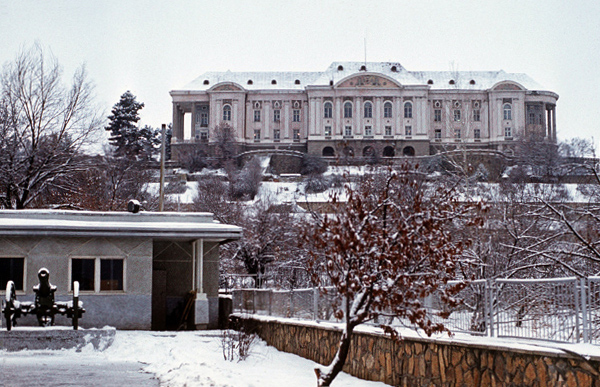
Photo: Photo: Mikhail Evstafiev · CC BY-SA 3.0 · Wikimedia Commons
Tajbeg Palace is a palace in Kabul, Afghanistan. Built in the 1920s under King Amanullah Khan. The free Lokali audio guide runs 7 minutes.
✓ Published October 2026 · how we write these guides
Visitor facts
| Lokali audio guide | 7 min · free |
|---|---|
| Type | Palace |
| Location | Kabul, Afghanistan |
| Coordinates | 34.4548, 69.1133 |
| Languages | 50+, in the Lokali app |
The story
Feel the wind first. Up here on this low hill above the southwest edge of Kabul, the air moves freely. It carries dust from the plain below and, on clear days, the cold breath of the mountains. Under your feet, the ground is dry and broken. Ahead stands a pale, scarred building with tall window openings and the outline of a grand European house. It looks oddly out of place among the brown hills. That contrast is the beginning of its story.
This is Tajbeg Palace. It is often called the Queen's Palace. It was built in the 1920s, during the reign of King Amanullah Khan. Amanullah came to the throne in 1919, the year Afghanistan secured full control of its own foreign affairs from Britain. He was a young ruler in a hurry. He wanted schools, new laws, new dress, and a new capital that showed a modern face to the world. This hill was part of that vision.
Amanullah planned a whole new administrative district here, away from the crowded old city. He called it Darul Aman, which means the abode of peace. Its centrepiece was the large Darul Aman Palace, which you can see on the plain below if the light allows. Tajbeg was its companion on the higher ground. German architects and engineers worked on the project, and you can see their influence in the formal European design. The idea was bold... a capital built from nothing, facing the future.
Look at the shape of the building. It follows the language of European palaces of that era. There are symmetrical wings, a strong central block, rows of tall windows, and a terrace that faces outward over the valley. In its first years, the plaster was smooth and pale, and gardens spread around it. Today much of that surface is gone. You can see brick, rubble, and patched repairs. The bones of the design are still clear, though, and they tell you what the builders hoped to make.
Amanullah's reforms did not last. After a long journey through Europe in the late 1920s, he returned home and pushed even faster for change. Many people resisted, especially in the countryside. In 1929, he was forced from power and left the country. The grand plan for Darul Aman slowed and stalled. The palaces remained, but the new capital he imagined never fully took shape. For decades, this hill saw quieter years, with the building used for various official purposes.
Then came the night that made Tajbeg known far beyond Afghanistan. In late 1979, the president of the country was Hafizullah Amin. He had moved his residence to this palace, partly because the hilltop was easier to defend. He believed the Soviet Union was his ally. In fact, Moscow had already decided to remove him. Soviet troops were arriving in Kabul, and Amin still thought they had come to help him.
On 27 December 1979, Soviet special forces attacked the palace. The operation is often known by its code name, Storm-333. Soviet soldiers, some of them dressed in Afghan uniforms, fought their way up this hill and into the building. The battle was short but very violent. Amin was killed inside the palace that night. Within hours, a new government loyal to Moscow was in place. This assault marked the start of the Soviet war in Afghanistan, which lasted for about a decade.
Here is a detail many visitors do not expect. After the attack, the Soviets did not abandon Tajbeg. They used it as a headquarters for their army in Afghanistan. So the building where the war began also became one of the places from which the war was run. For years, Soviet officers worked inside these rooms. The view from the terrace, which once showed a king's new capital, now looked over a country at war.
The damage did not end when Soviet troops left. In the 1990s, rival armed groups fought for control of Kabul. The Darul Aman area lay near the front lines, and both palaces were hit hard. Shells and gunfire tore through walls and roofs. Fires burned through the interiors. When you look closely at the stone and brick, you can still see the marks of that time. The palace carries the record of more than one war in its surfaces.
There is a second surprise in this landscape. Turn toward Darul Aman Palace on the plain. That building suffered similar damage, yet it was restored in the late 2010s and reopened with fresh walls and a clean roofline. Tajbeg has not received the same complete restoration. Standing here, you can compare the two. One shows what this district looked like when it was new. The other shows what decades of conflict can do to stone and plaster.
Now take a moment for the setting itself. From this height, Kabul spreads out in a wide bowl. Low houses climb the far hillsides. Roads run toward the old city centre. On many days a haze of dust and smoke softens the distance. Behind you, the hills rise toward higher ranges. In winter, snow often covers those peaks. You can understand why both a king and a president chose this ground. It gives a clear view, and it feels apart from the noise of the city.
The sounds here are simple. You may hear wind across the open slopes, distant traffic, the call to prayer drifting up from the neighbourhoods below, and perhaps a dog barking somewhere on the hillside. Access to the site can depend on local rules and the current security situation, so it is wise to follow the guidance of your local contacts. Move carefully around the ruins. Broken floors and loose stones are part of what remains, and safety matters more than any photograph.
Before you leave, look once more at the building in front of you. Notice the tall window frames that now hold only sky. Notice the patched brick next to the remaining fragments of pale plaster. This one hill holds a king's dream of a modern capital, the first night of a long war, and the damage of the years that followed. As you walk back down the slope, listen to the wind again. It is the same wind that moved across this hill when the palace was new.
Key facts
What to look for
Practical tips
Common questions
Is there a free audio guide to Tajbeg Palace?
Yes — the Lokali app narrates Tajbeg Palace free of charge in 50+ languages. The guide runs about 7 minutes, covers the history, what to look for on site and practical tips, and works offline once downloaded.
Where is Tajbeg Palace?
Tajbeg Palace is in Kabul, Afghanistan, at 34.4548, 69.1133. Tap the map link on this page for directions from where you are.
What is Tajbeg Palace known for?
Built in the 1920s under King Amanullah Khan. Part of Amanullah's planned Darul Aman capital district.
What should you look for at Tajbeg Palace?
Empty window frames opening straight onto the sky. Scraps of pale plaster beside exposed brickwork. Symmetrical wings in a European palace layout.
What should you know before visiting Tajbeg Palace?
Check current access rules with local contacts before visiting. Wear sturdy shoes for broken ground and loose stones.
On the map
Opens directions to Tajbeg Palace from your location.
More to see near Tajbeg Palace

Hear Tajbeg Palace in your language
The full story, narrated, in 50+ languages. Download it before you go and it plays offline, at your own pace, with no ticket and no tour group.