
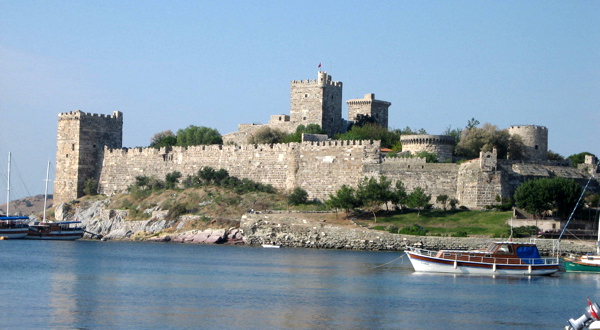
Photo: Wikimedia Commons contributor · CC BY-SA 3.0 · Wikimedia Commons
Kalymnos is a Greek island. It is in Kalymnos, Greece. Kalymnos lies in the Dodecanese, close to Turkey. The free Lokali audio guide runs 7 minutes.
✓ Published October 2026 · how we write these guides
Visitor facts
| Lokali audio guide | 7 min · free |
|---|---|
| Type | Archaeological Site |
| Location | Kalymnos, Greece |
| Coordinates | 36.9959, 26.9950 |
| Official website | kalymnos.gov.gr |
| Languages | 50+, in the Lokali app |
The story
Start with the light. On Kalymnos it falls hard and white on bare grey limestone, and the rock seems to hold the heat long after noon. The air smells of dry thyme and salt. Somewhere below you, a fishing boat engine knocks across the water, and a goat bell rings from a slope that looks far too steep for any animal. This is a dry, rocky island in the eastern Aegean, and the sea has shaped almost everything about its people.
Kalymnos belongs to the Dodecanese, a chain of Greek islands close to the coast of Turkey. Its neighbours include Kos to the south and Leros to the north. The island is mountainous and has very few trees on its high ground. Fertile land has always been scarce here. For generations, Kalymnians could not rely on farming alone. So they looked to the water around them, and they went down into it.
The island is known above all for sponges. For centuries, Kalymnian men dived for the natural sponges that grow on the seabed of the Mediterranean. In the oldest method, a diver held a heavy flat stone, called a skandalopetra, and let it pull him straight down on a single breath. He cut the sponges, gathered them, and was hauled back up by a rope. It took enormous lung capacity and nerve. Boys trained for it from a young age.
Then, in the late nineteenth century, a new technology arrived — the diving suit, with a heavy helmet and an air hose fed from the boat above. It let men stay down far longer and go much deeper. The harvests grew. But divers did not yet understand how the body reacts to rising too fast from depth. Many men were paralysed or killed by decompression sickness, which divers call the bends. Prosperity and grief came to the island together.
Here is something most visitors never hear about. Kalymnos has a traditional dance called the mihanikos, which loosely means the dance of the machine man, or the diver in the suit. In it, a dancer leans on a walking stick and moves with a stiff, broken step. He plays a diver crippled by the bends. As the music rises, he throws the stick away and dances freely again. Locals perform it at festivals and celebrations, and it carries the memory of those lost and injured men.
Each spring, the sponge fleets once left for months, sailing as far as the coast of North Africa. Families held farewell gatherings before the boats departed. Some men did not come home. Today the trade is much smaller. Disease struck sponge beds across the Mediterranean in the late twentieth century, and synthetic sponges took most of the market. Still, you will find sponge shops along the waterfront, with baskets of pale, honey-coloured sponges stacked by the doors.
The main town and port is Pothia. If you arrive by ferry, it is the first thing you see. Houses climb the hills in tiers on both sides of the harbour, painted white, ochre, pale blue and soft pink. In the evening the windows catch the low sun one row at a time. Along the quay, cafés fill with locals, and fishing boats tie up beside the larger ferries. The town feels like a working place first, and a holiday place second.
The island's past also includes a period of foreign rule. Italy took control of the Dodecanese in 1912, and Italian rule lasted until the Second World War. You can still see traces of that time in some of the public buildings around Pothia, with their formal arches and pastel facades. After the war, the islands joined Greece in 1948. Kalymnians kept their language, their church and their customs through these changes, and they remain fiercely proud of them.
A short drive inland from Pothia brings you to Chora, the old capital, set higher up and further from the sea. Islands like this one often built their main settlements inland, out of sight of pirates. Above Chora, on a rocky height, stand the ruins of a medieval castle, known as Pera Kastro. Inside its walls are small whitewashed chapels. Nearby, a row of old windmills stands along the ridge, their stone towers now quiet.
Now for the second surprise. In recent decades, Kalymnos has found a new way to live from its rock. In the late 1990s, climbers discovered that the island's limestone cliffs were ideal for sport climbing. The rock is full of pockets, ridges and hanging stalactites. Today there are thousands of bolted climbing routes, and climbers come from all over the world. The areas around Masouri and Myrties, on the west coast, fill with people carrying ropes and helmets.
From that west coast, look across the narrow channel to the islet of Telendos. It rises from the sea like a single great block of stone, very close to the main island. Locals say that Telendos was once joined to Kalymnos, and that an ancient earthquake split them apart. Small boats cross the channel throughout the day. On Telendos there are no cars, just a small village, a few tavernas and quiet paths. At sunset, the sun often drops just beside it.
On the eastern side of the island, the landscape changes completely. The road winds down into Vathy, a long, narrow inlet with steep rock walls on both sides. At the end of the inlet sits a small harbour. Behind it lies a green valley, with orchards of citrus trees — mandarins and lemons — enclosed by stone walls. After the bare grey mountains, the green feels almost unreal. In spring, the smell of blossom drifts across the road.
Kalymnians are also known for a loud and unusual Easter custom. Around Easter, some locals set off homemade explosives on the hillsides above the town. The booms echo across the harbour, and the sound is closer to a battle than a celebration. Some say the tradition began with the dynamite once used for fishing. Whatever its origin, it shows something about this island. People here have long lived with risk, and they meet it with noise and pride.
So take a moment where you are. Look at the rock, the sea, and the houses climbing up from the water. Every part of this island tells you how people found a living in a hard place — first beneath the waves, now on the cliffs. As you walk on, listen for the boat engines, the clink of climbing gear, or the scrape of a café chair on stone. The sea is still close. It always has been.
Key facts
What to look for
Practical tips
Common questions
Is there a free audio guide to Kalymnos?
Yes — the Lokali app narrates Kalymnos free of charge in 50+ languages. The guide runs about 7 minutes, covers the history, what to look for on site and practical tips, and works offline once downloaded.
Where is Kalymnos?
Kalymnos is in Kalymnos, Greece, at 36.9959, 26.9950. Tap the map link on this page for directions from where you are.
What is Kalymnos known for?
Kalymnos lies in the Dodecanese, close to Turkey. Sponge diving was the island's main trade for centuries.
What should you look for at Kalymnos?
Pastel houses rising in tiers around Pothia harbour. Pale sponges stacked in baskets outside harbour shops. Whitewashed chapels inside the walls of Pera Kastro.
What should you know before visiting Kalymnos?
Take the short boat across to Telendos for a car-free afternoon. Visit a waterfront sponge shop to see natural sponges up close.
When is the best time to visit Kalymnos?
Watch sunset from the west coast near Myrties.
On the map
Opens directions to Kalymnos from your location.
More to see near Kalymnos
Hear Kalymnos in your language
The full story, narrated, in 50+ languages. Download it before you go and it plays offline, at your own pace, with no ticket and no tour group.