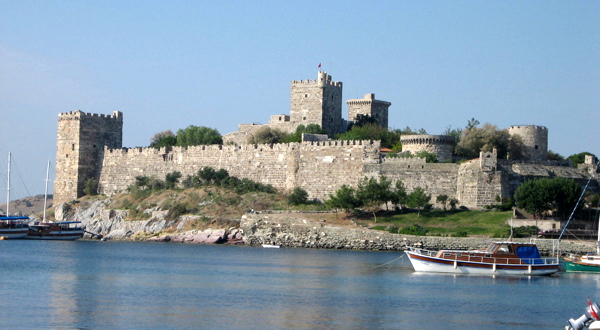
Bodrum Castle is a castle in Bodrum, Türkiye. Knights Hospitaller began the castle around 1406. Walls reuse marble from the Mausoleum of Halicarnassus. Most visitors spend 2-3 hours here. The free Lokali audio guide runs 6 minutes.
✓ Verified October 2026 · how we write these guides
Visitor facts
| Time needed | 2-3 hours |
|---|---|
| Lokali audio guide | 6 min · free |
| Type | Castle |
| Best for | History |
| Location | Bodrum, Türkiye |
| Coordinates | 37.0319, 27.4292 |
| Languages | 45, in the Lokali app |
The story
Gulls argue overhead, and rigging taps against the masts of wooden yachts in the harbour below. Salt hangs in the air. Above it all rise walls of grey and green stone, so broad at the base that they seem to grow out of the rock itself. This is Bodrum Castle, standing on a small headland between the town's two bays. Sea on three sides, town on the fourth. Before the history, just feel the position — whoever held this rock held the coast.
The builders were the Knights Hospitaller, a military order of European crusaders based on the island of Rhodes. In 1402, the Central Asian conqueror Timur destroyed their fortress at Smyrna, up the coast. The knights needed a new foothold on the Anatolian mainland, and a few years later, around 1406, they began building here. They dedicated the castle to Saint Peter and called it Petronium. Many scholars believe the town's name, Bodrum, echoes that old word.
Now look closely at the walls, because they hide a scandal of recycling. Among the rough greenish volcanic stone sit blocks of polished white marble — squared, gleaming, and clearly from somewhere else. They are. The knights quarried the ruins of the Mausoleum of Halicarnassus, one of the Seven Wonders of the Ancient World, which lay collapsed a short walk inland. Pieces of a wonder are packed into these fortifications. Spotting them is one of the castle's quiet games.
The knights came from across Europe, and they organised themselves by language groups. Each group took responsibility for part of the defences, which is why the towers carry national names: the English Tower, the French Tower, the German Tower, the Italian Tower, the Spanish Tower. On the English Tower, look for the carved lion relief and coats of arms left by its builders. The castle was a shared European project, assembled tower by tower on Anatolian rock.
For over a century, the fortress served as a stronghold and a refuge on a hostile coast. Then the politics changed in one stroke. In 1522, the Ottoman sultan Suleiman besieged and took Rhodes, the knights' headquarters. Under the surrender terms, the order left the region, and in 1523 this castle passed to the Ottomans without a fight. The chapel became a mosque, and a minaret rose beside it. Centuries later, the castle even served for a time as a prison.
What fills the castle today is stranger and better than weapons — shipwrecks. Since the 1960s, the fortress has housed the Museum of Underwater Archaeology, one of the most important of its kind anywhere. The collection began with objects raised by local sponge divers, who kept finding ancient cargoes on the seabed. Archaeologists followed the divers' tips, and Bodrum became a world centre for excavating ships that sank thousands of years ago. The halls inside hold their cargoes.
The star is the Uluburun shipwreck. In 1982, a sponge diver spotted odd metal slabs on the seabed off a cape near Kaş, along the coast to the east. They turned out to be copper ingots from a trading ship that sank about 3,300 years ago — one of the oldest wrecks ever excavated. Its cargo reads like a royal shopping list: copper and tin, coloured glass ingots, ebony, ivory, resin, and a gold scarab bearing the name of the Egyptian queen Nefertiti.
Another hall holds the Glass Wreck from Serçe Limanı, a ship that went down in the eleventh century carrying tons of broken glass destined for recycling. From those shattered fragments, researchers reassembled vessels piece by piece, and the display cases glow with green and purple. Between the two wrecks, you can stand within one castle and span more than two thousand years of Mediterranean trade — Bronze Age kings at one end, medieval glass merchants at the other.
Between the exhibition halls, the castle softens into a garden. Peacocks stroll the courtyards and terraces, entirely unbothered by visitors, and doves murmur in the wall niches. Amphorae are stacked in pyramids under the trees, and the planting mixes myrtle, plane trees, and Mediterranean herbs. The knights built for war, but the interior now feels closer to a shaded park with battlements. Take the slow route between halls, and let the peacocks set the pace.
Climb to the ramparts for the finale. From the walls, Bodrum arranges itself around you: white cube houses climbing the hills, the twin bays split by the castle itself, wooden gulets — the traditional local sailing boats — moored in rows, and ferries drawing lines toward the Greek island of Kos on the horizon. The knights watched this same water for enemy sails. You can watch it for the afternoon boat traffic, which is considerably more relaxing.
The castle has been restored more than once, most recently in a long project completed in recent years, so wander with curiosity — courtyards, cisterns, chapel, towers, dungeons. The dungeon below the Gatehouse carries a grim inscription about justice from the knights' era, a reminder that this was never a decorative building. Wear decent shoes. The stairs are worn, the ramparts are uneven, and the best corners of the castle all involve a short climb.
Before you leave, find a spot on the seaward wall and put your hand on a marble block that may once have shaded a king's tomb. Wonder, fortress, mosque, prison, museum — this headland has tried five careers and kept souvenirs from each. Below, the rigging is still tapping its patient rhythm against the masts. The gulls are still arguing. The sea, which sank every ship in the halls behind you, glitters as if it remembers none of it.
Key facts
What to look for
Practical tips
Common questions
How long do you need at Bodrum Castle?
Plan 2-3 hours. That is the time most visitors spend at Bodrum Castle. The free Lokali audio guide runs 6 minutes and is made to listen to while you walk.
Is there a free audio guide to Bodrum Castle?
Yes — the Lokali app narrates Bodrum Castle free of charge in 50+ languages. No ticket, tour group or subscription, and it works offline once downloaded.
Where is Bodrum Castle?
Bodrum Castle is in Bodrum, Türkiye, at 37.0319, 27.4292. Tap the map link on this page for directions.
What should you know before visiting Bodrum Castle?
Wear flat shoes for the uneven ramparts and stairs
What is Bodrum Castle known for?
Knights Hospitaller began the castle around 1406
What is the best time to visit Bodrum Castle?
Climb the towers early before midday heat builds
On the map
Opens directions to Bodrum Castle from your location.
More to see in Bodrum

Hear Bodrum Castle in your language
The full story, narrated, in 50+ languages. Download it before you go and it plays offline, at your own pace, with no ticket and no tour group.