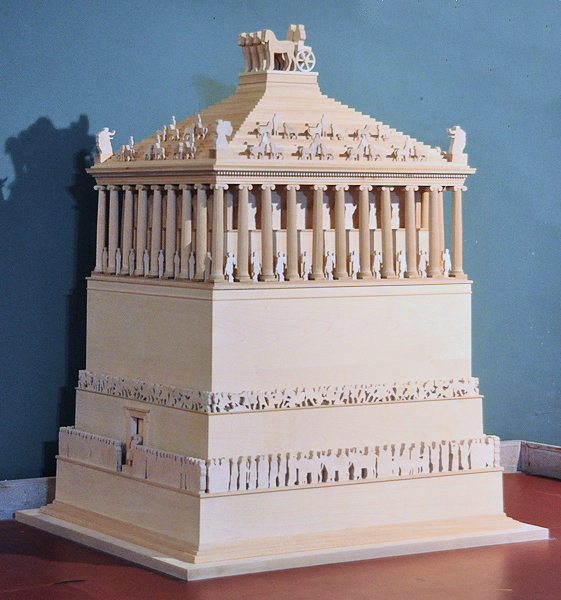
Mausoleum at Halicarnassus
37.0380° N · 27.4241° E · Ancient Wonder Site
Mausoleum at Halicarnassus is an ancient wonder site in Bodrum, Türkiye. Mausolus, ruler of Caria, died in 353 BC. The word mausoleum comes from this single tomb. Most visitors spend 45-60 min here. The free Lokali audio guide runs 6 minutes.
✓ Verified October 2026 · how we write these guides
Visitor facts
| Time needed | 45-60 min |
|---|---|
| Lokali audio guide | 6 min · free |
| Type | Ancient Wonder Site |
| Best for | History |
| Location | Bodrum, Türkiye |
| Coordinates | 37.038, 27.4241 |
| Languages | 45, in the Lokali app |
The story
It is quiet here. Birds move through the pines and olive trees, and traffic hums faintly from the streets of Bodrum beyond the wall. In front of you lies a sunken rectangle of pale stone — foundations, trenches, scattered drums and blocks. Be honest with your eyes: this is a ruin at ground level. Then adjust your imagination, because on this exact spot stood one of the Seven Wonders of the Ancient World, a tomb so famous it renamed tombs forever.
The man in question was Mausolus, ruler of Caria, the region around you. Officially he was a satrap — a provincial governor serving the Persian Empire — but in practice he ruled like a king. In the fourth century BC he moved his capital to Halicarnassus, the city that became Bodrum, and rebuilt it with walls, a palace, and a theatre. He planned his own tomb as the centrepiece. When he died in 353 BC, the project was already underway.
His successor was Artemisia, who was both his sister and his wife — royal marriages in Caria kept power inside the family. Ancient writers tell a startling story about her grief: she is said to have mixed her husband's ashes into her drink, making herself his living tomb. Story or not, she drove the construction forward. She died only about two years after him, yet the craftsmen chose to finish the monument anyway, reportedly as a memorial to their own skill.
What they finished was extraordinary. The tomb rose roughly forty-five metres — about the height of a modern fifteen-storey building — in three stacked parts. A tall rectangular podium held the burial. Above it ran a colonnade of marble columns, like a Greek temple lifted into the sky. Above that climbed a stepped pyramid roof, and at the very top stood a marble four-horse chariot. Statues and carved friezes covered the building at every level. Nothing quite like it existed.
We even know who made it, thanks to the Roman writer Pliny the Elder. He recorded that the architects were Satyros and Pythius, and that four of the most celebrated Greek sculptors of the age — Scopas, Bryaxis, Timotheus, and Leochares — each took one side of the building. Imagine that arrangement: four rival masters, one per facade, competing in marble on the same monument. The tomb was a sculpture gallery before it was anything else.
Ancient writers placed it on the list of the Seven Wonders, alongside the pyramids of Egypt and the hanging gardens of Babylon. And it achieved something none of the others managed: it entered the dictionary. The ruler's name, Mausolus, became the word mausoleum — now the term for a grand tomb in English and many other languages. Say the word anywhere in the world, and you are quoting this hillside. That is a rare kind of immortality.
The building outlasted the empire that watched it rise, and the ones after that. It stood for some fifteen hundred years, longer than almost any of its rivals on the Wonders list. Its end came slowly, not in a single disaster. A series of earthquakes between the twelfth and fifteenth centuries broke the colonnade, dropped the chariot, and finally brought the great mass of marble down into the pile of blocks that later generations found.
Then came the recyclers. In the fifteenth and sixteenth centuries, the Knights Hospitaller were strengthening their castle by the harbour — the fortress you can still visit today — and the fallen Wonder became their quarry. Squared green stones and polished marble from the tomb went into the castle walls, where sharp eyes can still find them. A later chronicler recorded that the knights even broke into a splendid burial chamber, and found it looted soon after. Treat that account with caution, as historians do.
The scientific chapter opened in the 1850s, when the British archaeologist Charles Newton located the site and excavated it. He shipped slabs of the frieze — Greeks battling Amazons in furious motion — and two colossal statues to London. The statues are known today as Mausolus and Artemisia, though the names are a guess; no inscription confirms who they portray. They stand now in the British Museum, calm and monumental, a very long way from this quiet garden.
So what is actually here? Walk the platform and read the ground. You can trace the rectangular cutting where the foundations sat, along with drainage channels cut into the rock, staircases, and the approach to the burial vault. Column drums and carved fragments rest in the grass. A small covered gallery displays a model of the monument, casts of the friezes, and finds from the site. Start there — it gives your imagination the scaffolding it needs.
There is one more place to look: up. Stand at the edge of the platform and rebuild the tomb in the air above you — podium, columns, pyramid, chariot, forty-five metres of marble flashing in the Aegean sun, visible to every ship entering the harbour. Sailors used it as a landmark for a thousand years. The town has grown over the view, but the geometry is still yours to raise, and no earthquake can touch that version.
Before you go, listen to the pines again and let the quiet do its work. Every mausoleum on Earth — presidential, imperial, municipal — carries this hillside's name like a signature. The building fell, the sculptures scattered, and yet the idea travelled further than the marble ever did. You are standing in the hole a word left behind. As endings go, the birds and the afternoon light make a gentler crown than any chariot.
Key facts
What to look for
Practical tips
Common questions
How long do you need at Mausoleum at Halicarnassus?
Plan 45-60 min. That is the time most visitors spend at Mausoleum at Halicarnassus. The free Lokali audio guide runs 6 minutes and is made to listen to while you walk.
Is there a free audio guide to Mausoleum at Halicarnassus?
Yes — the Lokali app narrates Mausoleum at Halicarnassus free of charge in 50+ languages. No ticket, tour group or subscription, and it works offline once downloaded.
Where is Mausoleum at Halicarnassus?
Mausoleum at Halicarnassus is in Bodrum, Türkiye, at 37.038, 27.4241. Tap the map link on this page for directions.
What should you know before visiting Mausoleum at Halicarnassus?
Start at the covered gallery to grasp the layout
What is Mausoleum at Halicarnassus known for?
Mausolus, ruler of Caria, died in 353 BC
On the map
Opens directions to Mausoleum at Halicarnassus from your location.
More to see in Bodrum

Hear Mausoleum at Halicarnassus in your language
The full story, narrated, in 50+ languages. Download it before you go and it plays offline, at your own pace, with no ticket and no tour group.