
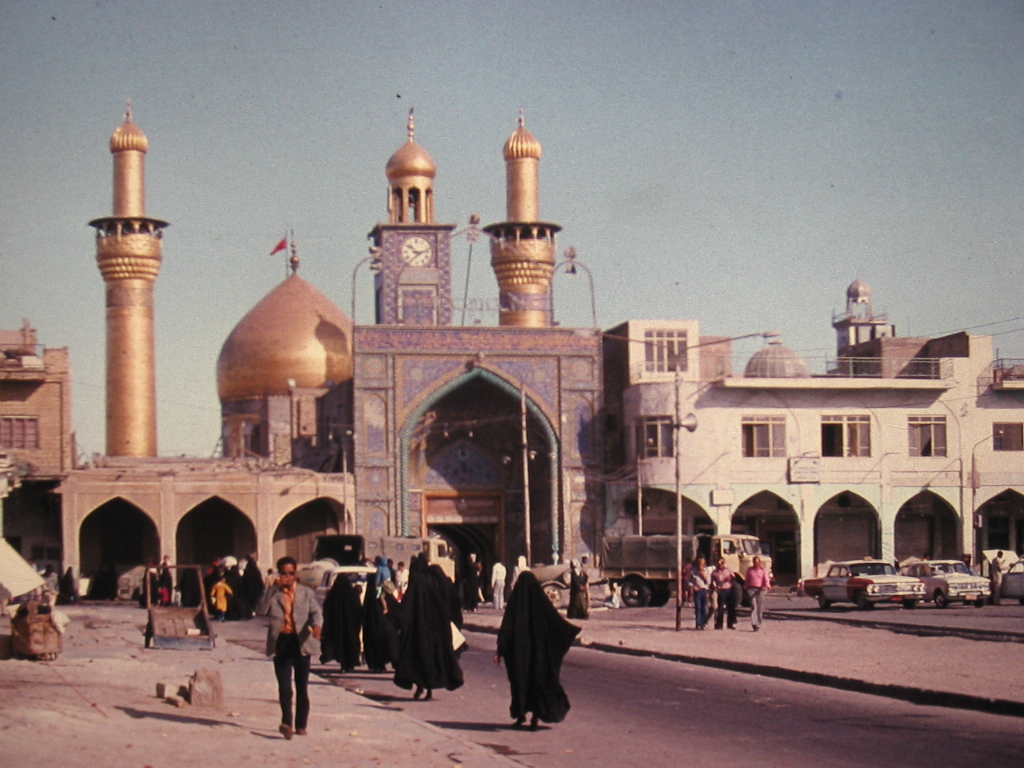
Photo: Sameralhusseini1987 · CC BY-SA 4.0 · Wikimedia Commons
Al-Abbas Shrine is a mosque in Iraq. Abbas ibn Ali was the half-brother of Imam Husayn. The free Lokali audio guide runs 7 minutes.
✓ Published October 2026 · how we write these guides
Visitor facts
| Lokali audio guide | 7 min · free |
|---|---|
| Type | Mosque |
| Location | Karbala, Iraq |
| Coordinates | 32.6172, 44.0362 |
| Languages | 50+, in the Lokali app |
The story
Take off your shoes, and the marble meets you first. It is cool, smooth, and slightly damp where it has just been washed. Around you, thousands of bare feet move across the same floor. Somewhere a man is reciting in a low, rising voice. Overhead, a golden dome catches the light and throws it back across the courtyard. This is the Al-Abbas Shrine in Karbala, and for millions of people it is one of the most beloved places on earth.
The man buried here is Abbas ibn Ali. He was a son of Ali ibn Abi Talib, the cousin and son-in-law of the Prophet Muhammad. His mother was a woman named Fatima bint Hizam, better known by the title Umm al-Banin, which means the mother of sons. Abbas was a half-brother of Husayn, the grandson of the Prophet. Their story, and the way it ended, is the reason this city exists in the form you see today.
In 680, on the plains beside the Euphrates, Husayn and a small company of family and companions faced a much larger army sent by the Umayyad caliph. The Umayyads were the ruling dynasty of the early Islamic empire, based in Damascus. The battle took place on the tenth day of the month of Muharram, a day Shia Muslims remember as Ashura. Husayn and nearly all the men with him were killed. Karbala became a place of mourning... and then a place of pilgrimage.
Abbas carried Husayn's banner that day. That is why he is often called the standard-bearer. The most famous story about him is about water. According to the tradition that pilgrims tell and retell, the camp had been cut off from the river, and the children were thirsty. Abbas rode to the Euphrates and filled a water skin. He did not drink himself. On the way back, the tradition says, he lost both arms, and the water skin was pierced before he could reach the tents.
That image — a man who would not drink while children waited — is everywhere here once you know to look for it. You will hear it in the recitations. You may see it in banners and paintings sold in the streets outside. Many visitors bring water, or hand out water, in his memory. During pilgrimage seasons, volunteers stand along the roads offering cups to strangers. Here, giving water is not just kindness. It is a way of remembering him.
Now look outward from the courtyard. The shrine of Abbas does not stand alone. A short walk away rises the shrine of Imam Husayn, with its own golden dome. The open space that links them is known as Bayn al-Haramayn, which means between the two shrines. On ordinary evenings, families stroll and sit there. On the great days of the calendar, it fills from edge to edge with people, moving slowly in both directions, from one brother to the other.
Why are the two brothers buried apart? The traditional explanation is that each man was buried close to where he fell. Abbas died nearer the river, on his way back with the water, so his grave lies there. Locals also tell a story that water still gathers in the lowest levels beneath the tomb, as if the river never quite left him. Treat that as a pilgrim's tale rather than a survey report. But it shows how closely Abbas and water are tied together here.
The building around you is the result of many centuries of rebuilding, gilding, and expansion. Rulers, communities, and ordinary donors have added to it over time. The shrine has also been damaged in times of war and unrest, and then restored. What you see today is largely the work of recent decades. A dedicated religious administration now looks after the complex, its services, and the crowds. It has enlarged courtyards and added roofs and shade, so that more pilgrims can fit inside at once.
Inside the main hall, the light changes completely. Many surfaces are covered in mirror work — thousands of small pieces of cut glass set into the walls and ceilings. This craft is common in Shia shrines in Iraq and Iran. The mirrors break the lamplight into countless points, so the room seems to glitter and move. In the centre stands the tomb itself, enclosed by a large metal cage of silver and gold. Pilgrims reach through the crowd to touch it, kiss it, and pray beside it.
Watch the people around that cage, because this is the heart of the place. Some weep openly. Some tie small pieces of cloth, or press their palms flat against the metal. Some speak quietly, as if to a relative. Among Shia Muslims, Abbas is known as Bab al-Hawaij, the gate of needs. People come to ask him for help with illness, debt, marriage, or children. In parts of Iraq, swearing an oath by Abbas is taken extremely seriously — more seriously, some say, than an ordinary promise.
The largest gatherings come during Muharram and especially at Arbaeen. Arbaeen marks forty days after Ashura, following the traditional period of mourning. In those weeks, enormous numbers of pilgrims walk to Karbala, many of them on foot from Najaf and from cities far beyond. Along the routes, local families set up tents and kitchens and feed walkers for free. If you visit outside these seasons, the shrine is calmer, and you can move more slowly and look more closely.
A few practical notes will make your visit easier. Security checks at the gates are thorough, and large bags or professional cameras may be turned away. Shoes go into a shoe depository near the entrance, where you receive a token. Men and women often use separate entrances. Women are expected to wear a full covering, and loose cloaks are often available to borrow at the gate. Dress modestly, move gently, and stay out of the way of people at prayer.
Before you leave, stand still for a moment in the courtyard. Look up at the dome, and then across toward the other golden dome, the one belonging to Husayn. Listen to the shuffle of feet on marble and the murmur of prayers in many accents. Notice the water stations and the people pausing to drink. As you walk out into the streets of Karbala, you carry a small part of that old story with you — a story about thirst, loyalty, and a brother who did not turn back.
Key facts
What to look for
Practical tips
Common questions
Is there a free audio guide to Al-Abbas Shrine?
Yes — the Lokali app narrates Al-Abbas Shrine free of charge in 50+ languages. The guide runs about 7 minutes, covers the history, what to look for on site and practical tips, and works offline once downloaded.
Where is Al-Abbas Shrine?
Al-Abbas Shrine is near Karbala, Iraq, at 32.6172, 44.0362. Tap the map link on this page for directions from where you are.
What is Al-Abbas Shrine known for?
Abbas ibn Ali was the half-brother of Imam Husayn. He died at the Battle of Karbala in 680.
What should you look for at Al-Abbas Shrine?
The golden dome facing Imam Husayn's shrine across the plaza. Mirror mosaics glittering on the walls and ceilings inside. The silver and gold cage around the tomb.
What should you know before visiting Al-Abbas Shrine?
Leave large bags and professional cameras at your hotel. Women should bring or borrow a full-length cloak.
On the map
Opens directions to Al-Abbas Shrine from your location.
More to see in Karbala


Hear Al-Abbas Shrine in your language
The full story, narrated, in 50+ languages. Download it before you go and it plays offline, at your own pace, with no ticket and no tour group.