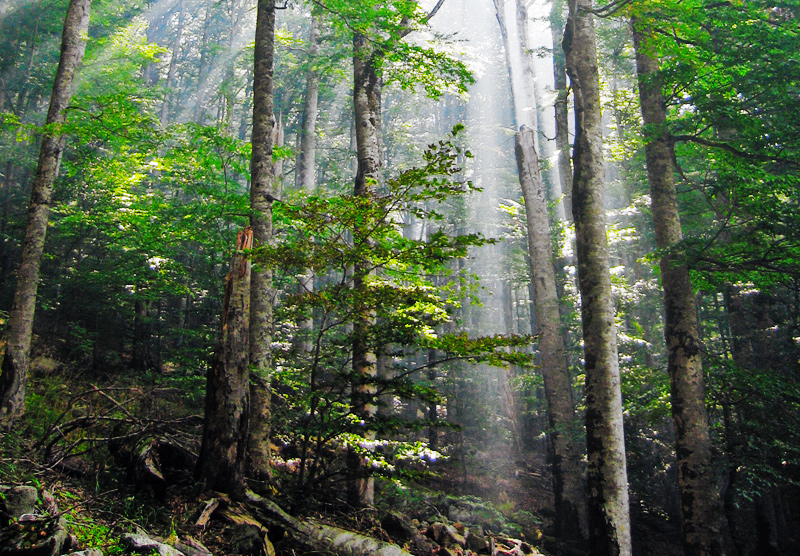
Biogradska Gora
42.8981° N · 19.6019° E · National Park
Photo: Snežana Trifunović · CC BY-SA 3.0 · Wikimedia Commons
Biogradska Gora is a protected area and national park in Montenegro. One of Europe's last remaining primeval forests. The free Lokali audio guide runs 7 minutes.
✓ Published October 2026 · how we write these guides
Visitor facts
| Lokali audio guide | 7 min · free |
|---|---|
| Type | National Park |
| Location | Kolašin, Montenegro |
| Coordinates | 42.8981, 19.6019 |
| Official website | nparkovi.me |
| Languages | 50+, in the Lokali app |
The story
Listen for a moment. Beneath the leaves there is water moving somewhere, a woodpecker working on a dead trunk, and a soft hush that seems to come from the trees themselves. The air is cool and damp, even in summer. It smells of wet bark, moss, and the slow decay of fallen wood. Underfoot, the path gives slightly, cushioned by centuries of leaves. You are standing in Biogradska Gora, one of the last stretches of primeval forest left in Europe.
Primeval is a word worth pausing on. It means this forest has never been cleared for timber or farmland. Many woods across Europe look wild, but most were cut and replanted at some point. Here, the trees have grown, fallen, and rotted where they stood for a very long time. That cycle is the point. A dead trunk on the ground is not a mess to tidy away. It is a home for fungi, beetles, and the birds that feed on them.
The forest lies on the slopes of Bjelasica, a mountain range in northern Montenegro. The town of Kolašin is a short drive away, and the main road between the coast and the north runs close by. This makes the place feel strange at first. You leave a highway, walk a few minutes, and the modern world simply falls quiet. Few old-growth forests in Europe are this easy to reach.
Now here is something most visitors miss. This forest was protected long before national parks became common. According to the account told across Montenegro, local clans gave the woodland to Prince Nikola in the late nineteenth century, after the region was freed from Ottoman rule. The prince, in turn, ordered that it be left untouched. Whether the story is polished by retelling or not, the result is clear. The trees you see survived because people chose to leave them alone.
The area later became a national park in the twentieth century, and it remains one of the oldest protected areas in the country. Today it covers a large sweep of Bjelasica, from the lake at its heart up to high pastures and peaks. Most visitors only see a small part of it. That is fine. The lake and the forest around it hold the essence of the whole park.
Let us talk about the trees. Look up, and you will see beech, with its smooth grey bark, standing beside dark fir and spruce. Maple and ash grow here too, along with elm and other broadleaf species. Some of these trees are several centuries old. They rise far above your head, straight and tall, because in a dense forest every tree competes for light. The canopy closes over the path like a roof, and the light below turns green.
At the centre of it all is Biogradsko Lake. It formed after the last Ice Age, when glaciers shaped these mountains and left hollows that filled with water. Montenegrins sometimes call such lakes the eyes of the mountain. This one is calm, dark, and edged with trees right down to the waterline. On a still morning, the surface holds a perfect copy of the forest. When the wind moves, the copy breaks into ripples and then slowly returns.
The lake is fed by a small river and by springs, and its outflow joins a stream that eventually runs toward the Tara, one of Montenegro's great rivers. So the water at your feet is part of a much longer journey. It leaves this quiet basin and travels through some of the deepest canyon country in Europe. That is a second surprise worth carrying with you. This small lake connects to a much larger landscape.
A well-kept path circles the lake, and it is the best way to understand the place. The walk is gentle and mostly flat, with wooden boardwalks over the wetter sections. Along the way you pass fallen giants, roots lifted out of the soil, and trunks wrapped in thick green moss. Keep an eye on the forest floor. Fungi grow in shelves on the dead wood, some pale, some orange, some shaped like small fans.
The name itself carries a quiet meaning. Biograd can be read as white town or white fortress, and gora means forest or mountain. Locals tell different stories about where the white town idea comes from. Some link it to an old settlement, others to the pale stone or mist of the valley. No single explanation is certain, so treat these as local tales rather than settled history. The mystery suits the place.
The forest is alive with more than trees. Birds are the easiest to notice, especially in the early morning, when their calls carry clearly across the water. Woodpeckers are common in old forests like this, because dead wood gives them food and nesting holes. Larger mammals live in the wider park too, but they are shy and rarely seen near the busy lakeside path. Mostly, you will meet them as sounds, tracks, or simply a sense of being watched.
Above the forest, the land opens into high meadows where shepherds have long brought their flocks in summer. These seasonal settlements are called katuns, small groups of wooden huts used during the grazing months. If you hike higher on Bjelasica, you may pass one and smell woodsmoke or fresh cheese. It is a reminder that this park is not only wilderness. People have shared these mountains for generations, living by the rhythm of the seasons.
Before you leave, stand at the edge of the lake once more. Notice how little you can hear beyond the water and the birds. Notice the colours: the deep green of the fir, the grey of the beech trunks, the dark mirror of the lake. As you walk back toward the road, look down at the fallen trunks one last time. Each one is slowly becoming soil, feeding the next tree. This forest has been doing that, quietly, for a very long time.
Key facts
What to look for
Practical tips
Common questions
Is there a free audio guide to Biogradska Gora?
Yes — the Lokali app narrates Biogradska Gora free of charge in 50+ languages. The guide runs about 7 minutes, covers the history, what to look for on site and practical tips, and works offline once downloaded.
Where is Biogradska Gora?
Biogradska Gora is near Kolašin, Montenegro, at 42.8981, 19.6019. Tap the map link on this page for directions from where you are.
What is Biogradska Gora known for?
One of Europe's last remaining primeval forests. Protected since the late nineteenth century under Prince Nikola.
What should you look for at Biogradska Gora?
Smooth grey beech trunks standing beside dark firs. Moss-covered fallen trees left to decay naturally. Shelf fungi growing in fans on dead wood.
What should you know before visiting Biogradska Gora?
Arrive early morning for still water and active birdsong. Walk the full loop path around the lake.
When is the best time to visit Biogradska Gora?
Bring a warm layer; the forest stays cool in summer.
On the map
Opens directions to Biogradska Gora from your location.
More to see near Biogradska Gora
Hear Biogradska Gora in your language
The full story, narrated, in 50+ languages. Download it before you go and it plays offline, at your own pace, with no ticket and no tour group.