
Photo: Gérard Janot · CC BY-SA 3.0 · Wikimedia Commons
Kotor Cathedral is a seat of the Catholic Bishopric of Kotor. The cathedral was consecrated in 1166. The free Lokali audio guide runs 6 minutes.
✓ Published October 2026 · how we write these guides
Visitor facts
| Lokali audio guide | 6 min · free |
|---|---|
| Type | Cathedral |
| Location | Kotor, Montenegro |
| Coordinates | 42.4243, 18.7714 |
| Official website | kotorskabiskupija.me |
| Languages | 50+, in the Lokali app |
The story
Stand still in the square for a moment. Under your feet, the paving stones are smooth and pale, polished by centuries of footsteps. Around you, voices bounce off stone walls that sit very close together. Above the rooftops, grey mountains rise so steeply they seem to lean over the town. And in front of you, two bell towers frame a wide stone arch. This is the Cathedral of Saint Tryphon, the spiritual heart of Kotor.
The cathedral is often called Kotor Cathedral, but locals know it by the name of its saint. Saint Tryphon was an early Christian martyr from Asia Minor, in what is now Turkey. He has nothing to do with this coast by birth. Yet for more than a thousand years, he has been the patron and protector of Kotor. His story here begins not with a builder, but with a ship.
According to the traditional account, in the ninth century Venetian merchants were carrying the saint's relics along the Adriatic. A storm forced them into the Bay of Kotor. The townspeople acquired the relics, and a local citizen built a small church to hold them. Whether every detail of this tale is true is hard to say. But the relics stayed, and the town wrapped its identity around them.
The building you see today came later. The present cathedral was consecrated in 1166, which makes it one of the oldest Romanesque churches on the eastern Adriatic coast. Romanesque is the style of Europe before the Gothic era — thick walls, round arches, and a calm, heavy sense of strength. Look at the great arch between the towers. Its round shape is the signature of that period.
Now look up at the towers themselves. They are not quite twins. Their tops are Baroque, a later and more decorative style from the seventeenth and eighteenth centuries. That change was not a matter of fashion alone. In 1667, a powerful earthquake struck this coast. It badly damaged the cathedral, and the towers were rebuilt afterwards in the taste of the time. So the face of the church holds two different eras, one stacked on top of the other.
Here is a detail many visitors miss. Compare the two towers carefully. They differ in their finish and their detailing, and local guides often say one was never fully completed. Once you notice the difference, it is hard to stop seeing it. It is a small reminder that great buildings are rarely finished in one clean moment. They are repaired, extended, and left slightly uneven by the people who care for them.
The earthquakes did not stop in the seventeenth century. In 1979, another severe earthquake shook Montenegro and damaged much of Kotor, including the cathedral. Restoration took many years. That same year, the old town and the surrounding bay were added to the UNESCO World Heritage list. So the moment of destruction and the moment of international recognition arrived together. The careful repair work you see today is part of that long recovery.
Step inside, and the light changes at once. The air is cooler, and the noise of the square fades behind you. The interior is tall and fairly narrow, with rows of columns leading your eye toward the altar. Some columns are pale stone, others carry a warmer, pinkish tone. Your footsteps sound louder here. Give your eyes a minute to adjust before you move further in.
Above the main altar stands a stone canopy called a ciborium. It rests on slender columns and rises in layers, like a small tower inside the church. It is generally dated to the fourteenth century and is one of the finest pieces of Gothic stonework in the building. Around the walls and arches, look for faded patches of colour. These are fragments of old frescoes, painted on wet plaster, that survived centuries of damp, candle smoke, and earthquakes.
The relics of Saint Tryphon are kept in a chapel and treasury connected to the cathedral. Here you will find silver and gold reliquaries — decorated containers made to hold sacred remains. Some are shaped to match the part of the body they hold. To a modern eye this can feel strange. But for medieval Kotor, these objects were proof that the saint was physically present, still watching over the town and its ships.
That connection to the sea is still alive. Kotor is a Catholic diocese, and the saint's feast in early February remains a major event. An old maritime brotherhood, the Boka Navy, performs a traditional circle dance in the square on that occasion. Its roots go back to the medieval sailors of the bay. If you visit in winter, you may see uniforms, flags, and slow, linked steps on the very stones you are standing on.
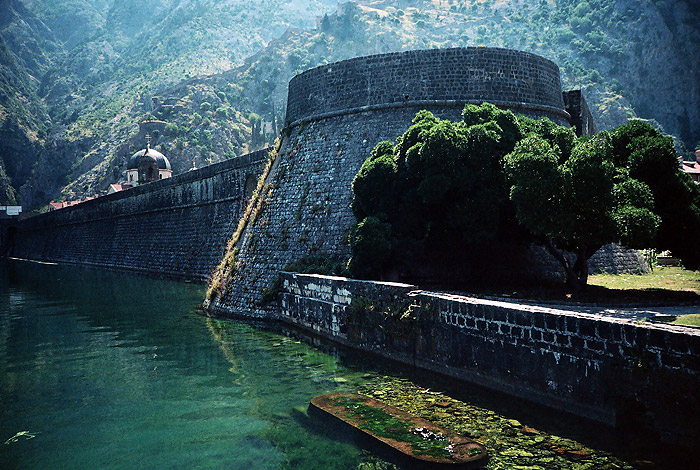
Outside again, notice how tightly the square is enclosed. Kotor grew inside its walls, squeezed between the water and the mountain. Space was precious, so the cathedral does not sit in an open plaza. It is pressed in among houses and narrow lanes. Behind the town, the fortification walls zigzag up the slope of Saint John's Hill. From certain corners of the square, you can see the towers and those walls in one view.
Before you leave, stand back from the entrance once more. Look at the round arch, the two uneven towers, and the patched, weathered stone. Listen to the café chatter, the church bells, perhaps a cat crossing the paving. This building has fallen and risen more than once. Today it is still open, still used, still the centre of the town. As you walk on through the lanes, glance back — the towers will follow you above the rooftops.
Key facts
What to look for
Practical tips
Common questions
Is there a free audio guide to Kotor Cathedral?
Yes — the Lokali app narrates Kotor Cathedral free of charge in 50+ languages. The guide runs about 6 minutes, covers the history, what to look for on site and practical tips, and works offline once downloaded.
Where is Kotor Cathedral?
Kotor Cathedral is in Kotor, Montenegro, at 42.4243, 18.7714. Tap the map link on this page for directions from where you are.
What is Kotor Cathedral known for?
The cathedral was consecrated in 1166. Dedicated to Saint Tryphon, patron saint of Kotor.
What should you look for at Kotor Cathedral?
The round Romanesque arch linking the two towers. Subtle differences between the left and right towers. The tall Gothic stone canopy above the main altar.
What should you know before visiting Kotor Cathedral?
Pause in the doorway to let your eyes adjust. Visit the treasury upstairs to see the reliquaries.
When is the best time to visit Kotor Cathedral?
Come early morning for a quieter square.
On the map
Opens directions to Kotor Cathedral from your location.
More to see near Kotor Cathedral


Hear Kotor Cathedral in your language
The full story, narrated, in 50+ languages. Download it before you go and it plays offline, at your own pace, with no ticket and no tour group.