
Federal Territory Mosque
3.1719° N · 101.6711° E · Mosque
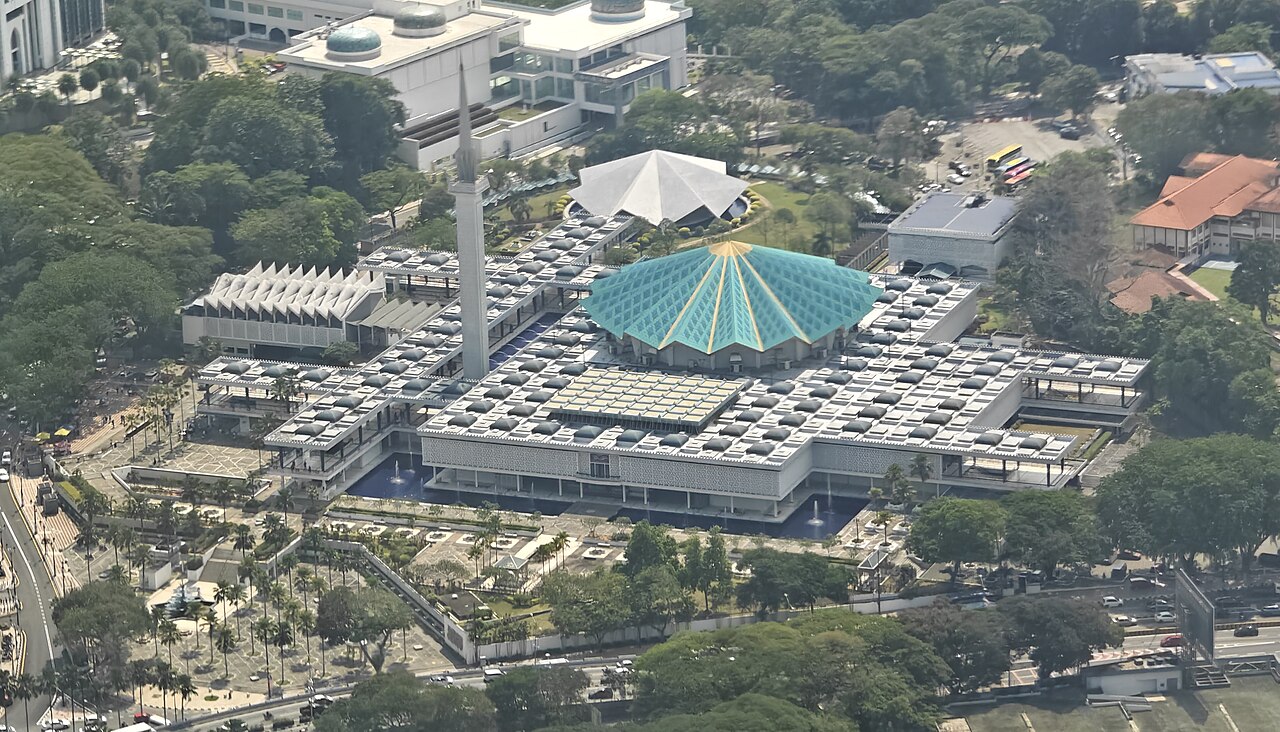
Photo: CEphoto, Uwe Aranas · CC BY-SA 3.0 · Wikimedia Commons
Federal Territory Mosque is a mosque in Kuala Lumpur, Malaysia. Local name is Masjid Wilayah Persekutuan. The free Lokali audio guide runs 6 minutes.
✓ Published October 2026 · how we write these guides
Visitor facts
| Lokali audio guide | 6 min · free |
|---|---|
| Type | Mosque |
| Location | Kuala Lumpur, Malaysia |
| Coordinates | 3.1719, 101.6711 |
| Languages | 50+, in the Lokali app |
The story
Listen first. Traffic hums somewhere behind the trees, but here the sound softens. Water moves gently in the pools around the mosque, and the air carries the heavy warmth of a Malaysian afternoon. Under your feet, pale paving stone feels cool, even in the heat. Ahead, a cluster of domes rises in layers, one above another, like a small hill of stone. This is the Federal Territory Mosque, known locally as Masjid Wilayah Persekutuan.
The mosque sits on the northwestern side of Kuala Lumpur, close to the large government offices along Jalan Duta. It is a little away from the city centre, and that distance matters. Many visitors never make the trip. Those who do often find a calmer place than the busy mosques downtown. Wide lawns, open courtyards and long reflecting pools give the building space to breathe, and give you space to slow down.
The mosque is a fairly young building. Construction began in the late 1990s, and it opened to worshippers in 2000. That makes it one of the newer major mosques in the Malaysian capital. Yet it does not look new in spirit. Its designers looked back across centuries, and across thousands of kilometres, to find their main inspiration... the great imperial mosques of Istanbul.
Here is the first surprise for many visitors. The overall shape of this mosque follows the style of the Ottoman Empire, the Turkish-based empire that ruled much of the Middle East and southeastern Europe for centuries. In particular, people often compare it to the Sultan Ahmed Mosque in Istanbul, the building most travellers call the Blue Mosque. Look at the way the central dome sits high, with smaller half-domes and domes stepping down around it. That cascading outline is a classic Ottoman idea.
But this is not a copy. Look closer and you will see Malaysian ideas woven into the Turkish frame. The builders combined the Ottoman silhouette with Malay traditions of decoration and with the practical needs of a tropical climate. Deep shade, open galleries and moving air matter here, where rain can arrive suddenly and the sun can be fierce. The result is a building that feels both far-travelled and firmly at home in Kuala Lumpur.
Count the domes if you like. The figure most often given is twenty-two domes in total, large and small. Their surfaces carry soft blue and turquoise tones, colours that link back to Ottoman tilework and also echo the sky on a clear day. From different angles the domes overlap in new ways. Walk slowly around the outside and watch the roofline change shape as you move.
The water around the mosque is not only decoration. Pools and channels surround parts of the building, and they reflect the domes and minarets on still days. In a hot city, water also cools the air and calms the eye. Many Islamic gardens use water in this way, as a symbol of purity and of paradise. Stand at the edge of a pool for a moment. You may notice the breeze feels slightly cooler here.
Now think about scale. The prayer halls and courtyards are designed to hold a very large congregation. The capacity is commonly cited at around 17,000 worshippers. On ordinary weekdays the mosque can feel almost empty, quiet and echoing. On Friday, the main day of congregational prayer in Islam, the picture changes completely. Cars fill the roads nearby, and thousands of men gather in long, straight lines facing Mecca.
That direction is important. Every mosque is oriented toward the Kaaba in Mecca, the holiest site in Islam. Inside the prayer hall, a decorated niche called the mihrab marks this direction for worshippers. Near it stands the minbar, a raised pulpit with steps, where the imam gives the Friday sermon. If you visit the interior, these two features help you read the whole room. Everything else is arranged around them.
The interior decoration rewards a patient eye. Islamic tradition generally avoids images of people and animals in places of worship. Instead, artists use geometry, plant-like patterns and calligraphy, which is the art of beautiful writing. Here you will find verses from the Quran, the holy book of Islam, worked into the walls and domes. Some of the script uses angular, blocky letter forms. Even if you cannot read Arabic, the rhythm of the lines is easy to follow.
A second detail many visitors miss is the craftsmanship. Much of the decorative work draws on skills from different parts of the Muslim world, and on Malaysian artisans as well. Look at doors, screens and carved panels, where Malay woodcarving traditions often appear. Malaysia has a long history of fine carving in timber, especially in palaces and traditional houses. Seeing those patterns beside Ottoman forms shows how this building brings two worlds together.
The mosque is a working place of prayer first, and a visitor attraction second. Non-Muslim guests are generally welcome outside prayer times. Visitors are expected to dress modestly, and robes and headscarves are often available at the entrance for those who need them. Shoes come off before you enter the prayer areas. Move quietly, keep your voice low, and give space to anyone who is praying. These small gestures are noticed and appreciated.
Before you leave, find a spot in the courtyard or beside the water and simply look up. Watch how the light moves across the blue domes, how shadows shift under the arches. Listen for the sound of water, the scuff of bare feet on cool stone, perhaps the call to prayer rising from the minarets. As you walk back toward the road and the city, turn around once more. The domes will still be there, stepping quietly up into the Kuala Lumpur sky.
Key facts
What to look for
Practical tips
Common questions
Is there a free audio guide to Federal Territory Mosque?
Yes — the Lokali app narrates Federal Territory Mosque free of charge in 50+ languages. The guide runs about 6 minutes, covers the history, what to look for on site and practical tips, and works offline once downloaded.
Where is Federal Territory Mosque?
Federal Territory Mosque is in Kuala Lumpur, Malaysia, at 3.1719, 101.6711. Tap the map link on this page for directions from where you are.
What is Federal Territory Mosque known for?
Local name is Masjid Wilayah Persekutuan. Opened to worshippers in the year 2000.
What should you look for at Federal Territory Mosque?
Twenty-two domes stepping down in layers. Blue and turquoise tones across the dome surfaces. Domes reflected in the surrounding pools.
What should you know before visiting Federal Territory Mosque?
Dress modestly; borrow a robe at the entrance if needed. Avoid visiting during Friday congregational prayers.
On the map
Opens directions to Federal Territory Mosque from your location.
More to see in Kuala Lumpur



Hear Federal Territory Mosque in your language
The full story, narrated, in 50+ languages. Download it before you go and it plays offline, at your own pace, with no ticket and no tour group.