Masjid Negara is a mosque in Kuala Lumpur, Malaysia. Malaysia's national mosque, completed in 1965. Most visitors spend 45–60 min here. The free Lokali audio guide runs 5 minutes.
✓ Verified August 2026 · how we write these guides
Visitor facts
| Time needed | 45–60 min |
|---|---|
| Lokali audio guide | 5 min · free |
| Type | Mosque |
| Best for | History |
| Location | Kuala Lumpur, Malaysia |
| Coordinates | 3.1582, 101.6934 |
| Languages | 45, in the Lokali app |
The story
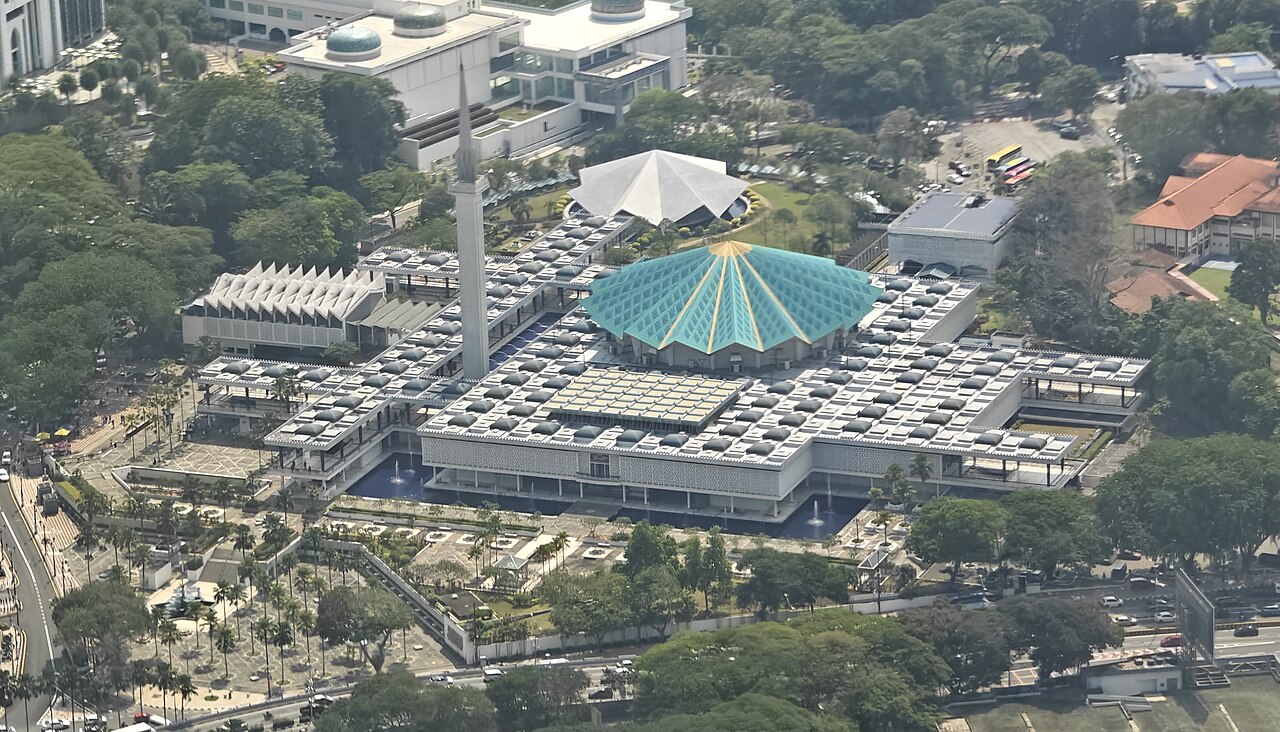
Stand at the entrance and look up. A wide concrete roof folds above you, shaped like a great star or a half-open umbrella. The sun is warm. Water moves quietly in long pools around the building. People slip off their shoes. The marble floor is cool under bare feet. This is Masjid Negara, the national mosque of Kuala Lumpur, and it sits in the green heart of the capital.
The mosque opened in 1965, a few years after the country became independent. Its builders did not want an old style. They wanted a mosque for a new nation. So they chose clean lines, open space, and a roof unlike any other. The shape speaks of the future rather than the past, and it still feels modern today.
Three architects led the design. One was British, named Howard Ashley. Two were Kuala Lumpurn, Hisham Albakri and Baharuddin Kassim. Together they shaped a building of concrete, glass, and light. Concrete was a bold choice then, modern and plain, and it let them bend the roof into shapes that older materials could not hold. The team avoided the round dome seen on many older mosques. In its place they set a folded roof with many sharp points reaching toward the sky.
Look closely at the main roof. It rises into a star with many points. Some people see a star. Others see an open umbrella, the kind held against tropical rain and strong sun. The umbrella is a sign of shelter. For a young country, it also became a sign of hope and shared shelter for every citizen.
Now turn to the tall tower nearby. This is the minaret, and it stands about 73 meters high. From the top, the call to prayer once carried across the city. The tower is slim and plain. Its folded top echoes the umbrella shape of the roof, so the whole design feels joined into one idea.
The mosque can hold a very large crowd. On important days, as many as 15,000 people gather here to pray. The main hall opens wide, with room for long rows of worshippers. Above them a wide decorated ceiling spreads out, and a large hanging light casts a soft glow over the carpet below. Light enters through patterned screens along the walls. The air feels calm and cool, even when many feet cross the floor at once.
Water is part of the design. Shallow pools and fountains surround the building. They cool the air in the tropical heat. They also create soft reflections of the concrete above. As you walk the raised paths, you may hear water on one side and quiet prayer on the other. The sound and the stone work together.
Around the mosque lie gardens and open courtyards. Covered walkways link one part to another. Their roofs are shaped in small folded points, like many little umbrellas in a row. Walking beneath them, you move from sun to shade and back again. The design keeps you sheltered as you go from gate to hall.
The decoration here is gentle, not heavy. You will see tile work in cool colors, simple patterns, and careful geometry. Parts of the roof are covered in green and blue tiles, added in a later renovation, and they shift in tone as the light changes. There are no loud images. Islamic art often avoids figures and turns instead to shape and rhythm. Here the rhythm is quiet, repeated, and easy on the eye, so the mind can settle and rest.
Visitors of all faiths are welcome outside prayer times. At the entrance, staff lend robes and head coverings to those who need them. You are asked to dress simply and to remove your shoes. These small acts are a sign of respect, shared by guests from many lands who come to see this place.
Take your time on the wide terrace. From here you can see the city beyond the trees. The mosque sits near the old railway station and the green of the Lake Gardens. It is a place of pause inside a busy capital, held apart by water and open sky. Few sounds reach you up here.
Near the mosque stands a smaller building with a roof like a seven-pointed star. This is the Heroes' Mausoleum. Several leaders of the country are buried beneath it. The roof floats on slender columns, open to the air at the sides. People come here quietly to remember those who helped shape the nation. It is a place of rest beside a place of prayer.
Before you leave, stand once more under the great folded roof. Think of the year 1965, and a new country choosing how to pray and how to build. The umbrella above you was meant as shelter for everyone. In the quiet here, that simple idea still feels close, and the cool air carries it gently.
Key facts
What to look for
Practical tips
Common questions
How long do you need at Masjid Negara?
Plan 45–60 min. That is the time most visitors spend at Masjid Negara. The free Lokali audio guide adds about 5 minutes of narration you can listen to as you walk, so it fits inside your visit rather than adding to it.
Is there a free audio guide to Masjid Negara?
Yes — the Lokali app narrates Masjid Negara free of charge in 50+ languages. It covers the history, what to look for on site and practical tips, and it works offline once downloaded.
Where is Masjid Negara?
Masjid Negara is in Kuala Lumpur, Malaysia, at 3.1582, 101.6934. Tap the map link on this page for directions from where you are.
What should you know before visiting Masjid Negara?
Remove your shoes and dress simply before entering.
What is Masjid Negara known for?
Kuala Lumpur's national mosque, opened to worshippers in 1965.
What is the best time to visit Masjid Negara?
Visit late afternoon when light reflects off the blue tiles and reflecting pool.
On the map
Opens directions to Masjid Negara from your location.
More to see in Kuala Lumpur


Hear Masjid Negara in your language
The full story, narrated, in 50+ languages. Download it before you go and it plays offline, at your own pace, with no ticket and no tour group.