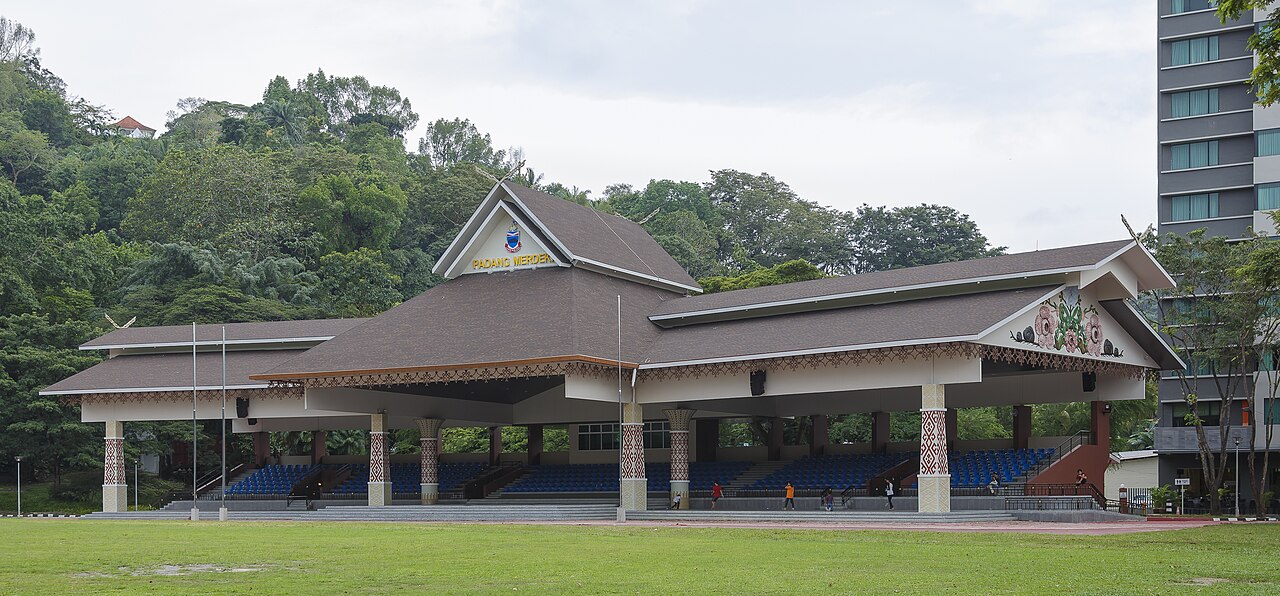
Merdeka Square is the historic heart of Kuala Lumpur, where Malaysia's independence was declared in 1957. It is in Kuala Lumpur, Malaysia. Most visitors spend 45–90 min here. The free Lokali audio guide runs 5 minutes.
✓ Verified August 2026 · how we write these guides
Visitor facts
| Time needed | 45–90 min |
|---|---|
| Lokali audio guide | 5 min · free |
| Type | Square |
| Best for | History |
| Location | Kuala Lumpur, Malaysia |
| Coordinates | 3.1423, 101.6937 |
| Languages | 45, in the Lokali app |
The story
Stand on the wide green lawn and feel the open space. Tall buildings ring the edges, but the center is grass and sky. A very tall flagpole rises in front of you, with a flag moving in the warm wind. This is Merdeka Square, in the heart of Kuala Lumpur. The word merdeka means freedom.
This open field has an older name, the Padang, which simply means field. For many years it was a cricket ground. British officials and club members played here on quiet afternoons. On match days long ago, crowds in white would gather at the edges to watch the play in the heat. The grass was kept short and green. Around it the city grew, but the field stayed open, a calm space among the buildings.
The most important moment here came at midnight, as 30 August turned into 31 August 1957. On that night the flag of the colonial era came down. The new flag of independent Malaya rose in its place. A great crowd watched in the dark. When the new flag reached the top, the country was free. People still mark this date each year.
Look at the flagpole now. It stands about 95 meters tall, among the highest in the world. It marks the place where the new flag first rose. Tilt your head back to follow it up. From certain spots the pole seems to touch the clouds, and the flag turns slowly as the wind shifts. The flag at the top is large, yet from the ground it can look small against the open sky.
Turn toward the long building on the eastern side. This is the Sultan Abdul Samad Building, finished in 1897. Its red brick and pale arches stretch in a long line. The brick was laid by hand, and fine detail runs along the arches and around every window. A clock tower rises from the center, topped by a shining copper dome. Two smaller domes sit at each end of the roof.
The style of this building mixes many sources. Arches, domes, and fine brickwork recall the design of Mughal India. A British architect named A.C. Norman led the plan. The result is a building that looks both eastern and western at once. For many people it is the face of old Kuala Lumpur.
The clock in the tower has marked the city's hours for more than a hundred years. It first rang in 1897. Locals sometimes call this tower a small cousin of the great clock in London. At night the building is lit, and the copper domes glow softly above the square below.
Face the western side now. There you will see a low building in black and white, with wooden beams and a steep roof. This is the Royal Selangor Club, once the social home of the colonial elite. Members watched cricket from its veranda. Behind it once lay courts and a bar where they gathered after the day's play. Its old nickname, the Spotted Dog, is still used today.
Walk the edge of the square and notice the mix of styles around you. A Tudor-style club, a Mughal-style hall, a tall modern flagpole, and a grass field between them all. Each one comes from a different time. Together they tell the story of how this city grew and changed over the years.
Below the square lies a row of shops and a visitor area, built underground in later years. Fountains play near the lawn on some days. Couples stop for photographs. Runners cross the grass in the cool of the morning. On weekend evenings families spread out on the grass, and the lit building glows behind them like a long red wall. The old field still gathers the city, just as it always did before.
Try to come early or near sunset. In the middle of the day the open lawn offers little shade, and the heat can be strong. In softer light the red building glows, and the long shadows make the square feel calm. Bring water and take your time as you walk the edges.
Other old buildings ring the square as well. One pale building with arches now holds a museum of textiles. Another once served as the city library. They share the same red brick and the same arches as their larger neighbor. Together they form a ring of older design around the open green, each one carefully kept.
Stand once more by the great flagpole and look up. Picture the dark night of 1957, the silent crowd, and one flag rising. This grass has held cricket games, parades, and a nation's first free breath. The field is quiet now, but the moment it remembers still shapes the country today.
Key facts
What to look for
Practical tips
Common questions
How long do you need at Merdeka Square?
Plan 45–90 min. That is the time most visitors spend at Merdeka Square. The free Lokali audio guide adds about 5 minutes of narration you can listen to as you walk, so it fits inside your visit rather than adding to it.
Is there a free audio guide to Merdeka Square?
Yes — the Lokali app narrates Merdeka Square free of charge in 50+ languages. It covers the history, what to look for on site and practical tips, and it works offline once downloaded.
Where is Merdeka Square?
Merdeka Square is in Kuala Lumpur, Malaysia, at 3.1423, 101.6937. Tap the map link on this page for directions from where you are.
What should you know before visiting Merdeka Square?
Visit at sunrise or sunset to avoid heat.
What is Merdeka Square known for?
Malayan flag first raised here at midnight, 31 August 1957.
What is the best time to visit Merdeka Square?
The square is quietest in early morning.
On the map
Opens directions to Merdeka Square from your location.
More to see in Kuala Lumpur


Hear Merdeka Square in your language
The full story, narrated, in 50+ languages. Download it before you go and it plays offline, at your own pace, with no ticket and no tour group.