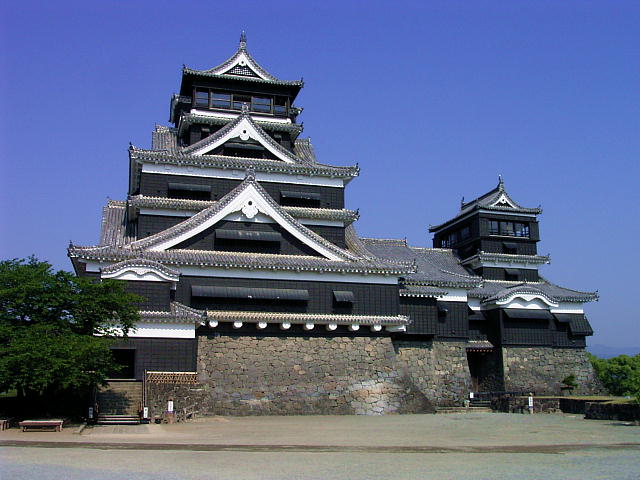
Photo: Birdman at Japanese Wikipedia · CC BY-SA 3.0 · Wikimedia Commons
Kumamoto Castle is a castle. It is in Kumamoto, Japan. Warlord Kato Kiyomasa rebuilt the castle in the early 1600s. The free Lokali audio guide runs 7 minutes.
✓ Published October 2026 · how we write these guides
Visitor facts
| Lokali audio guide | 7 min · free |
|---|---|
| Type | Castle |
| Location | Kumamoto, Japan |
| Coordinates | 32.8061, 130.7060 |
| Official website | castle.kumamoto-guide.jp |
| Languages | 50+, in the Lokali app |
The story
Listen to the gravel under your shoes. Then look up. A wall of grey stone rises in front of you. It starts almost flat, like a gentle ramp, then curves steeply upward until the top is nearly vertical. The keep sits above it, dark wood and white trim, sharp against the sky. This is Kumamoto Castle, and the stone under that keep has been tested by war, by fire, and by the earth itself.
The castle you see grew out of the vision of one man, Kato Kiyomasa. He was a powerful warlord at the very end of the sixteenth century, a time when Japan was still settling after long decades of civil war. Kiyomasa was known as a fierce general. He was also known as a gifted castle builder, especially of stone walls. He rebuilt an earlier fortress on this hill into something far larger, and the work was largely finished in the early 1600s.
That curving wall in front of you has a name. People call it musha-gaeshi, which roughly means warrior-repelling. The idea is simple and clever. An attacker could climb the lower slope with some ease. But as the curve grew steeper, hands and feet lost their grip. Near the top, the wall bends almost outward, and a climber would fall. Stand close to the base and follow the line upward with your eyes. You can feel how the angle changes.
Here is a story that locals love to tell, and it is worth treating as legend rather than record. Kiyomasa had served in a long, hungry military campaign overseas. According to popular tradition, he planned this castle so that it could survive a siege. People say he planted ginkgo trees for their edible nuts. Some versions add that walls and mats held hidden food. The castle does carry an old nickname, Ginnan Castle, after the ginkgo nut. How much of the rest is true, nobody can say for certain.
After Kiyomasa's family lost their domain, the Hosokawa clan took control in the 1630s. They held Kumamoto for more than two centuries, through the long and mostly peaceful Edo period. During those years the castle was less a battlefield and more a seat of government. Officials came and went. Records were kept. The great walls stood ready for a war that did not come... at least, not for a very long time.
That war came in 1877. Japan was changing fast. The samurai class had lost its old privileges, and many former samurai were angry. In the south, a revered leader named Saigo Takamori led a rebellion, known today as the Satsuma Rebellion. His army marched on Kumamoto, where government troops held the castle. Just before the siege began, a fire destroyed the main keep. Historians still discuss how that fire started.
Even without its keep, the castle held. For weeks, the rebels could not break the defences. Those steep stone walls did exactly what Kiyomasa had designed them to do, more than two and a half centuries after he built them. Eventually government reinforcements arrived and the siege ended. Many people see this as one of the last great tests of a Japanese castle in real combat. The old warrior-repelling walls had one final war to win.
Now look at the keep again. What you see is not the original. The main keep was rebuilt in 1960, using reinforced concrete on the outside shape of the old design. This surprises many visitors. It looks like timber from a distance. But some smaller structures around the grounds are genuinely old. The Uto Turret, a tall multi-storey tower in the western part of the grounds, is one of the original buildings that survived the fire of 1877.
In April 2016, two powerful earthquakes struck the Kumamoto region. The castle suffered terrible damage. Large sections of stone wall collapsed. Roof tiles slid off and shattered. Many turrets cracked and tilted. Then came an image that people across Japan still remember. One corner turret, the Iidamaru Five-Storey Turret, stayed standing on a single narrow column of corner stones. Everything else beneath it had fallen away. For many residents, that thin line of stone became a symbol of holding on.
Rebuilding began almost at once, and it is still going on. The team numbered and recorded fallen stones so each one could return to its original place, like pieces of a vast puzzle. The main keep was repaired first, and its interior reopened in 2021 with a museum inside. Full restoration of the whole site is a project of decades. Officials have spoken of finishing around the middle of this century. You are visiting a castle in the middle of healing.
As you walk, notice the raised walkway. It was built so that visitors can move through the grounds without touching damaged areas. From it, you can see things that ordinary visitors never saw before 2016 — the inside of collapsed walls, cranes, scaffolding, piles of carefully sorted stone. The workers are part of the view. If you stay a while, you may hear the low sound of machinery and the clink of tools on stone.
On the grounds you will also find the Honmaru Goten, the reconstructed palace where the lord once received guests. Its most famous room has walls covered in gold leaf and painted scenes. Not every part of the site is always open, because the restoration moves in stages. That is worth knowing before you set your heart on one specific building. Plan to see what is open today, and enjoy the rest from the outside.
Before you leave, pause once more at the base of a wall. Run your eyes along the stones. Some are dark with age. Some are lighter and newer, set back in place after the earthquake. Old and new sit side by side. Listen to the crows, the wind in the trees, the voices of school groups on the path. Then, as you walk back down toward the city, turn around once. The keep will still be there, watching over Kumamoto, as it has for four hundred years.
Key facts
What to look for
Practical tips
Common questions
Is there a free audio guide to Kumamoto Castle?
Yes — the Lokali app narrates Kumamoto Castle free of charge in 50+ languages. The guide runs about 7 minutes, covers the history, what to look for on site and practical tips, and works offline once downloaded.
Where is Kumamoto Castle?
Kumamoto Castle is in Kumamoto, Japan, at 32.8061, 130.7060. Tap the map link on this page for directions from where you are.
What is Kumamoto Castle known for?
Warlord Kato Kiyomasa rebuilt the castle in the early 1600s. Hosokawa clan ruled from here for over two centuries.
What should you look for at Kumamoto Castle?
Curving musha-gaeshi stone walls growing steeper toward the top. Lighter replaced stones beside darker original stones in walls. The Uto Turret, an original survivor of the 1877 fire.
What should you know before visiting Kumamoto Castle?
Use the raised walkway to see active restoration work up close. Check which buildings are open, since access changes by stage.
On the map
Opens directions to Kumamoto Castle from your location.
More to see in Kumamoto


Hear Kumamoto Castle in your language
The full story, narrated, in 50+ languages. Download it before you go and it plays offline, at your own pace, with no ticket and no tour group.