Photo: U5K0 · CC BY-SA 3.0 · Wikimedia Commons
Emona is an ancient city in Roman Italia, now Ljubljana. Emona was founded early in the first century. The free Lokali audio guide runs 7 minutes.
✓ Published October 2026 · how we write these guides
Visitor facts
| Lokali audio guide | 7 min · free |
|---|---|
| Type | Archaeological Site |
| Location | Ljubljana, Slovenia |
| Coordinates | 46.0477, 14.5009 |
| Languages | 50+, in the Lokali app |
The story
Run your hand along the old stone of the Roman wall at Mirje, in the south of Ljubljana. It feels cool and uneven. Some stones are smooth, others are rough and pitted. Behind you, traffic moves along a quiet residential street. In front of you is a line of masonry that has marked the edge of a city for nearly two thousand years. This is Emona, the Roman town that lies directly under the streets of modern Ljubljana.
Emona is not one building or one site. It is a buried town spread across the centre of the city. Its remains appear in several places. There are wall fragments in the south, house foundations in a garden near the old town, and early Christian ruins near the river. If you have walked through central Ljubljana, you have probably walked over Emona without knowing it. Many of the streets you use follow lines the Romans laid down.
The story begins early in the first century, during the reign of the emperor Augustus or his successor Tiberius. Historians still discuss the exact year. The Romans called the town Colonia Iulia Emona. A colony was a planned settlement. It was often built for retired soldiers and their families, and it brought Roman law and Roman habits to the frontier. Emona stood on an important route between Italy and the lands along the Danube. Goods, armies, and messengers passed through on their way east.
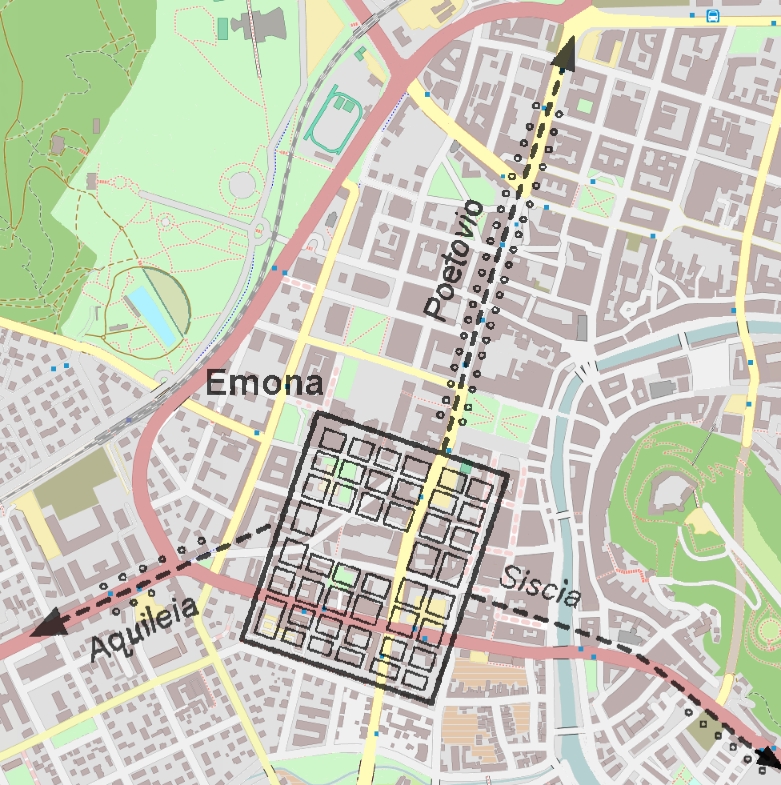
This is the first thing most visitors miss. The Romans did not grow Emona slowly. They drew it. The town was laid out as a rectangle, with straight streets crossing at right angles, like a grid on graph paper. Two main streets divided it. One ran north to south, the other east to west, and the forum, the public square, sat near their meeting point. Walls with towers and gates surrounded the whole grid. When you look at a map of the centre today, you can still see parts of that rectangle in the street plan south of the castle hill.
The wall here at Mirje is the longest stretch you can see. But what you see is not purely Roman. In the 1930s, the architect Jože Plečnik restored this section. Plečnik shaped much of modern Ljubljana. He designed bridges, markets, and the national library. At Mirje, he rebuilt and completed the damaged wall and added his own touches, including a small pyramid near a passage through the wall. So this is a Roman wall seen through the eyes of a twentieth-century architect. Some archaeologists have criticised his freedom. Many locals love it for exactly that reason.
Take a moment to study the masonry. Look at where the lower courses meet the upper ones. Often you can see a change in the stone, in the jointing, or in the colour of the mortar. That change can mark the line between ancient work and later repair. Plečnik also planted greenery along the wall. In summer, the soft leaves and grass sit against the hard stone. Joggers, dog walkers, and children on scooters use the path beside the wall as an ordinary neighbourhood route.
Now imagine life inside these walls. Emona had paved streets, drains, public baths, and houses with heated floors. The Romans heated rooms with a system called a hypocaust. Hot air from a furnace flowed through a hollow space under the floor, which rested on small pillars of brick or stone. Excavations in Ljubljana have uncovered remains of this kind of heating. On a cold Slovenian winter morning, a wealthy family in Emona could stand on a warm floor. Many homes in Europe would not have that comfort again for well over a thousand years.
North of here, in the Jakopič Garden, you can see the foundations of Roman houses that are preserved in the open air. The low walls show the outline of rooms, and you can still see pieces of mosaic floor and traces of the old drainage and heating. It is a small site, but it is intimate. You are not looking at a temple or a palace. You are looking at the floor plan of somebody's home. You can picture a kitchen, a courtyard, and a room where guests ate.
Here is a second surprise. Emona became a Christian town before its decline. On Erjavčeva Street, near the centre, archaeologists found the remains of an early Christian complex from late antiquity. It includes a baptistery, a building used for baptism, with mosaic floors. Some of the mosaics carry the names of the people who paid for them. It is a reminder that these mosaics were not anonymous decoration. Real people from Emona wanted to be remembered for their gifts to the church.
During the fourth and fifth centuries, the Roman world became unstable. Armies and migrating peoples moved through this region again and again, because Emona sat on the road into Italy. The town lost its importance and its population over time. By the end of antiquity, Roman life here had faded. The medieval town that grew into Ljubljana developed mainly around the castle hill and along the river, not inside the old Roman grid. Much of Emona slept under fields and gardens for centuries.
A bronze figure brings one Emonian back to the surface. Archaeologists found a gilded bronze statue of a man in Roman dress, now known as the Citizen of Emona. The original is kept in the National Museum of Slovenia. A copy stands outdoors in the city centre, near Congress Square. The figure wears a toga and has a calm expression. For many people in Ljubljana, he has become a face for the whole Roman town.
Ljubljana also has an older story of its origins, and this one is pure legend. Locals say that the Greek hero Jason and his Argonauts, sailing home with the Golden Fleece, travelled up the rivers to this area. According to the tale, Jason fought and killed a dragon in the marshes. That is one popular explanation of why a dragon appears on the city's coat of arms. Emona, by contrast, is documented history. It is the real ancient city you can touch here at the wall.
Before you leave, stand still for a minute and look along the wall. Notice how straight it runs. That straight line was drawn by Roman surveyors, long before the houses, trams, and cafés behind you. As you walk back towards the centre, watch the streets. When one runs perfectly straight and meets another at a sharp right angle, you may be walking along an old Roman line... still guiding people through Ljubljana, nearly two thousand years later.
Key facts
What to look for
Practical tips
Common questions
Is there a free audio guide to Emona?
Yes — the Lokali app narrates Emona free of charge in 50+ languages. The guide runs about 7 minutes, covers the history, what to look for on site and practical tips, and works offline once downloaded.
Where is Emona?
Emona is in Ljubljana, Slovenia, at 46.0477, 14.5009. Tap the map link on this page for directions from where you are.
What is Emona known for?
Emona was founded early in the first century. Its Roman name was Colonia Iulia Emona.
What should you look for at Emona?
The small pyramid Plečnik added near a wall passage. Changes in stone colour between Roman and later work. Mosaic floor fragments in the Jakopič Garden houses.
What should you know before visiting Emona?
Walk the full Mirje wall path for the best view. Combine the wall with a visit to Jakopič Garden.
On the map
Opens directions to Emona from your location.
More to see in Ljubljana


Hear Emona in your language
The full story, narrated, in 50+ languages. Download it before you go and it plays offline, at your own pace, with no ticket and no tour group.