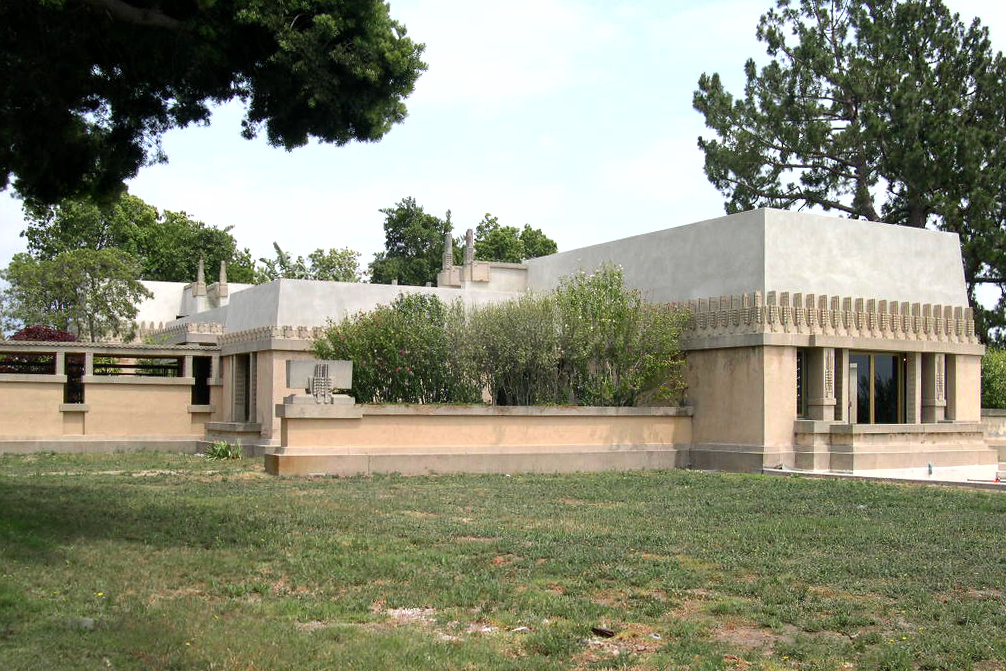
Photo: Sfoskett · CC BY-SA 3.0 · Wikimedia Commons
Hollyhock House is a house in Los Angeles, California. Frank Lloyd Wright's first commission in Los Angeles. The free Lokali audio guide runs 7 minutes.
✓ Published October 2026 · how we write these guides
Visitor facts
| Lokali audio guide | 7 min · free |
|---|---|
| Type | Museum |
| Location | Los Angeles, United States |
| Coordinates | 34.1000, -118.2943 |
| Official website | barnsdall.org |
| Languages | 50+, in the Lokali app |
The story
Feel the slope under your feet as you climb Olive Hill. The path rises gently through old olive trees, their grey-green leaves moving in the dry breeze. Traffic hums somewhere below on Hollywood Boulevard. Then the trees open, and a long, low building appears. It is pale and heavy, with walls that lean slightly inward, like the sides of an ancient temple. This is Hollyhock House, a short drive from Glendale, in Barnsdall Art Park in the East Hollywood district of Los Angeles.
The house was the first Los Angeles commission for the American architect Frank Lloyd Wright. He designed it for Aline Barnsdall, an heiress to an oil fortune. She was not a typical client. She was independent, restless, and passionate about experimental theatre. She bought this whole hill with a large plan in mind. It was not only a home. She imagined an arts colony here, with a theatre, studios, and houses for artists, all gathered on one summit above the young city.
Construction took place between 1919 and 1921. Those were the years when Los Angeles was growing fast, and orange groves were turning into streets. Wright called the style of this house California Romanza. Romanza is a musical term for a free, lyrical piece. Wright used the word to suggest a building that followed its own rhythm, without strict rules. Look at the massing as you approach. The walls slope, the roofs are flat, and the building stays close to the ground.
Many visitors see something very old in these forms. The sloped walls and heavy horizontal bands recall the temples of the ancient Maya, the civilisation that built stone cities in Mexico and Central America. Architects often describe this house as part of a Mayan Revival trend of the period. Wright himself did not like to admit to borrowed influences. But standing here, it is hard not to think of a stone platform on a hill, built to look out over a wide plain.
Now, the name. Aline Barnsdall's favourite flower was the hollyhock — a tall garden plant with flat, open blooms stacked up a single stem. Wright turned that flower into a geometric pattern. He did not carve realistic petals. Instead, he reduced the hollyhock to squares, lines, and stepped shapes. Here is the first surprise. Once you learn to recognise the pattern, you find it almost everywhere — on the roofline, on the cast concrete ornaments, in the leaded glass, and even in the furniture.
Here is a second detail that many visitors miss. Wright was rarely on this hill during construction. In those years he was mostly in Japan, working on the Imperial Hotel in Tokyo. Day-to-day work here was supervised by his assistant Rudolph Schindler, a young Austrian architect who later became a major modernist in Los Angeles himself. Wright's son, Lloyd Wright, also worked on the project, including the landscape. So this house carries the hands of several designers, not one.
The relationship between architect and client was not easy. Costs rose, schedules slipped, and distance made communication difficult. Letters had to cross the Pacific Ocean. The full arts colony that Barnsdall imagined was never completed. The theatre she wanted was never built here. Barnsdall herself spent relatively little time living in the house. In 1927 she gave the house and much of the hill to the City of Los Angeles, on the condition that the land would serve the arts and the public.
That gift explains what you see around you today. Olive Hill became Barnsdall Art Park. Beside the house you will find the Los Angeles Municipal Art Gallery and art studios where classes still take place. In a sense, part of Barnsdall's dream did come true. Families come here for painting workshops. Students sketch on the lawns. The hill is still a place for making art, even if the form is different from her first plan.
Inside, the most famous room is the living room. At its centre stands a large fireplace. Above it is an abstract relief carved in stone, a field of flat planes and angles. The real surprise is at floor level. In front of the hearth, Wright placed a shallow pool of water, like a small moat. A skylight sits above. So in one place he gathered fire, water, earth, and light from the sky. Many writers read it as a quiet symbol of the four elements.
The plan of the house turns around a central courtyard, open to the sky. Rooms wrap around this outdoor space, and the courtyard steps down toward the lawns. Wright wanted the boundary between inside and outside to feel soft. In the mild climate of Southern California, that idea made sense. Roof terraces connect to the courtyard by stairs, so the flat roofs act as extra outdoor rooms. From up there, the house works almost like a stage, with the city as the audience.
The house has not had an easy life. Earthquakes in Southern California damaged it, and the 1994 Northridge earthquake caused serious harm. Years of restoration followed. Workers repaired walls, restored finishes, and brought back original colours and details. The house reopened to the public in 2015 after a major restoration. In 2019, UNESCO added it to the World Heritage List, together with seven other Wright buildings, as part of a group called the Twentieth-Century Architecture of Frank Lloyd Wright.
When you walk around the outside, notice how the walls change through the day. In the morning the surfaces look cool and almost grey. In the late afternoon the light turns warm, and the hollyhock ornaments throw sharp shadows. Turn away from the house for a moment and look out. On a clear day you can see the Hollywood Hills, and on the ridge to the north, the white domes of Griffith Observatory. The view helps you understand why Barnsdall chose this hilltop.
As you leave, pause under the olive trees once more. Listen to the city below — the buses, the sirens, the endless movement of Los Angeles. A century ago, this hill was one woman's idea of a quiet place for art, above that noise. Look back at the long, pale walls. Find one more hollyhock in the concrete. Then carry that pattern with you down the hill, and see if you start to notice flowers hidden in other buildings too.
Key facts
What to look for
Practical tips
Common questions
Is there a free audio guide to Hollyhock House?
Yes — the Lokali app narrates Hollyhock House free of charge in 50+ languages. The guide runs about 7 minutes, covers the history, what to look for on site and practical tips, and works offline once downloaded.
Where is Hollyhock House?
Hollyhock House is in Los Angeles, United States, at 34.1000, -118.2943. Tap the map link on this page for directions from where you are.
What is Hollyhock House known for?
Frank Lloyd Wright's first commission in Los Angeles. Built between 1919 and 1921 for Aline Barnsdall.
What should you look for at Hollyhock House?
Abstract hollyhock motifs repeated along the roofline. Shallow pool of water in front of the living room hearth. Inward-sloping walls that recall ancient Maya temples.
What should you know before visiting Hollyhock House?
Reserve or check tour availability online before you arrive. Wear comfortable shoes for the walk up Olive Hill.
When is the best time to visit Hollyhock House?
Come in late afternoon for warm light on the walls.
On the map
Opens directions to Hollyhock House from your location.
More to see in Los Angeles



Hear Hollyhock House in your language
The full story, narrated, in 50+ languages. Download it before you go and it plays offline, at your own pace, with no ticket and no tour group.