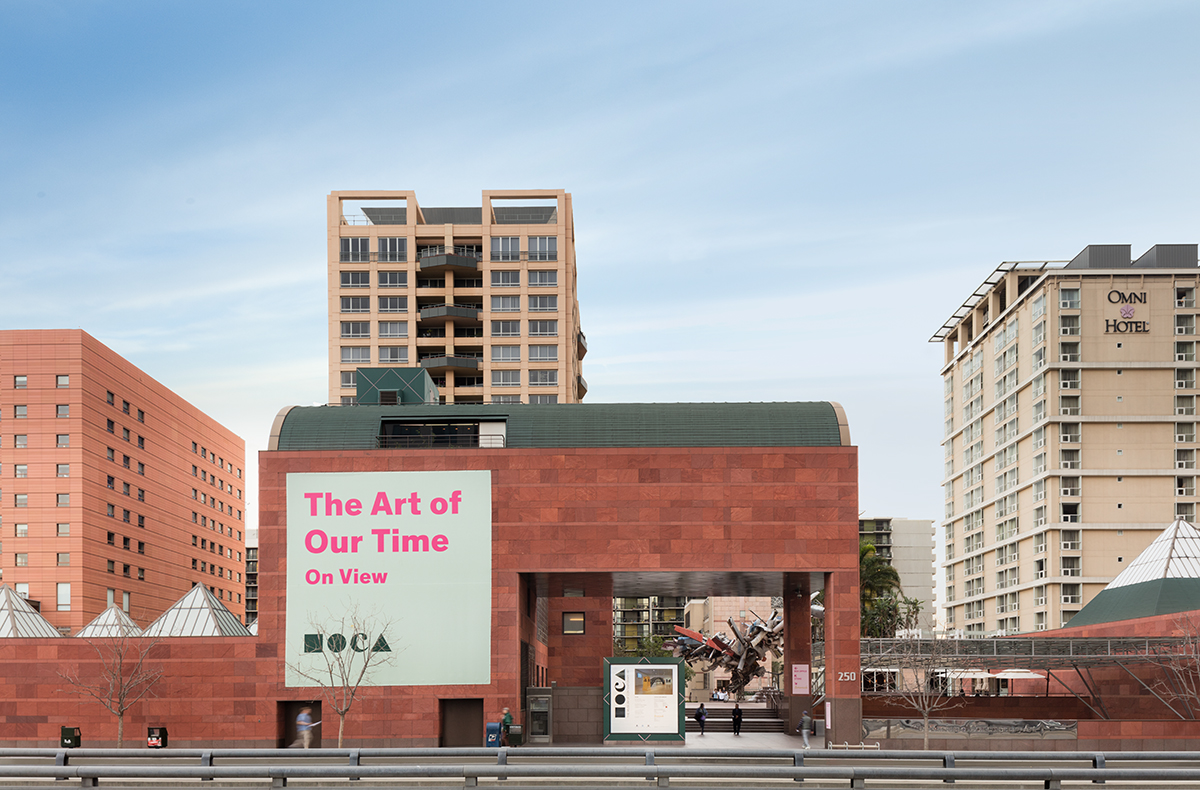
Museum of Contemporary Art, Los Angeles
34.0533° N · 118.2504° W · Museum
Photo: Grandave-1986 · CC BY-SA 4.0 · Wikimedia Commons
Museum of Contemporary Art, Los Angeles is an art museum in Los Angeles, California. MOCA was founded in 1979 by artists and collectors. The free Lokali audio guide runs 7 minutes.
✓ Published October 2026 · how we write these guides
Visitor facts
| Lokali audio guide | 7 min · free |
|---|---|
| Type | Museum |
| Location | Los Angeles, United States |
| Coordinates | 34.0533, -118.2504 |
| Official website | moca.org |
| Languages | 50+, in the Lokali app |
The story
Start with the stone. Put your hand on the wall if you can reach it. It is red sandstone, warm in the afternoon sun, rough under the fingertips. Behind you, traffic moves along Grand Avenue and office towers rise on every side. But in front of you, a set of steps leads down, away from the street noise, into a quieter courtyard. This is the Museum of Contemporary Art, Los Angeles, which locals simply call MOCA.
The museum was founded in 1979. At that time, Los Angeles was already a city full of working artists, yet it had no museum devoted only to the art of its own time. A group of artists, collectors and civic leaders decided to change that. They wanted a place for new work that was still being argued about. The result was the first museum in the city dedicated entirely to contemporary art.
The building you are looking at opened in 1986. Its architect was Arata Isozaki, a Japanese designer who would later receive the Pritzker Prize, often described as the highest honour in architecture. This was one of his first major buildings in the United States. Isozaki did not try to compete with the glass towers around him. Instead, he made something low, solid and almost quiet, a building that seems to sit close to the ground.
Look at the shapes. There are pyramids, a cube and a long half-cylinder, like a barrel cut in two along its length. Isozaki built the museum from simple geometric forms, the kind a child might stack with wooden blocks. The pyramids are skylights. They bring daylight down into the galleries below. The effect from outside is modest, even playful. The scale is human. You can take in the whole front of the building without tilting your head back.
Here is a detail many visitors miss. Much of the gallery space lies below street level. From Grand Avenue, the museum looks small. Once you go down the steps and through the courtyard, it opens up into a series of rooms with high ceilings. The museum was built as part of a larger redevelopment plan for this hilltop. Keeping the building low left space and light around it, and it made the entrance feel like a descent into a separate world.
Now for a surprise in the museum's own story. While this building was still under construction, MOCA needed somewhere to show art. So in 1983 it opened a temporary space in an old warehouse in Little Tokyo, a short distance east of here. Frank Gehry, the Los Angeles architect, adapted the warehouse with a light touch. It was called the Temporary Contemporary. People loved it so much that it never closed. Today it is known as the Geffen Contemporary, and it is still part of the museum.
A young museum needs a collection, and MOCA found one quickly. In 1984 it acquired a large group of works from the Italian collector Giuseppe Panza. The group included paintings by Mark Rothko, Franz Kline and Robert Rauschenberg, artists who shaped American art after the Second World War. Almost overnight, a museum only a few years old held work that older institutions would envy. That purchase gave MOCA real weight from the start.
The collection focuses on art made from the 1940s onward. Today it holds several thousand works, including painting, sculpture, photography, film and large installations. Artists from Los Angeles have a strong place in it. That matters here. For decades, critics on the East Coast and in Europe often treated this city as a place of movies, not serious art. MOCA helped show that a strong art scene had been growing in these streets and studios for a long time.
The museum has also built a reputation for ambitious exhibitions. One well-known example came in 1992, with a large show about Los Angeles art of that moment, called Helter Skelter. It was loud, raw and divisive, and it is still discussed today. What you see on your own visit will depend on the season. Galleries rotate, and works from the collection come in and out of view. Every visit can be a little different.
Step back out to Grand Avenue and look across the street. That white, honeycomb-like building is The Broad, another contemporary art museum, which opened in 2015. It was founded by Eli Broad, a businessman who was also the founding chairman of MOCA. In other words, one of the people who helped create this museum later built his own, directly opposite. A short walk down the avenue, the curved steel of Gehry's Walt Disney Concert Hall rises above the sidewalk.
This hilltop is called Bunker Hill, and it has changed many times. In the late nineteenth century, it held large Victorian houses with views over the young city. In the mid twentieth century, much of the old neighbourhood was cleared, and towers and plazas took its place. Nearby, a small funicular railway called Angels Flight still carries passengers up and down the slope. It is a reminder that this hill was once a neighbourhood people climbed home to.
Inside, pay attention to the light. Under the pyramid skylights, daylight falls softly onto the walls. It changes as clouds pass and as the afternoon moves on. The rooms are calm, and the sound of the city fades away almost completely. Many visitors are surprised by how peaceful it feels, only a few metres below one of the busiest streets downtown. Take your time. Some works ask for a quick look. Others reward a long pause.
Before you leave, stand in the sunken courtyard for a moment. Look up at the edge where the red stone meets the sky, and at the towers beyond it. Isozaki made a small building in a city of giants, and he chose to go down instead of up. As you climb back to street level, notice the noise of Grand Avenue return, step by step... and the quiet you are leaving behind.
Key facts
What to look for
Practical tips
Common questions
Is there a free audio guide to Museum of Contemporary Art, Los Angeles?
Yes — the Lokali app narrates Museum of Contemporary Art, Los Angeles free of charge in 50+ languages. The guide runs about 7 minutes, covers the history, what to look for on site and practical tips, and works offline once downloaded.
Where is Museum of Contemporary Art, Los Angeles?
Museum of Contemporary Art, Los Angeles is in Los Angeles, United States, at 34.0533, -118.2504. Tap the map link on this page for directions from where you are.
What is Museum of Contemporary Art, Los Angeles known for?
MOCA was founded in 1979 by artists and collectors. Japanese architect Arata Isozaki designed the Grand Avenue building.
What should you look for at Museum of Contemporary Art, Los Angeles?
Rough red sandstone cladding on the museum's outer walls. Pyramid-shaped skylights rising above the low roofline. The long half-cylinder vault over the entrance wing.
What should you know before visiting Museum of Contemporary Art, Los Angeles?
Pair your visit with The Broad directly across Grand Avenue. Ride Angels Flight funicular to reach Bunker Hill from Hill Street.
On the map
Opens directions to Museum of Contemporary Art, Los Angeles from your location.
More to see in Los Angeles


Hear Museum of Contemporary Art, Los Angeles in your language
The full story, narrated, in 50+ languages. Download it before you go and it plays offline, at your own pace, with no ticket and no tour group.