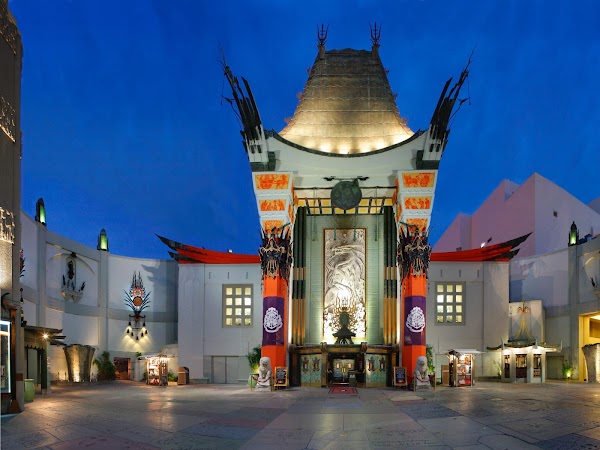
TCL Chinese Theatre
34.1023° N · 118.3413° W · Theatre
TCL Chinese Theatre is a theatre in Los Angeles, United States. Historic movie palace built in 1927 with ornate Chinese-inspired architecture. Most visitors spend 30–60 min here. The free Lokali audio guide runs 5 minutes.
✓ Verified August 2026 · how we write these guides
Visitor facts
| Time needed | 30–60 min |
|---|---|
| Lokali audio guide | 5 min · free |
| Type | Theatre |
| Best for | History |
| Location | Los Angeles, United States |
| Coordinates | 34.1023, -118.3413 |
| Languages | 45, in the Lokali app |
The story
Look down. Pressed into the concrete beneath your feet are the handprints and footprints of a full century of movie stars. Marilyn Monroe. John Wayne. Meryl Streep. This forecourt belongs to the TCL Chinese Theatre, the most celebrated movie palace in Hollywood, and one of the most photographed buildings in America. Around you, tourists kneel and press their palms into the prints, laughing at the fit.
The showman Sid Grauman opened this theatre in 1927. Grauman understood spectacle better than anyone in the young film industry. He had already built the Egyptian Theatre a few blocks away in 1922. For his next project he wanted something bolder. He chose the form of a grand Chinese pavilion, exotic and theatrical, designed to make every visit feel like an event. Skilled artisans spent months on the carvings and painted details.
The building rises like a great red and jade pagoda. Its bronze roof climbs about ninety feet above the forecourt. A carved stone dragon stretches between two coral columns on the facade. At the entrance stand two guardian lion statues brought from China, often called Heaven Dogs. Small details reward a slow look, from temple bells to delicate masks worked into the stone.
The theatre opened in May 1927 with the premiere of Cecil B. DeMille's silent epic, The King of Kings. Thousands of fans filled Hollywood Boulevard to watch the stars arrive. Premiere nights here became a Hollywood ritual. Searchlights swept the sky. Limousines rolled up to the curb. Crowds pressed forward for a glimpse of Charlie Chaplin or Greta Garbo.
The famous forecourt began, according to legend, with a misstep. The story says actress Norma Talmadge accidentally walked into wet cement during construction. Grauman saw an opportunity at once. Whether the tale is true or simply good publicity, he soon invited stars to leave their prints on purpose. A ritual was born, and it continues to this day.
About two hundred concrete blocks now fill the forecourt. Each one records a small ceremony. A star kneels in fresh cement, presses both palms flat, and signs with a stick. Some left more personal marks. Groucho Marx pressed his cigar into the cement. Jimmy Durante added the outline of his nose. Betty Grable left the shape of her leg. In 1977 the droid R2-D2 rolled its wheels through, beside the boot prints of Darth Vader.
The theatre has hosted history as well as premieres. The Academy Awards ceremony took place here three times, in 1944, 1945, and 1946. Star Wars opened here in 1977, and fans camped on the sidewalk for days. Decades later, people still line up for opening nights, wearing costumes and carrying signs, keeping an old tradition alive.
For most of its life this was Grauman's Chinese Theatre. In 2013 a Chinese electronics company, TCL, bought the naming rights. That same year the main auditorium was rebuilt as one of the largest IMAX theatres in the world, with more than nine hundred seats and a screen several stories tall. Old showmanship met new technology, and both survived.
If you buy a ticket or join a guided tour, the interior rewards you. The lobby and auditorium keep their 1927 character, with Chinese-inspired murals, silk-red walls, and a huge ornamental medallion overhead. Sit for a moment and imagine the room in the silent era, when a live orchestra played beneath the screen. The theatre still runs films daily, so you can watch a movie where premieres have played for a century.
The forecourt itself is free and always busy. Visitors crouch over the slabs, comparing their hands to the prints of their favorite stars. The prints are smaller than most people expect. Fame, it turns out, comes in ordinary sizes. Costumed characters work the sidewalk outside, and street performers add their own noise to the scene. Come early in the morning if you want quiet photographs of the forecourt.
The theatre anchors one of the densest stretches of movie history anywhere. The Hollywood Walk of Fame runs along the sidewalk out front. The Dolby Theatre, home of today's Academy Awards, stands next door. The Egyptian Theatre, Grauman's earlier creation, is a short walk east. One block holds a century of cinema.
Cement is a humble material. Yet here it does what film does. It holds a moment still. Kneel down, place your hand over a print, and feel how close the past can be. The stars were people. They knelt where you are kneeling now. For a moment, the distance between the audience and the screen almost disappears.
Key facts
What to look for
Practical tips
Common questions
How long do you need at TCL Chinese Theatre?
Plan 30–60 min. That is the time most visitors spend at TCL Chinese Theatre. The free Lokali audio guide adds about 5 minutes of narration you can listen to as you walk, so it fits inside your visit rather than adding to it.
Is there a free audio guide to TCL Chinese Theatre?
Yes — the Lokali app narrates TCL Chinese Theatre free of charge in 50+ languages. It covers the history, what to look for on site and practical tips, and it works offline once downloaded.
Where is TCL Chinese Theatre?
TCL Chinese Theatre is in Los Angeles, United States, at 34.1023, -118.3413. Tap the map link on this page for directions from where you are.
What should you know before visiting TCL Chinese Theatre?
Visit the forecourt early morning to avoid the biggest crowds.
What is TCL Chinese Theatre known for?
Opened in 1927 by showman Sid Grauman.
What is the best time to visit TCL Chinese Theatre?
Step into the lobby to see the original red-lacquered interior and ornamental details.
On the map
Opens directions to TCL Chinese Theatre from your location.
More to see in Los Angeles





Hear TCL Chinese Theatre in your language
The full story, narrated, in 50+ languages. Download it before you go and it plays offline, at your own pace, with no ticket and no tour group.