
Photo: R Prazeres · CC BY-SA 4.0 · Wikimedia Commons
KV11 is a tomb of Ramesses III. Tomb was first begun for Setnakhte, Ramesses the Third's father. The free Lokali audio guide runs 7 minutes.
✓ Published October 2026 · how we write these guides
Visitor facts
| Lokali audio guide | 7 min · free |
|---|---|
| Type | Memorial |
| Location | Luxor, Egypt |
| Coordinates | 25.7500, 32.6143 |
| Languages | 50+, in the Lokali app |
The story
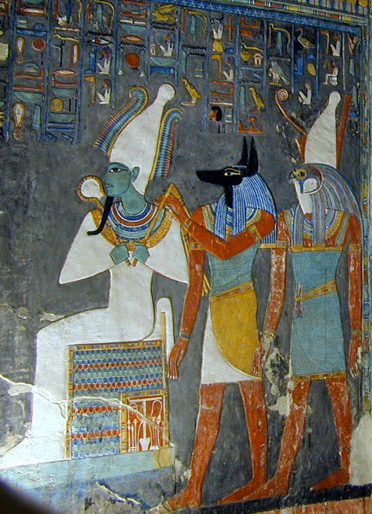
Step out of the sunlight and the air changes. The heat stays at your back, and the passage ahead is cooler, dimmer, and smells faintly of dust and old stone. Underfoot, the floor slopes gently downward. Around you, the walls carry colour: deep reds, ochre yellows, and a blue that has survived more than three thousand years in the dark. This is KV11, cut into the limestone of the Valley of the Kings for one of Egypt's last great pharaohs, Ramesses the Third.
The tomb did not begin as his. It was started for his father, Setnakhte, the founder of the Twentieth Dynasty. Setnakhte's workers cut steadily into the hillside. Then they made a mistake. Their tunnel broke through into an older tomb next door, the one we now call KV10, made for a king named Amenmesse. You cannot easily dig through someone else's eternity. The work stopped, and Setnakhte was buried elsewhere.
When Ramesses the Third came to the throne, he took over the abandoned project. His builders solved the problem with a simple idea — they shifted the axis of the tomb sideways, away from the collision, and kept digging. As you walk deeper, watch for this. The corridor does not run in one perfectly straight line. There is a jog in the plan, a quiet record of an ancient accident and the practical way stonecutters worked around it.
Who was the man buried here? Ramesses the Third ruled in the twelfth century before Christ, at a time when the eastern Mediterranean world was falling into crisis. Old kingdoms collapsed. Groups that Egyptian texts call the Sea Peoples moved across the region. Ramesses fought them, and he recorded his victories on the walls of his great memorial temple at Medinet Habu, across the fields from this valley. In many ways, he was the last pharaoh of the New Kingdom to rule with real strength.
Now look at the small side chambers that open off the first corridors. This is what makes KV11 different from most royal tombs. Royal tombs usually show gods, spells, and the journey of the sun through the night. These little rooms show daily life as well. There are scenes of a royal kitchen, with workers preparing food. There are boats on the river. There are weapons and armour, and treasures stored for the king's use in the afterlife.
One of these chambers gave the tomb its nickname — the Tomb of the Harpers. On its walls, two blind musicians play large harps before the gods. It is a gentle image in a place built for death. In 1768, the Scottish traveller James Bruce came here and copied the harpers. His drawings helped introduce the scene to European readers, and for a long time people also called this place Bruce's Tomb. Take a moment with the harpers. They are easy to walk past.
Beyond the side chambers, the tomb returns to more familiar royal themes. The walls show the king standing before gods, making offerings, and being welcomed into the next world. There are passages from the great funerary books — long religious texts that describe the twelve hours of night. In them, the sun god sails through the underworld, faces dangers, and is reborn each morning. The dead king hoped to share that journey and rise with the sun.
Here is something most visitors never think about. The men who carved and painted this tomb lived in a village just over the hill, now called Deir el-Medina. During the reign of Ramesses the Third, their rations of grain arrived late. The workers stopped work and protested. A papyrus now in Turin records what happened. It is often described as the first documented labour strike in history — and it happened to the people building tombs like this one.
The king's later years were troubled in other ways too. Surviving court records describe a plot inside the royal household, a conspiracy aimed at the king himself. Scholars still debate the details. What we know is that the conspirators were put on trial. Modern scientific study of the king's mummy has added to the discussion, and some researchers believe the plot reached him. It is a dark story, and it sits behind the bright colours on these walls.
The king's body did not stay here. In ancient times, the Valley of the Kings was robbed again and again. Priests eventually gathered many royal mummies and hid them together for safety. The mummy of Ramesses the Third was found in one of these hidden groups, at Deir el-Bahari, in 1881. Today it is held in Egyptian museum care, far from the tomb that was cut for it.
His great stone sarcophagus travelled even further. In the early nineteenth century, it was removed from the burial chamber. Today the box of the sarcophagus is in the Louvre in Paris. Its lid is in the Fitzwilliam Museum in Cambridge, in England. So one coffin is split across two countries. Standing here, you are in the place it was made to protect, but the stone itself is gone.
As you move toward the deeper parts of the tomb, pay attention to the surface of the walls. In some places the plaster is smooth and the paint is crisp. In others, the colour is faded, the stone is cracked, or the decoration has flaked away. Water, time, and centuries of visitors have all left marks. Low light protects the paint, so your eyes need a moment to adjust. Give them that moment, and more detail appears.
The design of the tomb also tells a story. Long, sloping corridors lead from the bright entrance toward the burial chamber, deep inside the hill. The Egyptians saw this path as a journey from the world of the living into the hidden realm of the gods. Every step you take downward follows the route the king's coffin once took, carried by priests and workers in a slow procession, by lamplight.
When you climb back toward the entrance, notice how the light grows stronger. The colours fade into shadow behind you, and the warm air of the valley returns. Outside, the pale cliffs rise on every side, quiet and almost bare. It is hard to believe how much colour is hidden inside them. Before you walk on, look back at the dark doorway once more — and remember the harpers, still playing in the dark.
Key facts
What to look for
Practical tips
Common questions
Is there a free audio guide to KV11?
Yes — the Lokali app narrates KV11 free of charge in 50+ languages. The guide runs about 7 minutes, covers the history, what to look for on site and practical tips, and works offline once downloaded.
Where is KV11?
KV11 is near Luxor, Egypt, at 25.7500, 32.6143. Tap the map link on this page for directions from where you are.
What is KV11 known for?
Tomb was first begun for Setnakhte, Ramesses the Third's father. Workers accidentally broke into the neighbouring tomb, KV10.
What should you look for at KV11?
The two blind harpers playing before the gods. Kitchen and food preparation scenes in a side chamber. The sideways shift in the corridor's line.
What should you know before visiting KV11?
Pause inside to let your eyes adjust to the low light. Check whether photography needs a separate permit before entering.
When is the best time to visit KV11?
Visit early to avoid the midday heat and tour crowds.
On the map
Opens directions to KV11 from your location.
More to see in Luxor


Hear KV11 in your language
The full story, narrated, in 50+ languages. Download it before you go and it plays offline, at your own pace, with no ticket and no tour group.