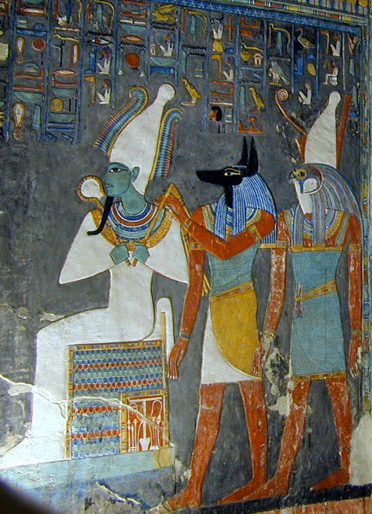
Photo: derivative work: A. Parrot (talk) La_tombe_de_Horemheb_(KV.57)_(Vallée_des_Rois_Thèbes_oue · CC BY 2.0 · Wikimedia Commons
KV57 is an ancient Egyptian tomb. It is near Luxor, Egypt. Tomb of Horemheb, last king of the Eighteenth Dynasty. The free Lokali audio guide runs 7 minutes.
✓ Published October 2026 · how we write these guides
Visitor facts
| Lokali audio guide | 7 min · free |
|---|---|
| Type | Memorial |
| Location | Luxor, Egypt |
| Coordinates | 25.7500, 32.6143 |
| Languages | 50+, in the Lokali app |
The story
The air changes as you go down. Outside, the Valley of the Kings is white limestone and hard sunlight, and every step makes a dry crunch. Inside KV57, the heat thickens and the light turns soft and yellow. The corridor slopes steeply into the hillside, and the walls close in around you. Somewhere ahead, under electric lamps, colour begins to appear — deep blue-grey, warm ochre, clean black lines. This is the tomb of Horemheb, and it holds one of the clearest lessons in Egyptian art you will find anywhere.
First, the man. Horemheb was not born a king. He rose as a soldier and an administrator, serving at court during the reign of the young Tutankhamun. After Tutankhamun died, the elderly official Ay held the throne for a short time. Then Horemheb took the crown himself. He became the last pharaoh of the Eighteenth Dynasty — the royal line that had produced Hatshepsut, Thutmose the Third, and Akhenaten. His reign closed a long and turbulent chapter.
That turbulence matters here. Akhenaten, a few decades earlier, had broken with tradition. He promoted a single sun god, the Aten, and moved the capital away from Thebes, the ancient name for this area. After his death, his experiment was undone. Horemheb is often seen as the king who finished that undoing. He presented himself as a restorer of order and of the old gods. Later kings even counted his reign as following directly after the earlier traditional rulers, as if the Amarna years had not happened.
Here is something many visitors do not realise. Horemheb already had a grand tomb before he became king. As a general, he built one in the north, at Saqqara, near the old capital of Memphis. When he took the throne, a private tomb was no longer enough. A king needed a royal tomb here, in the valley, among his predecessors. So this is the second resting place he prepared — and the Saqqara tomb was left behind, though it remained a place of honour.
Notice the shape of the tomb as you walk. Earlier royal tombs in this valley often turned a sharp corner partway down. KV57 runs much straighter, in a long descending line. This change marks a shift in design that later tombs continued. You pass through corridors and down stairways, cross a deep shaft, and move through chambers with pillars. The plan feels deliberate and clean. It is the work of a planned project, not of improvisation.
That deep shaft, often called the well, had more than one purpose. It may have helped protect the inner rooms from flash floods, which sometimes pour through the valley after rare storms. It may also have been meant to slow down robbers. Many scholars also see a religious meaning in it, linked to the underworld. Whatever its main purpose, it did not stop thieves. When the tomb was entered in modern times, it had already been robbed in antiquity.
The modern discovery came in 1908. The work was led by the archaeologist Edward Ayrton, and funded by the American lawyer Theodore Davis, who sponsored many excavations in this valley. They found the tomb disturbed and its treasures gone. Broken objects lay scattered through the chambers. Human remains of several individuals were also found, and their identity is still discussed. The body of Horemheb himself has never been securely identified. The king's mummy remains one of the valley's open questions.
Now look closely at the walls. The decoration here is not painted on a flat surface. Much of it is raised relief — the figures stand slightly proud of the background, carved and then painted. The colours sit on a blue-grey ground that makes the gods and the king almost glow. You will see Horemheb standing before deities, offering to them and being received by them. The figures are tall, calm, and finely drawn, with long, elegant proportions.
This tomb also carries an important first. It is the earliest royal tomb known to use the Book of Gates. This is a funerary text about the night journey of the sun god through the underworld. The underworld is divided into twelve hours of the night, and each hour is guarded by a gate. The sun's boat must pass every gate to rise again at dawn. The dead king hoped to travel with it, and to be reborn each morning.
And here is the real treasure of KV57. The decoration was never finished. In several places you can see every stage of the work, side by side. There are grid lines that helped artists keep proportions. There are first sketches in red paint. There are corrections in black, where a master adjusted the line. Some areas are partly carved, and others are fully carved and painted. It is like looking at a workshop frozen in the middle of a working day.
Why did the work stop? The simplest explanation is time. A royal tomb was usually started early in a reign and continued until the king died. When he died, the work ended, and the burial went ahead with whatever was complete. The exact length of Horemheb's reign is still debated by historians. But the unfinished walls tell us clearly that the artists did not reach the end of their plan.
At the bottom lies the burial chamber, and in it stands the stone sarcophagus. It is carved from red granite, a hard stone brought from the far south of Egypt. At its corners, protective goddesses spread their winged arms around the box, as if to hold the king safely inside. The lid and the body of the sarcophagus show how much effort went into this one object. Imagine moving that weight down the long corridor you just walked.
Before you climb back up, pause for a moment. Look again at a red sketch line beside a finished figure. One hand drew the first idea, and another hand began to carve it. Then the work simply stopped. As you walk back toward the daylight, the colours fade behind you and the heat of the valley returns. Notice the pale cliffs and the open sky. The workers who cut this tomb climbed these same paths, with their own tools, toward their own unfinished day.
Key facts
What to look for
Practical tips
Common questions
Is there a free audio guide to KV57?
Yes — the Lokali app narrates KV57 free of charge in 50+ languages. The guide runs about 7 minutes, covers the history, what to look for on site and practical tips, and works offline once downloaded.
Where is KV57?
KV57 is near Luxor, Egypt, at 25.7500, 32.6143. Tap the map link on this page for directions from where you are.
What is KV57 known for?
Tomb of Horemheb, last king of the Eighteenth Dynasty. Discovered in 1908 by archaeologist Edward Ayrton.
What should you look for at KV57?
Red preliminary sketches beside fully carved painted figures. Black correction lines drawn over earlier red outlines. Faint grid lines artists used to keep proportions.
What should you know before visiting KV57?
Check at the entrance which tombs are open today. KV57 often requires a separate ticket from the main entry.
On the map
Opens directions to KV57 from your location.
More to see in Luxor


Hear KV57 in your language
The full story, narrated, in 50+ languages. Download it before you go and it plays offline, at your own pace, with no ticket and no tour group.