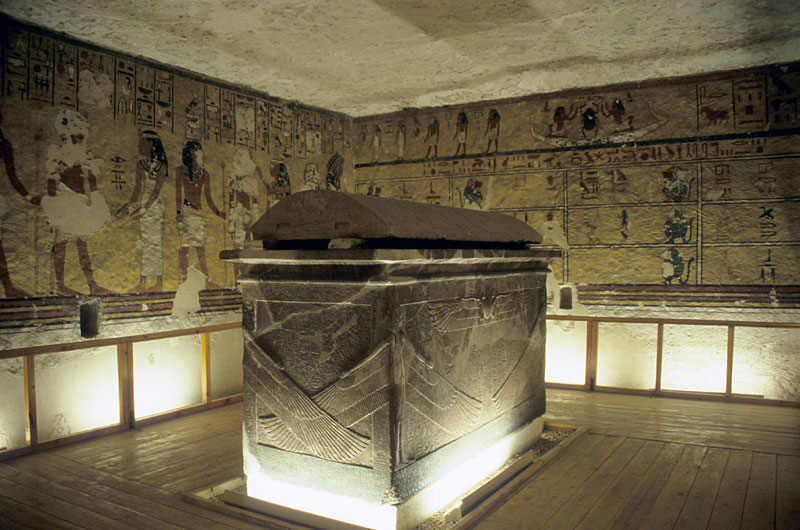
Tomb of Ay (WV23), West Valley of the Kings
25.7500° N · 32.6143° E · Monument
Photo: Roland Unger · CC BY-SA 3.0 · Wikimedia Commons
Tomb of Ay (WV23), West Valley of the Kings is an ancient Egyptian tomb. It is near Luxor, Egypt. WV23 belongs to Ay, Eighteenth Dynasty pharaoh. The free Lokali audio guide runs 7 minutes.
✓ Published October 2026 · how we write these guides
Visitor facts
| Lokali audio guide | 7 min · free |
|---|---|
| Type | Monument |
| Location | Luxor, Egypt |
| Coordinates | 25.7500, 32.6143 |
| Languages | 50+, in the Lokali app |
The story
Listen for a moment. In this side valley the noise of the tour buses fades quickly. What remains is the crunch of limestone grit under your shoes and the dry tick of stones cooling in the shade. The cliffs here are pale gold and cracked into deep folds. Very little grows. This is the West Valley, a quieter branch of the Valley of the Kings, and the doorway in front of you leads to the tomb of a pharaoh named Ay.
Most visitors to Luxor never come this far. The main valley, with its famous tombs and long queues, lies over the ridge to the east. This western branch winds deeper into the Theban hills, and only a few royal tombs were ever cut here. Archaeologists label each tomb with a code. WV means West Valley, and twenty-three is the number this tomb received in the modern list. So WV23 is simply its catalogue name — a quiet label for a complicated king.
Ay ruled Egypt in the Eighteenth Dynasty, in the late fourteenth century before Christ. He was not born a king. He spent most of his career as a courtier and official, close to the royal family through one of the most unsettled periods in Egyptian history. He served under Akhenaten, the pharaoh who turned Egypt's religion toward a single sun disc, the Aten. Later he served the young king Tutankhamun. When Tutankhamun died without an heir, the elderly Ay took the throne himself.
Here is a detail many visitors miss. Before he was king, Ay had already prepared a tomb for himself — far to the north, at Akhenaten's capital, Amarna. That earlier tomb carries one of the longest surviving versions of the Great Hymn to the Aten, a poem in praise of the sun. But Ay never used it. When he became pharaoh, he needed a royal tomb in the royal hills of Thebes. And so he came here.
Some Egyptologists believe this tomb was first started for someone else — possibly for Tutankhamun himself. The idea is that the young king died suddenly, before a grand royal tomb was ready. He was then buried in a smaller tomb in the main valley, and Ay took over this larger project. It is an attractive theory, but it is still debated. What we can say is that the tomb is unfinished in places, and its plan feels hurried.
As you walk in, notice the rhythm of the passage. A sloping corridor cuts down into the rock, then stairs, then more corridor. The walls near the entrance are mostly plain, smoothed but never painted. Royal tombs usually carried long religious texts from top to bottom. Here, much of that work was never done. The decoration is concentrated in the burial chamber at the end, as if the workmen ran out of time.
In the burial chamber, look for the most unusual scene in the tomb. The king stands in a papyrus boat in the marshes, hunting birds with a throwing stick and spearing fish. Scenes like this were common in the tombs of nobles. In the tomb of a pharaoh, they are very rare. Perhaps it reflects Ay's long life as a high official. He carried the tastes of a nobleman with him onto the throne.
Now look along another wall for a row of baboons, sitting in neat squares. There are twelve of them. They come from a religious book about the sun's journey through the night, and the baboons greet the sun at the first hour of darkness. These animals gave this whole area its local Arabic name — Wadi el-Qurud, the Valley of the Monkeys. So when guides here speak of the monkey valley, they mean this painting.
Next, look closely at the faces and the royal names. Many of them are gone. The king's image has been hacked away, and the oval frames that held his name, called cartouches, have been chiselled out. This damage was done in ancient times, not by modern thieves. Many scholars connect it to Horemheb, the general who ruled after Ay. Erasing a name was a way to remove a person from memory — and in Egyptian belief, to threaten his life after death.
In the centre of the chamber stands the sarcophagus, a large stone box carved from red granite. It was found broken into pieces. In modern times it was reassembled, and it now sits again in the chamber where it was meant to be. At each corner, carved goddesses spread their wings around the coffin, as if to hold it safe. Ay's mummy has never been identified. Whatever happened to his body, it was not left here for us.
The tomb was first recorded by Europeans in 1816, when the Italian explorer Giovanni Battista Belzoni came up this valley. Belzoni was a former strongman and showman who became one of the early excavators in Egypt. His methods were rough by modern standards. Later teams returned with more care. In the twentieth century, archaeologists cleared the tomb more fully and studied what remained of its debris.
It is worth thinking about what this place meant to Ay. He saw the old gods set aside under Akhenaten, then brought back under Tutankhamun. He outlived kings he served. He reached the throne late in life and ruled only a few years. And his successor tried to erase him. This tomb is his last statement — part royal, part private, part unfinished — cut into a quiet valley away from the others.
When you step back outside, let your eyes adjust to the glare. Look up at the cliff above the doorway, where the rock has split into layers. Turn slowly and look down the valley the way you came. The path curves out of sight between the hills. Three thousand years ago, a funeral procession walked this same route, carrying an old king to his rest. Today there is mostly silence, the heat, and the sound of your own steps on the stones.
Key facts
What to look for
Practical tips
Common questions
Is there a free audio guide to Tomb of Ay (WV23), West Valley of the Kings?
Yes — the Lokali app narrates Tomb of Ay (WV23), West Valley of the Kings free of charge in 50+ languages. The guide runs about 7 minutes, covers the history, what to look for on site and practical tips, and works offline once downloaded.
Where is Tomb of Ay (WV23), West Valley of the Kings?
Tomb of Ay (WV23), West Valley of the Kings is near Luxor, Egypt, at 25.7500, 32.6143. Tap the map link on this page for directions from where you are.
What is Tomb of Ay (WV23), West Valley of the Kings known for?
WV23 belongs to Ay, Eighteenth Dynasty pharaoh. Ay succeeded Tutankhamun in the late fourteenth century.
What should you look for at Tomb of Ay (WV23), West Valley of the Kings?
Twelve seated baboons painted in neat squares. The king hunting birds from a papyrus boat. Chiselled-out cartouches where Ay's name once stood.
What should you know before visiting Tomb of Ay (WV23), West Valley of the Kings?
Check whether WV23 needs a separate ticket. Arrange transport, since the West Valley is remote.
When is the best time to visit Tomb of Ay (WV23), West Valley of the Kings?
Come early for a quieter, cooler visit.
On the map
Opens directions to Tomb of Ay (WV23), West Valley of the Kings from your location.
More to see in Luxor


Hear Tomb of Ay (WV23), West Valley of the Kings in your language
The full story, narrated, in 50+ languages. Download it before you go and it plays offline, at your own pace, with no ticket and no tour group.